
Let me save you a quarter of your marketing year.
If your plan for this quarter includes “rank for best hotels in [your city],” close the tab, cancel the freelancer, and read this instead. That page is a losing hand for a single independent property, and I want to show you exactly why the math is against you, then hand you the play that actually works: building the one local guide your city does not have yet.
This is not a motivational reframe. It is a different bet with a different, better payout.
Why “best hotels in [city]” is a rigged table
Type “best hotels in Savannah” or “best hotels in Asheville” into Google right now. Count the results before you see a single actual hotel website. You will get Booking.com, Expedia, Hotels.com, TripAdvisor, a couple of newspaper or magazine listicles, maybe a Reddit thread, and a map pack. The organic real estate is owned by aggregators and publishers with domain authority in the 80s and 90s and content teams that update those pages weekly.
You are one hotel with one domain. You are not going to out-authority Expedia on a query that is, definitionally, a comparison of many hotels. And here is the part people miss: even if you somehow ranked, you would be ranking your own property on a “which of these is best” query, which reads as exactly what it is. Nobody trusts a hotel that declares itself the best hotel in town. The format fights you.
There is a deeper structural problem. These OTAs do not just win the branded listicle terms. They have built entire destination-content engines to intercept travelers upstream, which I broke down in detail in the mega-guide on OTA destination landers that rank. They are not competing with you on “best hotels.” They are competing with you on everything a traveler thinks about before they get to “best hotels,” and then charging you 15 to 25 percent commission to hand your own guest back to you. If you have not run the numbers on what that costs, the book-direct math is worth twenty minutes of your life.
So the listicle term is expensive to chase, nearly impossible to win, and low-trust even if you do. That is three strikes. Let us go find a better pitch.
The searcher you actually want is not asking “best hotels”
Think about the real journey. Almost nobody wakes up and types “best hotels in [city]” as their first and last research query. They ask a cascade of specific, anxious, practical questions:
- Which neighborhood should I stay in for a first visit?
- Is it walkable, or do I need a car?
- How do I get from the airport without renting?
- What is actually close to the convention center or the wedding venue?
- Is [neighborhood] safe to walk at night?
- What is the best month to come, and what will I pay?
- Where do locals eat that is not a tourist trap?
Every one of those is a query. Every one of those is a prompt someone is typing into ChatGPT or Gemini right now. And every one of those is a question a good hotel is genuinely, natively qualified to answer, because you live there and your front desk answers these exact questions forty times a week.
That is the whole strategic pivot. Stop trying to win the argument about which hotel is best. Start owning the questions people ask before they even get to that argument. Be the map, not the destination on someone else’s map.
The listicle answers “which hotel?” A local guide answers “how do I do this trip?” You are a suspicious author of the first and the single most credible author of the second. Write the one you are qualified to write.
Download this study as a one-page PDF
What “definitive” actually means (and why thin content fails)
Let me be blunt about a trap, because this is where most hotel “content strategies” quietly die. The answer is not to publish forty 400-word blog posts titled “Top 5 Things To Do Near Our Hotel.” That is listicle thinking wearing a guide costume. It is thin, it is generic, it is interchangeable with every other hotel blog on the same CMS template, and it earns nothing.
Definitive means you build the single best resource that exists on the internet for planning a stay in your specific area. Not the best hotel-owned resource. The best resource, period, better than the visitor bureau’s, better than the magazine’s, because you go deeper on the stuff those sources are too broad to cover.
Definitive has four ingredients:
-
Specificity that only a local has. Not “the historic district is charming.” Instead: “The historic district is roughly a fifteen-minute flat walk end to end, cobblestones on Jones Street will wreck a roller suitcase, and the free downtown shuttle loops every twenty minutes until 9pm.” That paragraph cannot be generated by someone who has never stood there. That is your moat.
-
Honest tradeoffs. The credibility unlock is telling people what is not right for them. “If you want nightlife, do not stay in [quiet neighborhood], stay in [other neighborhood]. We are twelve minutes away and it is genuinely quieter here, which is the point for some guests and a dealbreaker for others.” Honesty is a ranking signal to humans and, increasingly, the tone that AI models reward when they synthesize answers.
-
Logistics, not vibes. Transit times, parking realities, what is walkable, seasonal pricing, which months are humid, when the festival clogs everything. Logistics are searchable, citable, and almost nobody publishes them well.
-
Structure a machine can read. Clear headings phrased as the actual questions, short answerable paragraphs, tables for comparisons, an FAQ. This is what makes a page quotable by an AI assistant. If you want the deeper version of why this matters, I wrote about whether your hotel is invisible to ChatGPT, and it is the same muscle.
The build: a hub of guides your city does not have yet
Here is the practical architecture. You are building a small cluster, a hub with spokes, not a single hero page.
The hub: your neighborhood guide. One authoritative page: “Where to Stay in [City]: An Honest Neighborhood Guide.” It compares the real neighborhoods, who each one suits, what each costs, what each is like at night. Yes, your hotel sits in one of them, and you say so plainly and once. The page is not a sales pitch. It is the resource you wish existed when you were a traveler. This page earns links because other people want to reference an honest neighborhood breakdown, and it earns AI citations because it directly answers “which neighborhood in [city] should I stay in.”
The spokes: the logistics guides. Each is a full answer to one anxious question:
- Getting from [airport] to [city] without a rental car
- Is [city] walkable? A block-by-block reality check
- The best time to visit [city] (and when to avoid it)
- [City] for families with young kids, no car required
- Where locals actually eat in [neighborhood]
Notice these are the questions your front desk answers all day. You already own the raw material. You are just writing it down once, properly, instead of repeating it on the phone.
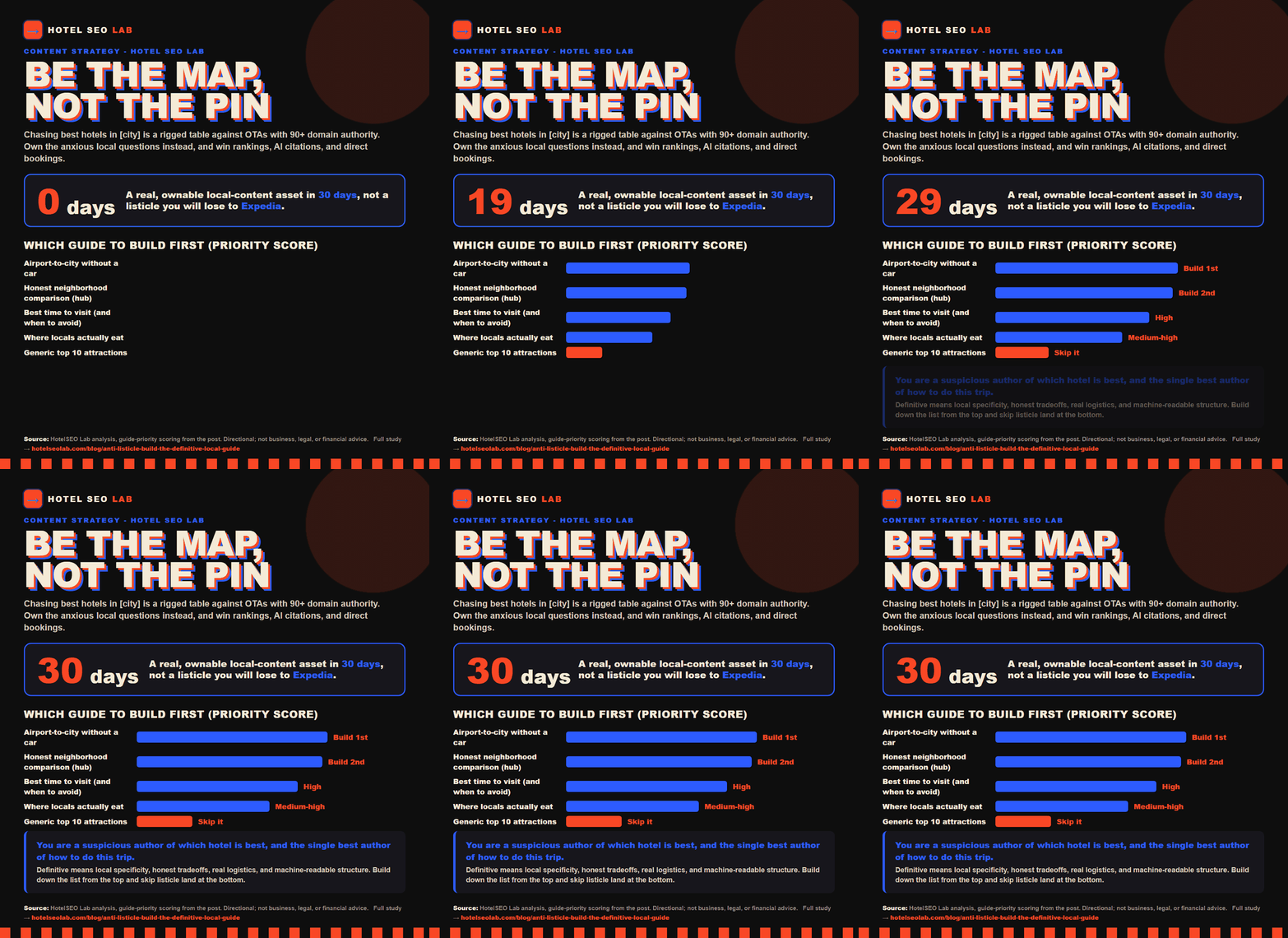
Here is a simple way to score which spoke to build first:
| Guide candidate | Search demand | Can you answer it better than anyone? | AI-citation potential |
|---|---|---|---|
| Airport-to-city without a car | High | Yes, you book these transfers weekly | Very high, it is pure logistics |
| Neighborhood comparison | High | Yes, uniquely local | Very high |
| Best time to visit | Medium-high | Yes, seasonal pricing insight | High |
| Where locals eat | Medium | Yes, and it builds trust | Medium-high |
| Generic “top 10 attractions” | High | No, everyone has this | Low, saturated |
Build down that list from the top. Skip the bottom row entirely; that is listicle land and you cannot win it.
Wire it so the guide actually feeds bookings
A guide that ranks but never mentions your hotel is charity. A guide that mentions your hotel every paragraph is spam that will not rank. The balance is: be genuinely useful for 90 percent of the page, then place clean, contextual off-ramps.
Inside the neighborhood guide, when you describe your own neighborhood honestly, link to your rooms page for readers who decide it fits. Inside the airport guide, note that you arrange transfers and link to booking. These are helpful, not pushy, because the reader already self-selected by reading that far. This is the same discipline behind good book-direct conversion work: earn the click by being useful, then make the next step obvious and frictionless.
And crucially, keep these guides on your own domain, not on a third party. The entire point is that you stop renting your destination content from OTAs. If you want the full argument for why owning this layer matters, how OTAs quietly steal your search visibility is the piece to read next.
A quick gut check before you publish any guide: would a local friend who works in tourism nod along, or would they roll their eyes? If it reads like a brochure, it will rank like a brochure. Write it for the friend.
Why this wins the AI-citation game specifically
The listicle strategy was already fading before AI assistants arrived. It is fully cooked now. When someone asks ChatGPT “where should I stay in [city] for a first visit with kids,” the model does not want to regurgitate a “top 10 hotels” affiliate page. It wants a source that actually answers that composite question with specific, structured, trustworthy detail. Guess which of your two possible pages that is.
This is the durable advantage. AI assistants reward exactly the qualities a hotel can uniquely produce: first-hand local specificity, honest tradeoffs, clean logistics, and question-shaped structure. That is not a coincidence, and it is not going to reverse. If you want the strategic layer on this, our take on the sleeping-giant opportunity in structured local data and the whole AI visibility service both start from the same premise this article does: specific beats generic, and local beats broad.
There is also a compounding local-SEO benefit. Deep, genuinely local content strengthens the topical relevance signals that also lift your map presence, which pairs directly with the Google Business Profile playbook. And if you run an extended-stay or aparthotel property, the guide-first approach is even stronger, because your guests plan longer, research harder, and ask more logistics questions, as I covered in the aparthotel and extended-stay marketing guide.
A 30-day starting plan
You do not need an agency to begin. You need a month and some discipline.
- Week 1: Pick your hub. Write the honest neighborhood guide. Interview your own front desk staff for the specifics you have stopped noticing.
- Week 2: Build the two highest-scoring spokes from the table above. Airport logistics and best-time-to-visit are usually the fastest wins.
- Week 3: Add structure, an FAQ on each, internal links between the hub and spokes, and clean booking off-ramps. Make it machine-readable.
- Week 4: Publish, submit to Search Console, and set a quarterly reminder to update prices and seasonal notes. These pages decay if you abandon them; they compound if you tend them.
That is a real asset in thirty days. Not a listicle you will lose, but a resource you will own.
Stop fighting Expedia for the term you cannot win. Go build the one page your city is missing and let it earn organic rankings, AI citations, and direct bookings while your competitors keep bidding on a rigged table.
If you want a second set of eyes on which guides your market is missing and how to structure them, book a call and we will map the cluster with you.