
Here is a gap almost no independent hotel is exploiting, and I mean almost none.
Every serious operator now knows they need to show up in AI answers. The conversation about whether ChatGPT, Gemini, Perplexity and Google’s AI Overviews are sending real travelers your way is over. They are. But the entire English-speaking hotel world is now crowding into the same English-language AEO playbook at once. Meanwhile the German family planning a two-week European trip, the Spanish couple looking for a boutique stay, and the Brazilian traveler researching in Portuguese are asking the same engines the same questions, in their own language, and getting answers built from a completely different, far thinner pool of content.
That thin pool is the opportunity. This is the fringe move, and fringe is exactly where an independent hotel wins, because the chains have not automated it yet and your OTA “partners” are not doing it for you either.
The short version: if a meaningful slice of your guests come from Germany, Spain, Mexico, Brazil or any non-English market, and your only quotable, structured content lives in English, you are invisible to those travelers at the exact moment an AI engine is deciding who to recommend.
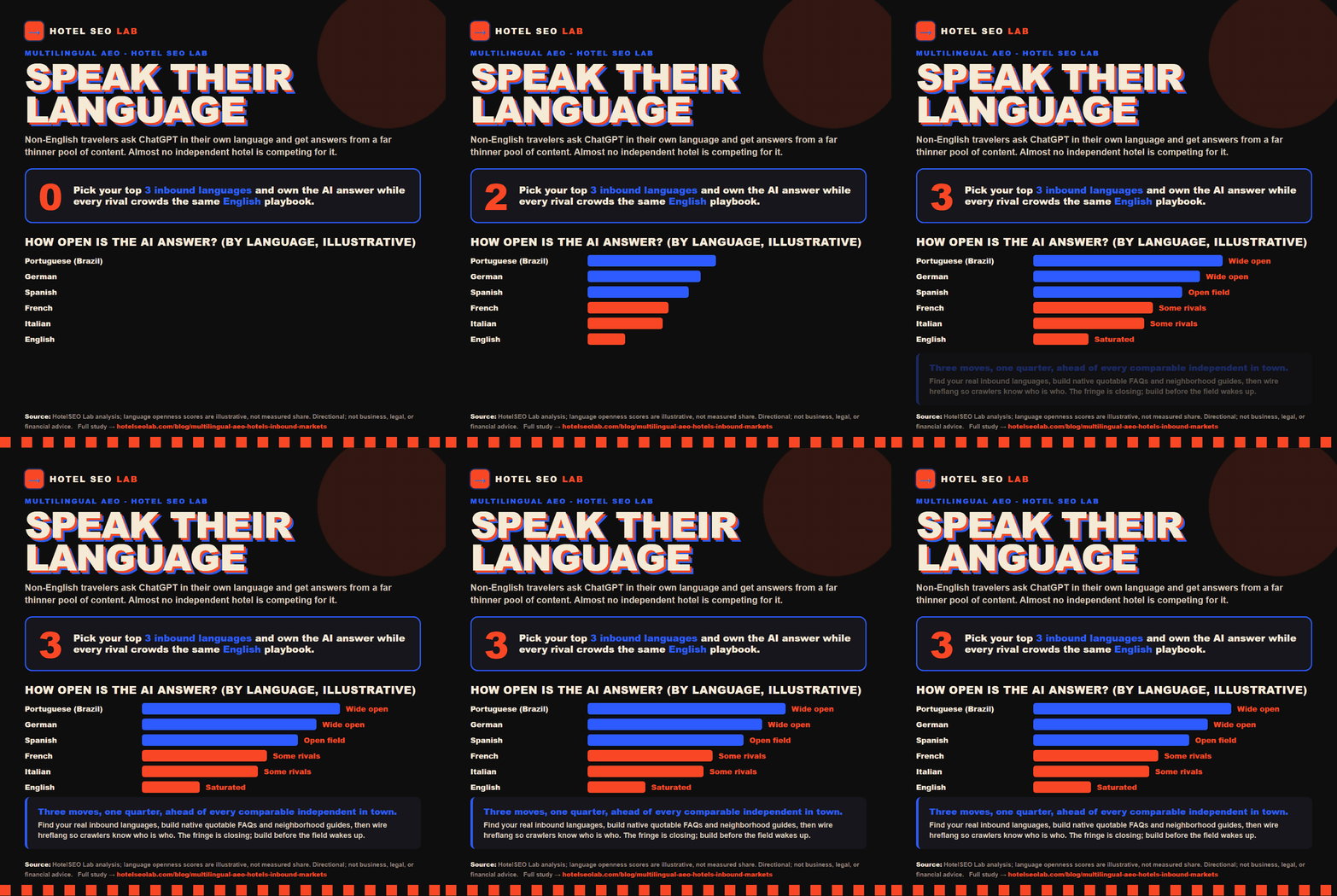
Download this study as a one-page PDF
Why the AI engines answer differently by language
When someone asks ChatGPT a travel question in German, the model does not quietly answer in English and translate the result back. It retrieves, weighs and synthesizes from what it can find and trust in German. The same is true for Spanish and Portuguese. Language is not a cosmetic layer on top of one universal answer; it shapes which sources get pulled into the response in the first place.
This matters because the supply of trustworthy, specific, well-structured hotel content in English is enormous and getting more competitive by the week. The supply in German, Spanish and especially Portuguese for a given small destination is comparatively sparse. Fewer independent properties have native-language pages. Fewer have structured FAQs a model can lift a clean sentence from. The bar to become the source an engine quotes is dramatically lower.
If you have read Is your hotel invisible to ChatGPT?, you already understand the core mechanic of AEO: engines reward content that is specific, factual, and structured so a machine can extract a confident, quotable answer. Everything in that playbook still applies. The multilingual edge is simply running that same playbook in the languages your competitors have ignored.
The three moves that actually matter
Let me be blunt about scope. You do not need to become a fifteen-language operation. You need to pick your top one to three inbound languages and do them properly. Half-built translation is worse than nothing because it signals low quality to both humans and models.
Here is the order of operations I would run.
1. Find your real inbound languages before you translate a word
Do not guess, and do not translate into whatever language your web developer speaks. Pull the evidence:
- Your booking-engine and PMS data on guest nationality and billing country.
- Google Analytics language and country segments for your existing site.
- Google Business Profile insights on where searches and direction requests originate. If you have not squeezed your profile properly yet, the Google Business Profile playbook for hotels is the place to start.
- The languages your front desk actually fields questions in.
For most European independents this lands on German first, then Spanish, then sometimes French or Italian. For properties in the US Sun Belt, coastal Mexico, Florida and much of Iberia, Spanish and Brazilian Portuguese are frequently the highest-value pair. Portuguese in particular is wildly under-served relative to how many travelers Brazil sends abroad, which is exactly why it is on the title of this piece.
Rank your languages by revenue contribution, not headcount. One high-ADR market that books direct is worth more than a large market that only ever arrives via a discount channel.
2. Build native, quotable, structured content, not translated brochure copy
This is where nearly everyone fails, so slow down here.
A translated version of your generic “Welcome to our charming hotel” homepage is useless for AEO. It answers no question. What AI engines quote is specific, extractable fact tied to a clear query. So the unit of work is not “translate the site.” It is “answer the real questions this language’s travelers ask, natively, in a structure a machine can lift.”
For each priority language, build:
A native-language FAQ block on the pages that matter. Not translated English FAQs. The questions a German guest asks are genuinely different from the ones an American asks. Germans want precise detail on public-transport connections, quiet hours, breakfast composition, cancellation terms and whether the AC is real air conditioning. Spanish and Latin American travelers often ask about late dining timing, family and connecting rooms, and airport transfer logistics. Write the questions the way they are actually typed, then answer each in two or three tight, factual sentences a model can quote verbatim.
Locally specific destination content in-language. This is the same logic behind why OTA destination landers rank so well, turned in your favor and in another language. A German-language guide to your neighborhood, written natively, naming real streets, transit lines, distances and specific nearby experiences, is a source an engine will reach for when a German traveler asks “what is there near [your area].” The OTAs are strong in English. In German, Spanish and Portuguese for a specific small destination, the field is often wide open.
Structured data that is language-aware. Your Hotel and FAQPage schema should reflect the language of the page it sits on, and each language version needs its own clean markup. This is the machine-readable spine that makes your facts easy to extract with confidence.
Native idiom, human-edited. Machine translation is a fine first draft and a terrible final one. AI engines are getting better at discounting thin, obviously-auto-translated boilerplate, and your actual guests spot bad phrasing in half a second. Pay a native speaker to edit. This one line item separates the properties that win inbound markets from the ones that publish embarrassing filler.
3. Wire the technical plumbing so crawlers know who is who
Great in-language content that the crawlers cannot map correctly is wasted effort. The essentials:
- Subdirectory structure on your primary domain, like /de/, /es/ and /pt/. For an independent hotel this beats separate domains almost every time: it keeps authority concentrated and is far simpler to maintain. It also respects the Cloudflare-style cost discipline of not sprawling into infrastructure you cannot look after.
- Correct hreflang tags so each language version declares its target audience and its relationship to the others. Get the return tags right or search and AI crawlers will treat the versions as unrelated duplicates.
- A truly localized experience, including prices in the guest’s likely currency where you can, dates and phone formats that read correctly, and a booking flow that does not dump a German speaker back into an English-only funnel. Your book-direct conversion path needs to survive the language switch, or you will win the AI recommendation and lose the booking.
The book-direct angle nobody connects to this
Here is why this is not just an SEO hobby. Inbound international guests are among the most expensive travelers to acquire through the OTAs, and international bookings frequently carry the fattest channel margins working against you. When a German traveler discovers you through Booking’s German-language machine, you pay for that guest, sometimes at a rate that would make your stomach drop if you did the book-direct commission math.
Being the property an AI engine names directly, in that traveler’s own language, is a way to enter the consideration set before the OTA does. It does not eliminate the OTAs, and I am not going to pretend it does. But every internationally-sourced booking you originate through your own in-language content is a booking you did not rent from a channel. That is the whole game, and it is the same logic underneath how OTAs quietly capture your search demand in the first place.
What “good” looks like in practice
Take a 40-room independent in a mid-size European city, with strong German and solid Spanish inbound demand. A realistic, non-heroic build over a quarter:
- A /de/ and /es/ version of the homepage, rooms, the direct-booking page and a genuine neighborhood guide, all native-edited.
- Ten to fifteen real, in-language FAQ answers per language, sitting on the relevant pages with proper FAQPage schema, targeting the actual questions those guests ask.
- Correct hreflang across all versions, verified, not assumed.
- A monthly prompt-check ritual, described below.
That is not a moonshot. It is a focused, finite project. And it puts the property ahead of essentially every comparable independent in town for German- and Spanish-language AI answers, because those competitors have done none of it.
How to measure it without fooling yourself
You will not get a clean ranking dashboard for AI answers, and anyone selling you one is overpromising. Here is the honest method:
Once a month, prompt ChatGPT, Gemini and Perplexity yourself, in each target language, using the real questions your inbound guests ask. Log three things: whether you are named at all, how accurately you are described, and which source the model appears to be leaning on. Watch it move over time. It is directional, it is a little manual, and it is genuinely informative, which is more than most “AI visibility scores” can claim.
If you want the broader framework this sits inside, our take on the AI-data sleeping giant covers why the structured signals you feed these engines compound, and our AI visibility, AEO and GEO service is where we run this end to end for properties that would rather not build it in-house.
The honest caveats
I am not going to hand you a guarantee, because there isn’t one and anyone who offers you a guaranteed top spot in ChatGPT is lying to you. The engines change their retrieval behavior without notice. Your citation this month may soften next month. Machine translation quality is improving, which slowly raises the floor and means the durable moat is genuine local specificity and native voice, not the mere fact of being translated.
But the direction of travel is clear. Non-English travelers are researching in their own language, the AI engines answer them from a thinner pool of sources, and almost no independent hotel is competing for that pool. That is the definition of a high-opportunity fringe, and fringes close. The properties that build native, structured, quotable content in their top inbound languages now will own those answers before the field wakes up.
If you want help figuring out which languages are actually worth the effort for your property, and building the quotable content that gets you cited, book a call and we will map it against your real inbound data before you spend a euro on translation.