
Opinion and directional analysis, based on public information at the time of writing. The mechanics described here are our interpretation of how search engagement and channel economics interact — they may be out of date, and search systems are opaque by design. Nothing here is affiliated with or endorsed by any named company, and none of it is business, legal, or financial advice. Rate-parity law varies by jurisdiction and by contract; verify your own situation with a qualified advisor before making changes.
Download this study as a one-page PDF
There is a specific kind of quiet damage that most independent hoteliers never see on a report. It does not show up as a line item. It does not trigger an alert. It just sits underneath your numbers, gently pressing down on everything — your click-through rate, your direct conversion, and eventually your visibility itself.
I call it the ghost rate problem. And it starts with a clause in your OTA contract that most owners signed years ago without thinking twice: rate parity.
What rate parity actually is
Rate parity is the requirement that the price you publish on your own website matches — or is no lower than — the price the OTA publishes for the same room, same dates, same conditions. Sometimes it is written explicitly. Sometimes it is enforced through “preferred placement” pressure, where undercutting the OTA quietly costs you ranking inside their marketplace. Either way, the practical effect is the same: your best public rate cannot be better than theirs.
On paper, this sounds neutral. Same price everywhere, the guest chooses their preferred channel, everybody wins. In practice, it is anything but neutral — because the two channels are not competing on equal footing. One of them spends hundreds of millions of dollars a year buying your name in search. The other is you.
If you have not already read our breakdown of how OTAs steal search, that is the backdrop for everything below. Parity is the mechanism that makes the theft profitable.
The click you never earned
Here is the mechanic almost nobody talks about.
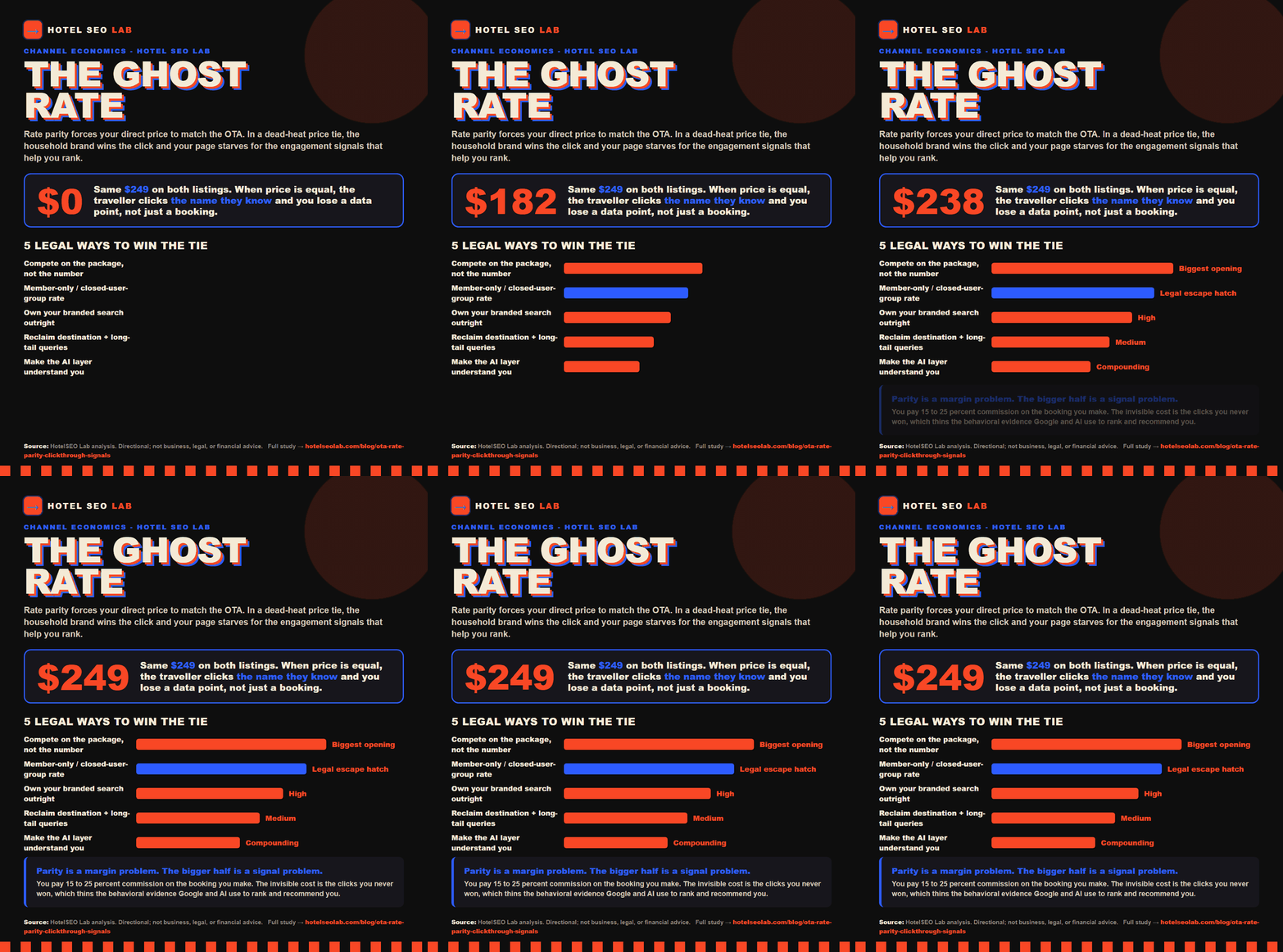
Imagine a traveller searching for your hotel by name, or searching a phrase like “boutique hotel near [your city] waterfront.” Two results appear near the top: the OTA listing and your own site. Both show, say, 249 dollars a night. Identical.
Now ask yourself the honest question: which one gets the click?
When price is equal, the decision collapses onto trust and familiarity. The OTA has a household brand, a review count in the tens of thousands, a “free cancellation” badge, and a checkout flow the traveller has used a dozen times. You have a logo they may not recognise and a booking engine they have never tested. With no price incentive to choose you, the rational traveller clicks the name they know.
That is the ghost rate at work. The rate that would have earned the click — the one where you are meaningfully cheaper direct — was never allowed to exist. It is a phantom. And every time a searcher picks the OTA in a dead heat, you lose more than a booking. You lose a data point.
The core claim of this piece in one line: parity does not just cost you margin on the bookings you make — it suppresses the behavioral signals that would have earned you more bookings in the first place.
Why the lost signal matters more than the lost margin
Most parity conversations stop at margin. You pay 15 to 25 percent commission, the OTA keeps it, and you would rather that money stayed in the building. Fair. We did the arithmetic on exactly that in the book-direct math breakdown, and the numbers are worse than most owners assume.
But margin is the visible wound. The signal loss is the invisible one, and over a year it may cost you more.
Modern search — both classic Google results and the AI answer layer — leans heavily on behavioral evidence. Not because an algorithm “rewards loyalty,” but because engagement is the cheapest available proxy for relevance and quality. The signals that quietly compound in your favour include:
- Click-through rate on your listing for branded and semi-branded queries.
- Dwell time and interaction once a searcher reaches your page.
- Conversion behavior — did the visit end in a booking, or a bounce back to the results page.
- Repeat and direct-navigation demand — people typing your name because they had a good direct experience.
Parity depresses the first one at the source. If you rarely win the click in a price tie, your page accumulates a thinner, weaker engagement profile than it deserves. Google does not see your contract. It sees a URL that people scroll past in favour of a big blue OTA button — and it draws the obvious conclusion. Your own branded search, the one term you should own outright, starts to feel contested.
This is the part that stings. You are not just paying commission on the booking. You are, in effect, training the search ecosystem to treat the OTA as the more relevant destination for your own name.
The AI answer layer makes this sharper, not softer
If you think this is a fading Google-blue-links problem, look at where discovery is heading. When someone asks an AI assistant “where should I stay in [your city] for a quiet weekend,” the model assembles an answer from whatever entities it understands well — with strong, corroborated, frequently-referenced presence.
OTAs have spent a decade becoming the most richly described hotel entities on the internet. Your independent property, throttled by parity and starved of direct engagement, is a fainter signal in that same corpus. We wrote about this exposure in is your hotel invisible to ChatGPT, and parity is one of the upstream causes. The rate you were never allowed to advertise is also a piece of distinctive, structured information about your property that the OTA got to own instead.
There is an emerging counter-move here worth understanding — the idea that first-party booking and guest data is a strategic asset the OTAs cannot fully replicate. We unpack that in the piece on first-party data as a sleeping giant for AI visibility. Parity is precisely the clause that keeps that giant asleep.
The honest caveats — because this is the insurgent, not a salesman
I am not going to pretend the mechanics above are laboratory-proven. They are not. Search systems are opaque, engagement signals are entangled with a dozen other factors, and correlation is not a control group. Here is where I want to be scrupulously fair:
- Parity does not directly touch rankings. No algorithm ingests your Expedia agreement. The pathway is behavioral and indirect.
- Some parity is legally dead or dying. Wide parity clauses have been banned or restricted in several European markets, and the regulatory tide has been moving against them. Your contract may already give you more room than you think.
- Brand strength beats price for some travellers regardless. A share of guests will book the OTA even when you are cheaper, out of pure habit. Removing parity is not a magic switch.
- The size of the effect is unknown. I am describing a direction, not a coefficient. Treat every mechanism here as a hypothesis to test against your own data, not a settled fact.
That is the honest version. The direction still holds even with all the caveats stacked on top: a rate you cannot advertise is a competitive weapon you are forbidden from firing.
What you can actually do about it
Parity governs the headline nightly rate. It almost never governs the total value of the booking. That gap is your entire opening, and it is bigger than most owners use.
1. Compete on the package, not the number. You may not be able to publish 229 dollars against the OTA’s 249. But you can publish 249 direct with a free upgrade when available, late checkout, a welcome drink, and the most flexible cancellation in the market. Same headline number, dramatically better deal — and none of it violates parity. Build the direct offer that makes the tie a landslide. Our book-direct conversion service exists for exactly this design problem.
2. Own the closed-user-group rate. Parity clauses frequently exempt member-only or logged-in pricing. A simple loyalty or “club” signup lets you offer a genuinely lower rate that never appears on the open market the OTA polices. This is one of the most under-used legal escape hatches in the whole system.
3. Win the branded search outright. When a searcher types your name, your result should be so obviously the right destination — richer content, real reviews, a clear direct-booking benefit — that the price tie stops mattering. That is a local SEO and Google Business Profile discipline as much as a website one, and the GBP playbook for hotels is the place to start.
4. Reclaim the destination and long-tail queries the OTA farms. The OTA does not just fight you on your name. It builds sprawling destination pages that capture “things to do near [your city]” traffic and funnels it into their funnel. You can build those too — better, and pointed at your own booking engine. That is the whole thesis of our OTA destination landers mega-guide, and it is doubly relevant for aparthotel and extended-stay properties where the research journey is longer.
5. Make the AI layer understand you as an entity. Structured content, consistent presence, and first-party proof of quality are how you become a destination the models can confidently recommend. Our AI visibility, AEO and GEO service is built around exactly that gap, and it pairs with the content and reputation work that feeds it.
The reframe
Rate parity is usually filed under “margin problem.” I think that is the smaller half of the story. The larger half is that parity quietly removes the price signal that would have earned your click — and by removing the click, it thins out the behavioral evidence that helps you rank, convert, and get recommended by the next generation of search.
You cannot always renegotiate the clause. But you can refuse to let it define the whole contest. The headline rate is one number on a listing. The reason a traveller chooses you is a much bigger thing — and that reason is still entirely yours to build.
If you want a clear read on where parity is costing you signal, and a value-based direct offer designed to win the click without breaking a single clause, book a session with us and we will map it against your actual numbers. If you are still sizing up whether it is worth it, the pricing page lays out where we start.
Reminder: this is opinion and directional analysis based on public information at the time of writing, and may be out of date. Any figures referenced (commission ranges, parity legality) are general and third-party in nature, subject to change and independent validation. Not affiliated with any named company. Not business, legal, or financial advice — verify your own contracts and local regulations with a qualified advisor. How we got this: the mechanics here are drawn from publicly reported OTA marketing practices, general parity-regulation news, and widely discussed principles of search behavior — not from any proprietary or company-confidential source.