
Somewhere in the setup wizard of nearly every hotel booking engine, there is a default that quietly shapes your SEO for years. The vendor gives you a hostname like book.yourhotel.com or reservations.yourhotel.com, you point a DNS record at it, the widget loads, bookings flow, everyone moves on. It works. That is exactly the problem.
That subdomain is a decision, not a default, and most independent hotels never get to weigh it. This piece is about what that decision costs, when the cost is real versus theoretical, and the three practical ways to fix it without breaking your reservations.
I am going to be specific and I am going to be honest, including about when this does not matter. If your booking engine subdomain is serving only transactional, no-index pages and you have no ambition to rank availability or offer pages, you can read the summary and get on with your day.
What “subdomain vs subfolder” actually means
Two ways to attach your booking flow to your brand:
- Subdomain:
book.yourhotel.com— technically a separate host that shares your root domain name. - Subfolder:
yourhotel.com/bookoryourhotel.com/reservations— a path that lives unambiguously inside your main website.
To a guest, these look almost identical in the address bar. To a search engine, an AI assistant, and your analytics, they are not the same thing at all. The core of the issue is how authority and context flow across that boundary.
The short version: a subfolder inherits the trust and context of your main site by default. A subdomain has to earn a share of it, and the sharing is inconsistent. For a page you want discovered and ranked, that difference is a tax you pay quietly, forever.
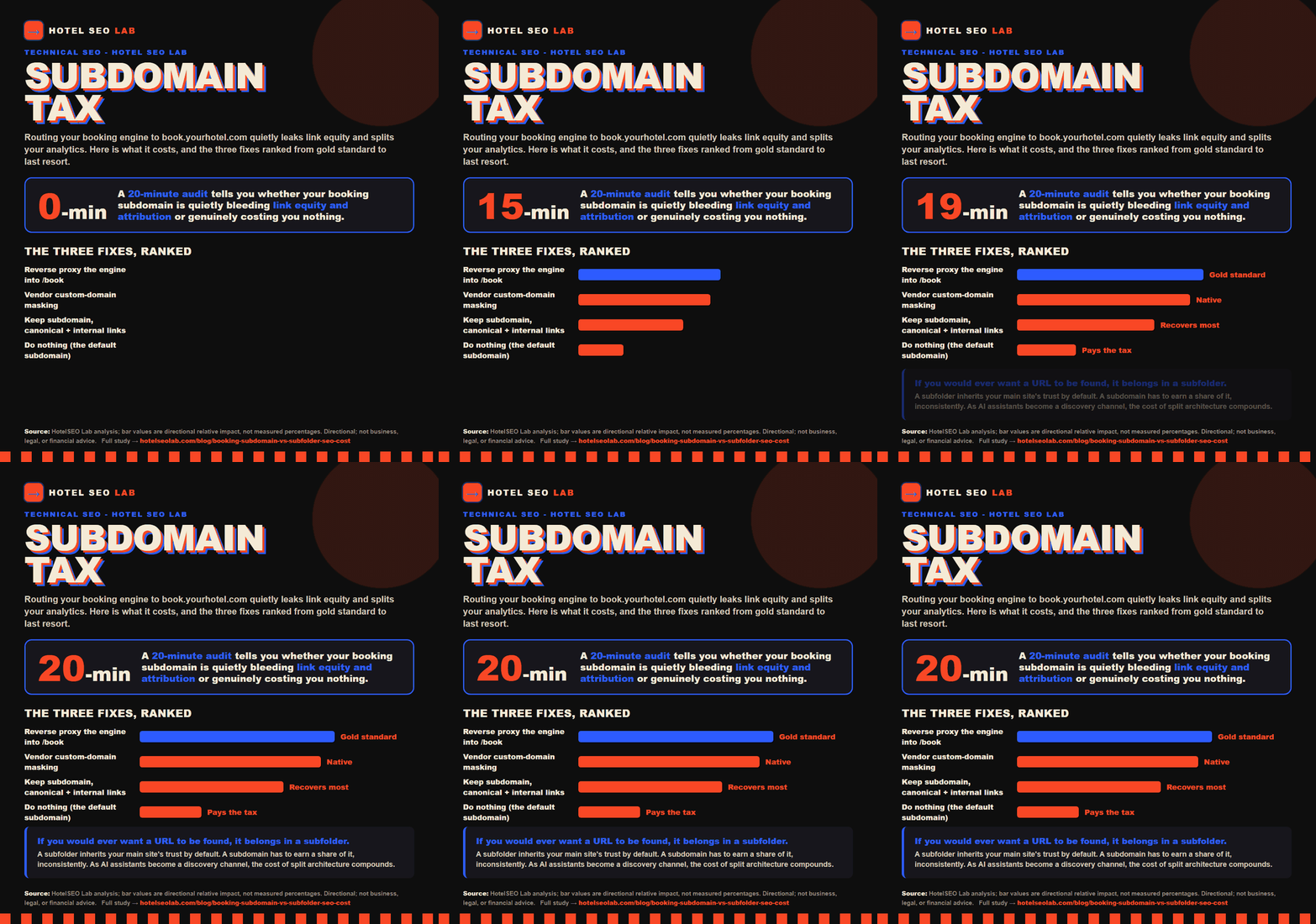
Download this study as a one-page PDF
The link-equity leak, explained without the hand-waving
Google’s public position, repeated for years, is that it is “fine” with either structure and can consolidate subdomains into the parent site. That is true and also incomplete. The honest reading is this: Google is capable of treating book.yourhotel.com as part of yourhotel.com. Whether it does so fully, and how quickly, depends on signals it does not publish.
Here is where the leak happens in practice.
When another site links to your booking engine — a review site linking to your availability page, a local guide pointing at a special-offer URL, an OTA-alternative listicle citing your direct-booking page — that link’s value lands on the host that was linked. If that host is a subdomain sitting on a vendor platform, the authority pools there, in a place you often cannot fully control, edit, or even see in Search Console unless you have set it up as a separate property. Consolidation to the root is possible but not guaranteed, and it is never instantaneous.
Compare that to a subfolder. A link to yourhotel.com/offers/summer-escape deposits its value directly into the same host as your homepage, your rooms pages, and your destination guides. There is no boundary to cross, no consolidation to hope for. The internal links you build from your homepage to that page flow within one hostname, which is the cleanest possible signal.
This is the same mechanism that makes OTAs so dangerous as competitors: they concentrate every scrap of authority onto one enormous domain and point it at pages that outrank yours for your own hotel’s name. We wrote about that dynamic in how OTAs steal search and in the mega-guide to OTA destination landers that rank. Splitting your own authority across a subdomain is a smaller, self-inflicted version of the same fragmentation.
The user-journey fragmentation nobody measures
Link equity is the SEO story. There is a second cost that shows up in your reporting and your conversion rate, and it is arguably more expensive.
When a guest moves from yourhotel.com to book.yourhotel.com, several things break unless you have deliberately fixed them:
- Analytics session continuity. By default, many analytics setups treat a cross-subdomain hop as a new session with a new referrer, which is your own site. Your booking engine’s traffic then looks like it came from “yourhotel.com referral” rather than the organic or paid source that actually drove it. Your attribution quietly lies to you, and you make budget decisions on it.
- Cookie and consent scope. Cookies set on the root are not automatically shared with a subdomain unless scoped correctly. Consent state, promo codes, and first-party tracking can drop at the boundary.
- Perceived trust. A guest who sees the URL change to a hostname they do not recognise, with a different visual shell from the vendor, hesitates at exactly the moment you need them not to. Trust friction at the payment step is real money.
None of this is fatal on its own. All of it is fixable. But it is invisible unless someone goes looking, and most hotels never do. The fragmented journey shows up as an unexplained drop in your funnel, blamed on “the market” or “the season” rather than a hostname boundary. If you are serious about the conversion side of this, our book-direct CRO service exists precisely to find these leaks.
When the subdomain genuinely does not matter
I promised honesty, so here it is. There are cases where the subdomain is fine and re-architecting would be wasted effort.
- The pages are pure transaction and set to noindex. If
book.yourhotel.comonly ever serves the calendar, cart, and checkout, and those are correctly excluded from indexing, there is little SEO equity to leak because you never wanted those pages ranked anyway. - You have no intention of ranking availability, rate, or offer pages. Some hotels rank entirely on their main-site content and treat booking as a closed transactional loop. Valid strategy.
- Your vendor’s subdomain is genuinely a separate product with its own strong domain. Rare, but a few booking platforms are large enough that the subdomain arrangement is negligible either way.
If all three describe you, fix your analytics cross-domain tracking and move on. Do not let a purist rebuild a working booking flow for a benefit you will never collect. The judgement call is whether any URL on that subdomain is something you would ever want a human or an AI assistant to find — not just use.
Why this is getting more important, not less
Here is the part that changes the calculus in 2026. The rise of AI assistants as a discovery channel raises the stakes on clean, consolidated site architecture.
When ChatGPT, Perplexity, or Google’s AI surfaces answer “where can I book [your hotel] directly”, they are reasoning over your site’s structure and authority to decide which URL to cite. A booking or offers page buried on a weakly-consolidated subdomain is a worse citation candidate than the same page sitting cleanly inside your main site. We dug into this in is your hotel invisible to ChatGPT, and it is the whole premise of our AI visibility, AEO and GEO service. Assistants reward sites that are legible. A fragmented host is less legible.
So the trend line matters: as more of your future bookings start with a question typed into an assistant rather than a query typed into Google, the cost of a split architecture compounds.
The three practical fixes, ranked
You have a subdomain today and you have decided the equity is worth capturing. Here are your real options, best to most-constrained.
Option 1: Reverse proxy the booking engine into a subfolder
This is the gold standard. You configure your web server or CDN so that requests to yourhotel.com/book are transparently served from the booking vendor’s system behind the scenes. The guest never leaves your hostname. Search engines see one unified site. Analytics sees one continuous journey.
- What it takes: a developer or capable web partner, plus a booking vendor that supports custom-domain or white-label serving. Cloudflare, a reverse proxy rule in your host, or a framework rewrite can all do this.
- The catch: it is real infrastructure. Misconfigure the proxy and you can break checkout, duplicate content, or create redirect loops. Test the full booking path, including payment, before you point live traffic at it. If you run this on Cloudflare, watch the request-cost implications of proxying and cache what you can.
- Best for: hotels serious about ranking offer and availability pages, and about clean AI-era architecture.
Option 2: Custom-domain masking within the subfolder path (vendor-native)
Many modern booking engines now offer a “custom domain” or “connected domain” setting that lets the booking flow live at yourhotel.com/reservations natively, without you standing up your own proxy. It is Option 1 with the vendor doing the plumbing.
- What it takes: checking your vendor’s documentation for “custom domain”, “embedded booking”, or “subfolder integration”. If it exists, it is usually a settings change plus a DNS or verification step.
- The catch: not every vendor offers it, and some charge for the tier that unlocks it. Ask directly; do not assume the subdomain is the only option because it was the default.
- Best for: hotels who want the subfolder benefit without owning proxy infrastructure.
Option 3: Keep the subdomain, but consolidate signals deliberately
If neither proxy nor custom-domain masking is available, you can still recover most of the loss with disciplined signal management. You are not eliminating the boundary; you are minimising what leaks across it.
- Canonicalize correctly. For any indexable page on the subdomain that has a main-site equivalent, or a preferred main-site version, set the canonical to the main-site URL. Do not canonicalize a genuinely unique booking page to an unrelated main page — that is a mistake Google will ignore or, worse, misread.
- Noindex the pure-transaction pages. Cart, checkout, and confirmation should not be indexed. This stops the subdomain from generating thin, duplicate, or parameter-bloated pages that dilute your profile.
- Verify the subdomain as its own property in Search Console so you can actually see its links and coverage instead of flying blind.
- Fix cross-domain analytics. Configure your analytics to treat the root and subdomain as one site so your attribution stops lying.
- Concentrate internal links from your main site to the specific booking or offer pages you want ranked, using descriptive anchor text. Internal links are the one authority lever you fully control.
Rule of thumb: if a URL on your booking subdomain is something you would ever want to appear in a search result or an AI answer, it belongs in a subfolder — via proxy or custom domain if at all possible, and via aggressive canonicalization and internal linking if not.
A 20-minute audit you can run today
You do not need us to tell you whether this is a problem for your specific hotel. Run this:
- Type your booking URL into the address bar. Is it a subdomain or a subfolder? Note it.
- Search Google for
site:book.yourhotel.com(using your actual booking host). How many pages are indexed? If it is more than a handful and they include thin cart or parameter pages, you have index bloat leaking equity. - Check your analytics referrers. Is a meaningful chunk of booking-engine traffic attributed to your own domain as a referral? That is the fragmentation showing up.
- Look at your backlinks. Do any external sites link to the subdomain rather than your main site? Each one is authority pooling in the weaker place.
- Ask your booking vendor one question: “Do you support serving the booking flow on a subfolder of our main domain, via custom domain or white-label?” Their answer decides whether Option 1 or 2 is on the table.
That audit tells you whether you are in the “does not matter” camp or the “quiet tax” camp. Most independents I look at are paying at least a small version of the tax, usually through analytics fragmentation they never knew about.
Where this fits in the bigger direct-booking picture
URL architecture is plumbing. It matters, but it is not the headline. The reason you care about capturing every scrap of your own authority is that you are competing with OTAs who spend enormous sums to outrank you for your own name, then charge you 15 to 25 percent for the privilege. The book-direct math is stark once you run it, and every structural inefficiency on your own site widens the gap in the OTA’s favour.
Clean architecture is one piece. It sits alongside a well-run Google Business Profile, genuinely rankable destination content, and an AI-visibility strategy that gets you cited when guests ask an assistant instead of a search box. Extended-stay and aparthotel operators have their own version of this, covered in our aparthotel and extended-stay marketing guide.
Fix the subdomain if it is costing you. Ignore it if it genuinely is not. But make it a decision this time, not a default someone else chose for you in a setup wizard.
If you want a second set of eyes on your booking-engine setup and where your authority is actually pooling, book a call and we will run the audit with you.