
Most independent hotel websites are not penalized for what they say. They are penalized for how they are built. A booking engine bolted onto a template, a “rooms” section that spawns forty near-identical URLs, a blog full of orphaned posts, and a parameter trap quietly generating tens of thousands of junk pages every time someone changes a date. Google crawls the mess, shrugs, and ranks the OTA instead.
This is the fixable half of hotel SEO. You do not need a bigger content budget to get architecture right — you need a plan for what deserves a page, what that page’s URL should look like, and how pages link to each other. Get that skeleton right and everything you publish afterward has somewhere to hang. Get it wrong and you are pouring content into a colander.
Here is the blueprint I use for independent hotels.
Start with the page types, not the pages
Before you touch a single URL, decide which types of pages your site needs to earn organic and AI-answer visibility. For a hotel there are really six, and each one maps to a different searcher intent:
- Room / accommodation pages — one per distinct room type. Bottom-funnel, high commercial intent.
- Rate plans — flexible, non-refundable, advance-purchase, member. These are states, not pages. More on why below.
- Packages / experiences — romance, spa, stay-and-dine, seasonal. Mid-funnel, gift-and-occasion intent.
- Offers / deals — time-boxed promotions. Transactional, often short-lived.
- Local guides — “things to do near,” neighborhood, event, and seasonal content. Top-funnel discovery and the raw material AI assistants quote.
- Core conversion pages — homepage, book direct, location/contact, amenities, gallery.
The single most common architecture mistake is collapsing these into two buckets (“rooms” and “a blog”) or, worse, exploding them into thousands of machine-generated variants. Your job is to give each type a clean, predictable home and a URL pattern that never changes.
Rule of thumb: if a page can’t attract its own search demand or answer its own question, it doesn’t deserve its own indexable URL. It’s a state, a filter, or a section of another page.
Download this study as a one-page PDF
URL patterns that don’t fight you
Pick a pattern per type and hold the line. Consistency matters more than cleverness here — crawlers and AI retrieval systems both reward predictability.
| Page type | URL pattern | Example |
|---|---|---|
| Room type | /rooms/[room-name] | /rooms/ocean-suite |
| All rooms | /rooms | /rooms |
| Package | /packages/[package-name] | /packages/spa-escape |
| Offer | /offers/[offer-name] | /offers/summer-midweek |
| Local guide | /guide/[topic] | /guide/things-to-do-nearby |
| Amenity | /hotel/[amenity] | /hotel/rooftop-pool |
A few hard rules that save you pain:
- Words, not IDs.
/rooms/ocean-suitenot/rooms?id=4471. Descriptive slugs help humans, crawlers, and models understand the page before they read it. - Lowercase, hyphenated, no trailing junk. Kill uppercase, underscores, spaces, and session tokens in the visible path.
- Shallow beats deep. Three folder levels is plenty.
/accommodation/room-types/suites/ocean/deluxe-ocean-suiteis where link equity goes to die. - Stable forever. A URL is a promise. If you rebrand “Deluxe King” to “Signature King,” 301-redirect the old URL — don’t orphan it and don’t let both exist.
- One canonical per page. Pick www-or-not, trailing-slash-or-not, http-to-https, and enforce it site-wide with redirects. Pick one and never look back.
Room pages: one per intent, not one per SKU
Your room pages are your money pages. They should each be a proper landing page: 300 to 600 words of genuine, specific copy (real square footage, real bed configuration, the actual view, who the room suits), original photography, an FAQ, structured data, and a direct path to check availability.
The trap is over-splitting. A property management system might expose “King,” “King Sofa,” “King High Floor,” and “King Accessible” as four rate-loaded room codes. That does not mean four indexable pages. Ask: could a human plausibly search for this, and can I write non-boilerplate content about it? An accessible room — yes, distinct demand and features. A “high floor” variant of the same room — no, that’s a booking preference, not a page. Fold it into the parent room with a variant selector.
Every near-duplicate room page you publish is a page competing against your own other room page for the same query. You are not adding coverage; you are splitting it. This is exactly the internal-competition problem that lets OTAs out-rank your own property — don’t hand them the win by fragmenting your own site.
Rate plans and the date-parameter trap
This is the single most expensive architecture mistake in hotel SEO, so it gets its own section.
Your booking engine generates a URL every time a visitor changes a date, guest count, promo code, or rate plan. Left unchecked, one room page becomes tens of thousands of crawlable, near-identical, constantly-changing URLs:
/rooms/ocean-suite?checkin=2026-07-02&checkout=2026-07-05&adults=2&rate=NONREF
/rooms/ocean-suite?checkin=2026-07-03&checkout=2026-07-06&adults=2&rate=FLEX
Google will crawl these. It will waste your crawl budget on them. And because they are 99% identical, it may decide your good room page is just one more piece of duplicate noise. Rate plans are transactional states — they are the job of the booking engine, not of the index.
How to defend the site:
- Canonicalize. Every parameterized variant of a room page should carry a canonical tag pointing at the clean
/rooms/ocean-suiteURL. - Block the patterns. Disallow date/guest/promo parameter paths in robots directives, or route them through a booking subdomain or path you keep out of the index entirely.
- Keep the booking engine off your content paths. If your engine lives at
book.yourhotel.comor/booking/, its parameter soup never contaminates your indexable pages. - Never internally link to a parameterized URL as if it were a page. Link to
/rooms/ocean-suite; let the “check availability” button add parameters client-side.
If you run on Cloudflare or any usage-billed backend, an uncontrolled parameter space isn’t just an SEO problem — it’s a cost problem. Crawlers multiplying across thousands of parameter permutations can hammer a database on every request. Cache dynamic reads and never let an unbounded parameter route hit an unindexed query.
Packages, offers, and the difference between them
Packages and offers look similar and behave differently, so structure them differently.
Packages are evergreen or seasonal products — a spa escape, a stay-and-dine, an anniversary package. They earn durable search demand (“spa hotel package near [your city]”), so give them permanent, indexable /packages/[name] URLs, real content, and internal links from relevant room and guide pages. Treat them like room pages: they are commercial landing pages.
Offers are time-boxed promotions — a summer flash sale, a midweek discount. They come and go. Two approaches that both work:
- Keep a stable
/offershub page that’s always indexed, and rotate individual offers within it, or - Give each offer a URL but 301-redirect expired offers to the hub (never leave a dead “20% off — expired 2024” page in the index).
The failure mode is a graveyard of expired offer pages, each thin, each dated, each telling Google your site is stale. Prune ruthlessly. An offer that ended is a redirect, not an archive.
Packages are also your best lever for higher-value direct bookings, which is the whole point — every package booked on your site is commission you keep instead of handing to an OTA. If you haven’t run those numbers, the book-direct math is stark, and a tight book-direct conversion setup turns package traffic into revenue.
Local guides: the layer OTAs can’t fake
Your rooms and offers compete with the OTA listing of the exact same rooms. Your local guide content does not — it’s the one place you have a structural advantage, because you actually know the neighborhood and the OTA is scraping a template.
Structure it as a coherent cluster under /guide/:
/guide/things-to-do-nearby/guide/best-restaurants-walking-distance/guide/getting-from-the-airport/guide/[local-event]-where-to-stay
These pages do three jobs at once: they capture top-funnel discovery search, they earn internal links you can point at your room and package pages, and they are the exact kind of specific, first-hand content that AI assistants quote when someone asks “where should I stay near [landmark].” If you’re wondering whether models can even see you, start with is your hotel invisible to ChatGPT and the mechanics of AI visibility for hotels. The same destination-content logic is why OTA destination landers rank so well — you can build the same asset on your own domain and keep the booking.
Internal linking: the skeleton that holds it together
A pile of well-built pages with no links between them is a pile, not a site. Internal linking is how you tell crawlers and models which pages matter and how they relate.
The model I use for hotels:
- Homepage links to the rooms hub, packages hub, offers hub, and guide hub — your four pillars.
- Room pages link up to the rooms hub, across to relevant packages (“this suite pairs with our spa escape”), and down/out to a relevant guide (“planning your visit? see things to do nearby”).
- Guide pages link to the specific room or package that best serves the reader’s intent — this is where you push top-funnel readers toward booking.
- Package pages link to the eligible room types and back to the packages hub.
- Every page links to book-direct.
Two things to police:
- No orphans. Every indexable page needs at least one internal link pointing at it. A page you can’t reach by clicking is a page Google barely values. Crawl your own site periodically and hunt for orphaned pages — a technical hotel SEO audit surfaces them fast.
- Descriptive anchors. Link with “our rooftop pool” or “spa escape package,” not “click here.” Anchor text is a ranking and relevance signal for the page you’re linking to.
Killing thin and duplicate pages
Architecture rots over time. Every quarter, do a quick census and act on it:
- Thin pages — under ~250 words, boilerplate, no unique value. Either enrich them or merge them into a stronger parent. A room page that’s just a photo and a “book now” button is thin.
- Duplicate pages — two rooms with near-identical copy, an offer that’s a clone of a package, a
/things-to-doand a/nearby-attractionscovering the same ground. Consolidate to one strong URL and 301 the rest. - Expired pages — dead offers, past events. Redirect to the hub.
- Parameter pages — confirm your canonical and robots rules are still holding the line after any booking-engine update.
Consolidation almost always helps. One 800-word room page with real detail out-ranks three 200-word near-duplicates every time, and it stops you competing against yourself.
A note on the aparthotel / extended-stay case
If you run an aparthotel or extended-stay property, the room-vs-rate-plan distinction gets sharper: length-of-stay is a rate dimension, not a page dimension. Don’t build “weekly rate” and “monthly rate” pages — build strong apartment-type pages and let stay-length live in the booking engine. The extended-stay marketing playbook goes deeper on the intent split.
The short version
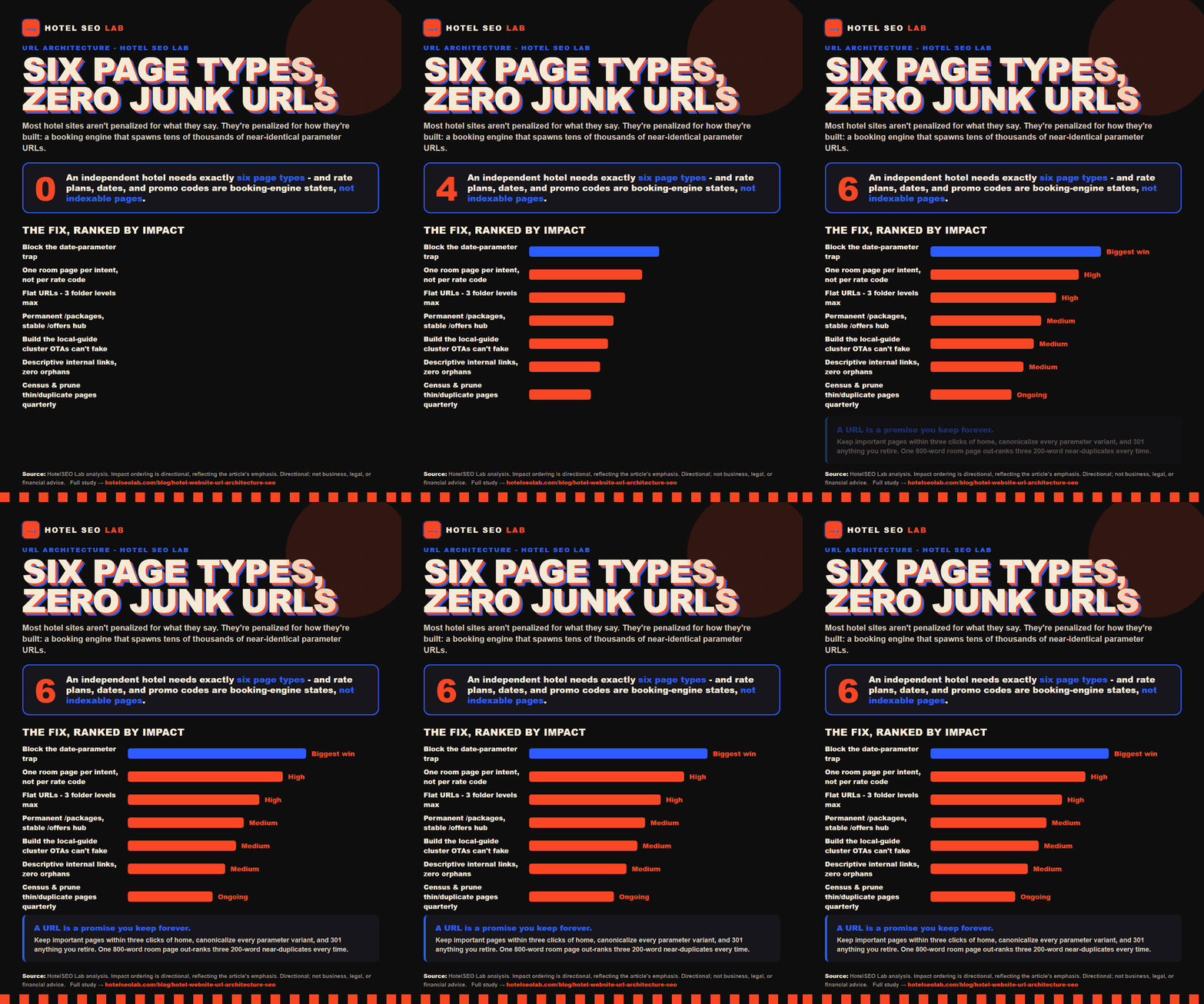
Decide your six page types. Give each a clean, permanent, human-readable URL pattern. Build one strong room page per genuine intent — not per rate code. Keep rate plans, dates, and promo codes as booking-engine states, canonicalized and blocked from the index. Give packages permanent pages and offers a stable hub. Build a real local-guide cluster — it’s the layer OTAs can’t replicate. Wire it all together with descriptive internal links and zero orphans. Then census quarterly and prune.
None of this requires guessing or magic. It requires a plan and the discipline to hold the pattern. If you’d rather have someone map your current architecture, find the parameter traps, and hand you a redirect-and-restructure plan, book a call and we’ll pull your site apart on the screen together.