
Ask most independent hoteliers what an “entity” is and you get a blank stare. Fair enough — it sounds like SEO jargon. But it is the single most useful mental model I can hand you for the next few years of search, because Google, Bing, and every AI answer engine have quietly stopped thinking in keywords and started thinking in things.
Your hotel is a thing. The question is whether the machines know it exists, know it is distinct from the three other properties with similar names two towns over, and know a handful of reliable facts about it. When they do, you get a Knowledge Panel, cleaner local results, and — increasingly — a fighting chance of being named in an AI answer. When they don’t, you are a fuzzy string of text that gets confused, merged, or ignored.
This is a build-it-from-scratch guide to becoming a recognized entity. It is specific, it is doable by a determined owner or marketer, and I am going to be honest about the parts that are slow, unglamorous, and not guaranteed.
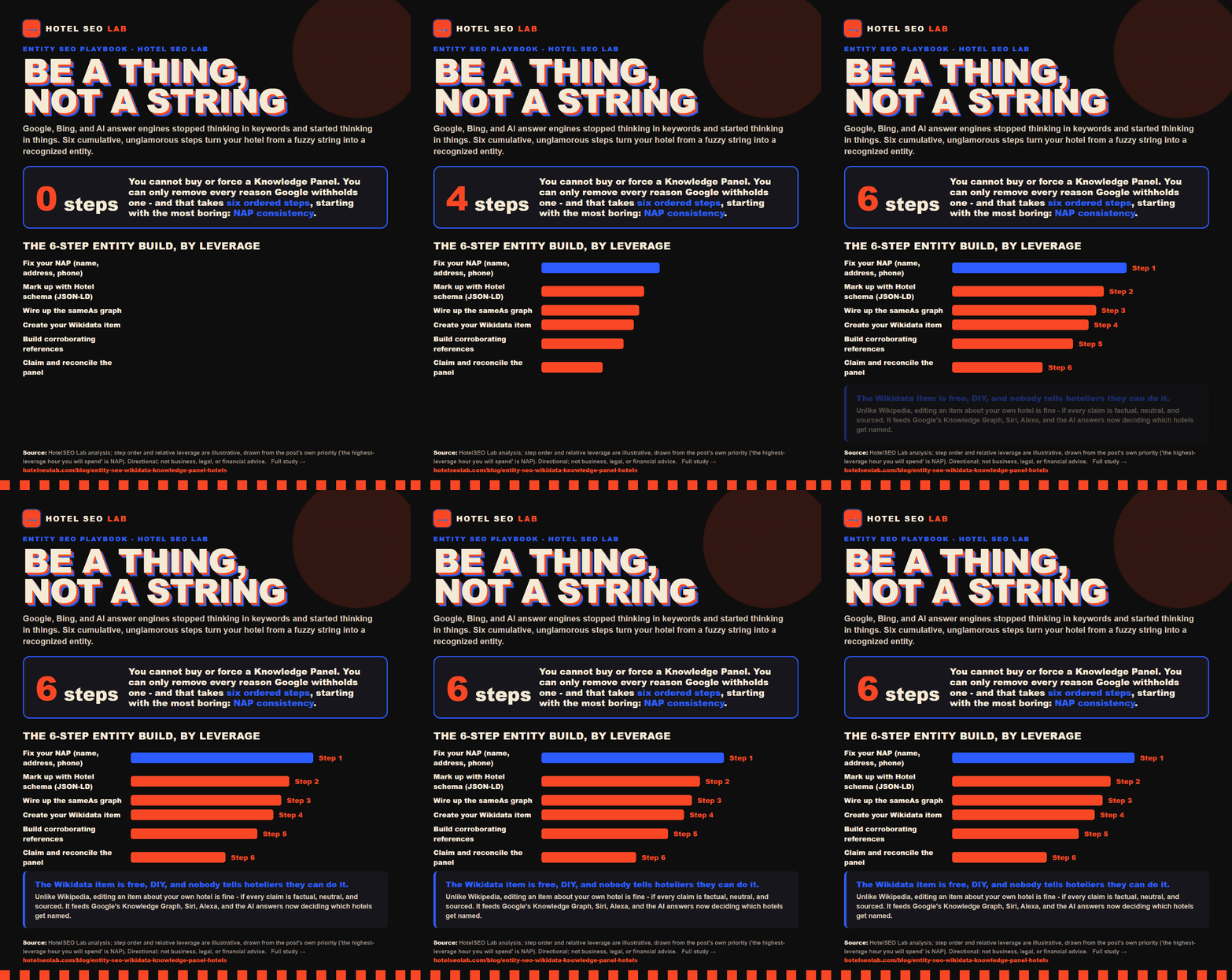
The uncomfortable truth up front: you cannot buy or force a Knowledge Panel, and no one can promise you one on a timeline. What you can do is remove every reason for Google to withhold it. That is what entity SEO actually is — clearing the ambiguity, one signal at a time.
Download this study as a one-page PDF
What “entity” means, without the jargon
An entity is a uniquely identified thing that a knowledge graph stores facts about. Google’s Knowledge Graph, Bing’s, and open databases like Wikidata all assign your hotel an internal ID and then attach attributes to it: name, location, star rating, year opened, parent company, official website, social profiles.
The magic is disambiguation. “The Grand” could be a hotel, a film, a chess opening. “The Grand in [your city]” narrows it. A knowledge graph entry with coordinates, a founding date, and a website pins it down to exactly one real building. Once a machine is confident which thing you mean, everything downstream — the panel on the right of the search results, the map pin, the AI citation — gets easier and more accurate.
Keywords tell a search engine what a page is about. Entities tell it what exists and how those things relate. The shift from the first to the second is why this work matters now in a way it didn’t a decade ago. If you want the broader context on why AI systems in particular reward this, our piece on whether your hotel is invisible to ChatGPT covers the retrieval side.
Step 1: Fix your NAP before you do anything else
NAP — Name, Address, Phone — sounds like the most boring thing in marketing, and it is. It is also the foundation, and if it is inconsistent, nothing you build on top will hold.
Pick one canonical form of each and enforce it everywhere:
- Name. Decide whether you are “The Harbour Hotel”, “Harbour Hotel [City]”, or “The Harbour Hotel & Spa” — and never mix them. Machines treat “St.” and “Saint”, ”&” and “and”, “Co.” and “Company” as potentially different. Choose one.
- Address. One exact street-address format. Same suite notation, same abbreviations, everywhere.
- Phone. One primary number, same formatting. If you run call tracking, keep your canonical public number consistent and be deliberate about where tracking numbers appear.
Then audit where these appear: your website footer and contact page, Google Business Profile, Apple Maps, Bing Places, TripAdvisor, your OTA listings, your booking engine, industry directories, your Facebook and Instagram, chamber of commerce pages. Every mismatch is a small vote for confusion. This is tedious and there is no shortcut — but it is the highest-leverage hour you will spend, because entity confidence is built on corroboration, and corroboration requires the sources to agree.
Your Google Business Profile is the anchor citation here. If it is not fully optimized and verified, stop and fix that first — our Google Business Profile playbook for hotels and the local SEO service page walk through it properly.
Step 2: Mark up your hotel with structured data
Structured data (schema.org markup, usually in JSON-LD) is how you hand a search engine machine-readable facts instead of hoping it parses them out of your prose. For a hotel, the relevant type is Hotel (which extends LodgingBusiness and LocalBusiness).
At minimum, your homepage or a dedicated “about” page should express:
name,address(as aPostaladdress),telephone,urlgeocoordinates (latitude and longitude)image(a stable, high-quality logo and building photo)priceRange,starRatingif you hold an official ratingcheckinTime/checkoutTime,numberOfRoomssameAs— and this one is important enough to get its own step
Two rules that trip people up. First, the structured data must match what is visible on the page and match your NAP exactly — contradicting yourself in markup is worse than no markup. Second, do not invent a starRating or aggregateRating you cannot substantiate; fabricated review markup is a policy violation and a fast way to lose trust. If you want a deeper example of schema done for ranking, the OTA destination landers mega-guide shows how the big players structure their data — and how you can match it.
Step 3: sameAs — the connective tissue
The sameAs property is a list of URLs that all point to the same entity you. It is Google’s request: “show me your other verified profiles so I can confirm you are one consistent thing across the web.” This is the single most under-used field in hotel schema, and it is doing quiet, heavy lifting.
Populate sameAs with your official, owned or verified profiles:
- Your Facebook, Instagram, LinkedIn, and X/Twitter pages
- Your TripAdvisor and, where relevant, your primary OTA listing pages
- Your Wikidata item (built in the next step)
- Your Wikipedia article, if one legitimately exists
- Your Crunchbase or industry-body listing if applicable
Every link in sameAs that leads to a profile which itself links back to your site strengthens the loop. This bidirectional confirmation — your site vouches for the profile, the profile vouches for your site — is precisely what a knowledge graph uses to raise its confidence from “probably” to “yes, this is the entity.” The more independent, authoritative nodes agree, the more solid your entity becomes.
Step 4: Create your Wikidata entry
Here is the part most hoteliers don’t know they are allowed to do: you can create a Wikidata item for your hotel yourself, today, for free.
Wikidata is the open, structured knowledge base that feeds Wikipedia, Google’s Knowledge Graph, Siri, Alexa, and a great deal of the AI-training and AI-retrieval world. Unlike Wikipedia, it does not demand the same steep notability bar — a real, verifiable business that exists is generally an acceptable subject. And unlike Wikipedia, editing an item about your own property is broadly acceptable, provided every statement is factual, neutral, and sourced.
How to do it responsibly:
- Create an account at wikidata.org. Establish a small, honest edit history first if you can — it signals good faith.
- Search before you create. Your hotel may already have a stub item pulled from another database. If so, improve it rather than duplicating.
- Create the item with a clear label (“[Hotel Name], [City]”), a short neutral description (“hotel in [city], [country]”), and no marketing language whatsoever.
- Add statements (properties):
instance of→ hotelcountry,located in the administrative territorial entitycoordinate location(matching your schemageo)official websiteinception(year opened) if you can source itnumber of rooms,image(only if properly licensed on Wikimedia Commons)- Identifiers that link out: your TripAdvisor ID, GeoNames, any tourism-board registry ID
- Cite every non-obvious claim with a reference — your own site is acceptable for basic facts, a news article or tourism registry is stronger.
- Keep it neutral and accurate. No “luxury”, no “award-winning”, no superlatives. Wikidata records facts, not adjectives.
Be realistic: a thin, unsourced, promotional item gets reverted or deleted, and sloppy self-editing can draw negative attention. A careful, sourced, neutral item tends to stick. This is craft, not spam — treat it that way.
Once your item exists, add its URL to your website’s sameAs array. You have now created a direct, machine-readable bridge from an open global knowledge base to your site.
Step 5: Build corroborating references
An entity is only as strong as the independent sources that agree about it. Google will not build a rich panel from your say-so alone; it wants third parties to confirm the facts.
Sources that carry real weight:
- Local and trade press. A genuine mention in a regional newspaper, a travel outlet, or an industry publication is a durable citation. This is where earned PR and real stories earn their keep — see our content and reputation service for how we approach this.
- Tourism boards and DMOs. Your destination marketing organization, chamber of commerce, and official visitor sites are high-trust nodes.
- Structured directories with editorial standards, not link farms.
- Consistent OTA and review-platform listings. Even though the OTAs compete with you for bookings — and yes, they routinely outrank you for your own name — their listings are still entity-corroborating citations. Use them for the entity signal while you fight to win the direct booking. The book-direct math explains why that fight is worth it.
The through-line: every one of these should carry the same NAP and, ideally, link to or reference your official site. Consistency compounds.
Step 6: Claim and reconcile the panel
If a Knowledge Panel does appear, verify it. Google lets the official representative of an entity “claim” its panel (you will need to prove you represent the business, usually via an associated verified profile). Claiming lets you suggest corrections to wrong facts — a mismatched address, an outdated closure, a wrong photo.
Do not confuse the Knowledge Panel with your Google Business Profile — they are related but distinct. The GBP powers the local/map experience; the Knowledge Panel is the broader entity summary. Keeping both accurate and mutually consistent is the ongoing job.
How this feeds AI answers
Everything above is also, not coincidentally, the groundwork for being cited by AI systems. When ChatGPT, Gemini, Perplexity, or Google’s AI answers reach for facts about a hotel, they favor data that is structured, cross-referenced, and corroborated — which is exactly what a clean Wikidata item, matching schema, and consistent citations produce. A well-formed entity is easy for a model to identify, hard to confuse with a competitor, and safe to cite.
We have written about the broader mechanics of this in the FlipTo and SpaceTime “sleeping giant” analysis and across our AI visibility (AEO/GEO) service. Entity SEO is the foundation layer underneath all of it. If you run extended-stay or aparthotel inventory, the same principles apply — and there are wrinkles worth knowing in our aparthotel and extended-stay marketing guide.
The honest timeline
Here is what I will not do: promise you a panel by a date, or a Wikidata item that never gets challenged, or an AI citation on demand. None of that is within anyone’s control, and the properties that overpromise it are the ones you should not hire.
What I will tell you is that this work is cumulative and durable. NAP consistency, valid schema, a clean Wikidata entry, a sameAs graph, and real third-party corroboration do not decay the way a rented ad does. They compound. Do them properly and you make yourself the easy, unambiguous answer — for Google’s panel, for the map, and for the AI systems now quietly deciding which hotels get named and which get skipped.
Start with NAP this week. Build the Wikidata item next. Everything else follows.
If you want a second set of eyes on your hotel’s entity footprint — or you would rather we build the Wikidata item, schema, and citation graph correctly the first time — book a call and we will walk through exactly where your gaps are. No guarantees, just the honest work that moves the needle.