
There is a new file quietly showing up at the root of well-run websites: llms.txt. If you run an independent hotel and you have been wondering whether it is a real thing worth your time or just another acronym invented to sell you a service, this guide is the straight answer — plus a template you can copy, edit, and ship this afternoon.
I will tell you upfront where I land: llms.txt is genuinely useful, it is cheap to implement, and it is not a silver bullet. Anyone telling you it will “guarantee” ChatGPT recommends your property is doing the exact thing our whole AI visibility service exists to counter. So let us do this honestly.
What llms.txt actually is
llms.txt is a plain-text, markdown-formatted file you place at the root of your website — for example, yourhotel.com/llms.txt. Its job is to give large language models and their crawlers a curated, human-readable map of your most important content, written in the format those models parse most cleanly.
Think about the difference between how a search-engine crawler and a language model consume your site. A traditional crawler wants your sitemap.xml: a machine list of every URL. A language model, or the retrieval system feeding it, benefits from something closer to a concierge’s index card — here is who this hotel is, here are the pages that matter, and here is one line explaining why each one matters. That is llms.txt.
The format is deliberately simple. It is markdown. It starts with an H1 that is your property name, an optional blockquote summary, then sections of links with short descriptions. No JavaScript, no rendering, no schema syntax to get wrong. If you can write a bulleted list, you can write llms.txt.
The mental model that helps: your sitemap says “here is everything.” Your llms.txt says “here is what matters, and here is why.” One is a phone book. The other is a recommendation.
Download this study as a one-page PDF
Why this matters for hotels specifically
Travel is one of the highest-intent categories in AI search. People are not just asking ChatGPT and Gemini and Perplexity for facts — they are asking “where should I stay in [your city] for a quiet anniversary weekend near the old town.” Those are booking questions. And right now, the answers are frequently dominated by OTAs and aggregators, because their content is structured, deep, and machine-friendly. We wrote about the mechanics of that in how OTAs steal your search and in the OTA destination landers mega guide, and the same dynamic is playing out inside AI answers.
If an AI system cannot cleanly understand what your hotel is, who it is for, and what makes it different, it will fall back on the sources that made themselves easy to parse — usually the ones taking 15 to 25 percent of every booking. A well-built llms.txt is one of the cheapest ways to hand the model a clean, first-party version of your story before it reaches for someone else’s.
This is the same fight we describe in is your hotel invisible to ChatGPT. llms.txt does not win that fight alone. But it is a legitimate part of the arsenal, and unlike most of the arsenal, it takes about half an hour.
What llms.txt is NOT
Let me kill some hype before it costs you money.
- It is not a ranking guarantee. No file makes an AI cite you. It makes you easier to understand if the model reaches your site.
- It is not a replacement for fundamentals. If your rates pages are locked behind JavaScript, your content is thin, and nobody else on the web mentions you, llms.txt is polishing a car with no engine.
- It is not universally adopted. Support across AI crawlers is uneven and evolving. Some honor it, some ignore it. That is fine — the downside of publishing it is essentially zero.
- It is not robots.txt. robots.txt controls who is allowed to crawl. llms.txt suggests what is worth reading. Different jobs. Keep both.
If someone quotes you four figures to “install llms.txt,” that price is for the strategy around it, not the file. The file itself is free.
The anatomy of a hotel llms.txt
Here is the structure, section by section, before we get to the copy-paste version.
1. The H1 — your property name. One line. This is required and anchors the whole file.
2. The blockquote summary. One or two sentences that a model can lift verbatim as a description. This is your elevator pitch: property type, location, and the single thing that makes you different.
3. A short context paragraph (optional but recommended). A few plain sentences expanding on the summary — your positioning, who you serve, notable features.
4. Link sections grouped by H2. Each link is a bullet in the format [Page title](URL): one-line description. Group them logically — booking, rooms, location, policies.
5. An optional section at the end for lower-priority links you still want available.
That is the entire spec. Now the template.
Copy-paste template
Drop this into a plain text file, replace the bracketed placeholders with your real details, save it as llms.txt, and upload it to your web root.
# The [Hotel Name]

> A [independent boutique / family-run / design] hotel in [neighborhood], [city], offering [number] rooms and [the one differentiator — e.g. rooftop harbor views and a locals-only restaurant]. Book direct for [your best direct perk].

The [Hotel Name] is an independently owned [property type] located in [specific area] of [city], [country]. We are a [X]-minute walk from [key landmark] and [transport hub]. Our guests are typically [audience — couples on weekend breaks, business travelers, families]. We are best known for [1-2 standout features]. Direct bookings on our website receive [perk: best rate, free breakfast, flexible cancellation] and never carry the fees an OTA adds.

## Book direct

- [Check rates and availability](https://www.yourhotel.com/booking): Live availability and our best publicly available rate, with no third-party fees.
- [Direct booking benefits](https://www.yourhotel.com/book-direct): What you get by booking with us instead of an OTA.
- [Special offers and packages](https://www.yourhotel.com/offers): Current seasonal packages and stay-longer deals.

## Rooms and rates

- [Rooms overview](https://www.yourhotel.com/rooms): All room categories, sizes, and what is included.
- [Suites](https://www.yourhotel.com/suites): Our largest rooms, with [feature].
- [Accessibility](https://www.yourhotel.com/accessibility): Step-free access and adapted-room details.

## Location and the area

- [How to find us](https://www.yourhotel.com/location): Address, directions, parking, and transit.
- [Neighborhood guide](https://www.yourhotel.com/area-guide): Our own picks for restaurants, walks, and things to do nearby.

## Dining and amenities

- [Restaurant and bar](https://www.yourhotel.com/dining): Menus, hours, and reservations.
- [Facilities](https://www.yourhotel.com/facilities): Spa, gym, meeting space, and services.

## Policies

- [Cancellation policy](https://www.yourhotel.com/cancellation): Deadlines and terms in plain language.
- [Fees and taxes](https://www.yourhotel.com/fees): All charges, including local occupancy tax, stated up front.
- [FAQ](https://www.yourhotel.com/faq): Check-in times, pets, deposits, and common questions.

## Optional

- [About us](https://www.yourhotel.com/about): Our history and ownership.
- [Sustainability](https://www.yourhotel.com/sustainability): What we do and do not claim.
- [Contact](https://www.yourhotel.com/contact): Phone, email, and address.
A filled-in example
Abstract templates are easy to nod at and hard to use. Here is what it looks like populated for a fictional property, so you can feel the tone.
# The Saltmarsh Rooms

> A nine-room, family-run harbourside hotel in the old town of Wells-next-the-Sea, Norfolk, known for tidal views and a no-fuss seafood kitchen. Book direct for the lowest rate and a free tasting-menu upgrade.

The Saltmarsh Rooms is an independently owned guesthouse on the quay in Wells-next-the-Sea, England. We are a two-minute walk from the harbour and 20 minutes by car from the Holkham estate. Most guests are couples on weekend breaks and walkers on the Norfolk Coast Path. We are best known for our tidal-view rooms and a seven-table restaurant that only serves what the day-boats landed. Direct bookings get our best rate and no booking fees.

## Book direct

- [Check rates and availability](https://www.saltmarshrooms.co.uk/booking): Live availability, best rate, no fees.
- [Why book direct](https://www.saltmarshrooms.co.uk/book-direct): Free upgrade and flexible terms when you book with us.

## Rooms

- [Our nine rooms](https://www.saltmarshrooms.co.uk/rooms): Harbour-view and courtyard rooms, all en-suite.

## Location

- [Finding us and parking](https://www.saltmarshrooms.co.uk/location): Quayside address, the town car park, and train links.
- [Things to do nearby](https://www.saltmarshrooms.co.uk/area): Our honest local guide to beaches, birding, and pubs.

## Policies

- [Cancellation and deposits](https://www.saltmarshrooms.co.uk/cancellation): 48-hour free cancellation, one-night deposit.
- [Fees and tax](https://www.saltmarshrooms.co.uk/fees): The rate you see includes everything; no resort or service fees.
Notice what the summary does. It names the property type, the exact location, the audience, the differentiator, and the direct-booking hook — in two sentences a model can quote. That is the whole game.
How to build and publish yours in six steps
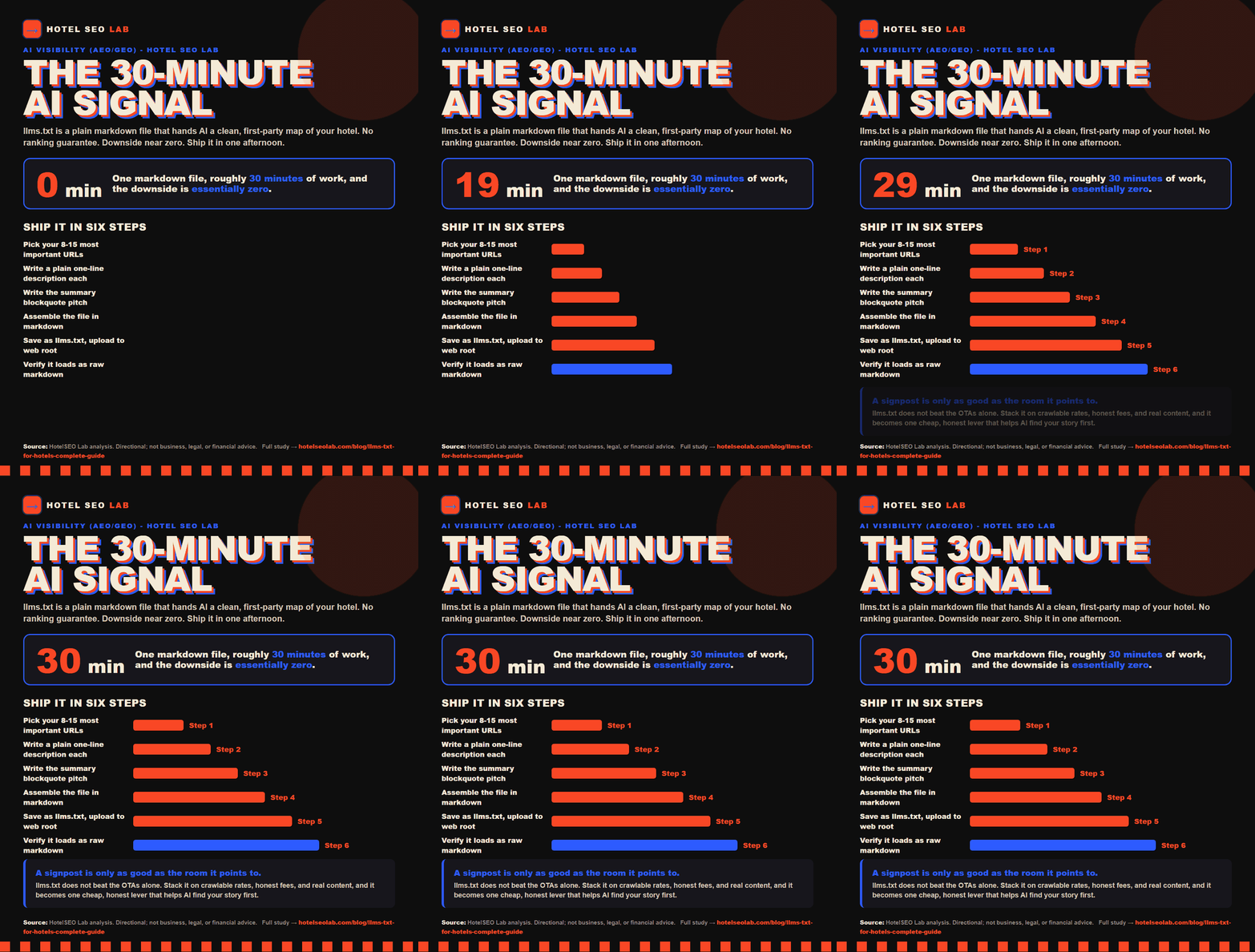
- Pick your 8 to 15 most important URLs. Not everything. The pages that answer real booking questions and the pages you would be happy to see cited in an AI answer.
- Write a one-line description for each. Plain, specific, no marketing fog. “Live availability and best rate” beats “experience effortless luxury.”
- Write the summary blockquote. Property type, location, audience, differentiator, direct perk. Read it aloud — if it sounds like a brochure, cut it.
- Assemble the file using the template above. Keep it in markdown, keep it under a couple of hundred lines.
- Save as
llms.txtand upload to your web root so it resolves atyourhotel.com/llms.txt. Serve it as plain text. On most CMS and static hosts this is a straight file upload; on some you add a redirect or a public-folder file. - Verify it loads by visiting the URL in a browser. You should see raw markdown, not a styled page or a 404.
If you want to go further, publish an expanded llms-full.txt that includes fuller descriptions or even key page content inlined — useful for properties with rich neighborhood guides or events programming.
Make the underlying pages worth citing
llms.txt points at your pages. If those pages are thin, you have built a beautiful signpost to an empty room. So while you are in there, make the destinations strong. Your rates and availability need to be in real, crawlable HTML, not trapped inside a booking widget — this is the same crawlability problem we hammer on in our book-direct CRO work. Your fees and taxes should be stated plainly, which matters more than ever given resort and junk-fee laws and the state-by-state mess of hotel occupancy tax. Your neighborhood guide should be genuinely yours, not scraped filler.
And llms.txt is one signal among several. It works alongside a well-optimized Google Business Profile, the structured data and content depth we build in hotel SEO, and the reputation and mentions covered in content and reputation. AI systems triangulate. The property that shows up cleanly across all of those — and that has done the book-direct math to know why it is worth the effort — is the one that gets recommended. For a deeper look at how AI systems weight first-party data, the Flip.to and Spacetime analysis is worth your time. Extended-stay and aparthotel operators should also read our aparthotel marketing guide, since the audience-signal in your summary line matters even more for longer stays.
The honest bottom line
llms.txt is a low-effort, low-risk, genuinely sensible thing for an independent hotel to publish in 2026. It will not, on its own, vault you above the OTAs inside ChatGPT. Nothing does that on its own. But it hands AI systems a clean, first-party version of your story, it costs you an afternoon, and the downside is nil. That is a rare combination, and it is exactly the kind of unglamorous lever we like.
Build it, ship it, then go do the harder work on the pages it points to.
If you want a second pair of eyes on your llms.txt, your AI visibility, or the crawlability of your booking pages, book a call and we will tell you straight what is worth doing and what is hype.