
I spend most of my time on how hotel prices get found and displayed, and there is one line on every guest’s final bill that quietly wrecks more booking-flow conversions than almost anything else: taxes. A guest sees a clean nightly rate, gets to checkout, and the total jumps by twelve, fifteen, seventeen percent. So I went and did the homework on how lodging taxes actually work, ran it through a deep, multi-source research pass, and had every claim adversarially fact-checked. The fact-checkers even killed two tempting-but-wrong claims along the way, which is exactly what you want from honest research.
This is a reference piece, written for operators who want to understand the machine — and, because this is a marketing site, the pricing and marketing angles hiding inside the tax code that most hoteliers never exploit.
Read this first — this is not legal or tax advice. I am a hotel marketer, not a tax professional or attorney. This is general, informational research, accurate to the best of my work at the time of writing and not necessarily accurate now. Lodging tax rates and rules change frequently and vary city by city — the figures below are illustrative of how the system is built, not guaranteed current totals for your property. Before you rely on any number, registration deadline, or exemption, verify it with your state department of revenue and your city finance or treasurer’s office, and consult a qualified tax professional.
Download this study as a one-page PDF
The big idea: it is a stack, not a tax
The single most useful thing to internalize is that “the hotel tax” is almost never one charge. It is a stack of independent levies imposed by overlapping governments, each of which adds its slice on top of the others. A typical guest’s combined rate is the arithmetic sum of:
- A state sales tax and/or a state lodging/occupancy excise
- A county occupancy tax
- A city occupancy tax
- One or more special-district assessments — tourism, convention center, sports/stadium, or similar
Because these stack, the combined effective rate a guest pays routinely far exceeds any single component. And here is a nuance the research surfaced that even some operators miss: lodging taxation is heavily a local instrument. A couple of states (Alaska and California) have no state-level lodging tax at all — localities do all the work — so “it’s a state tax” understates how much of the bite is city and county.
Verified examples of the stack in action
These are the jurisdictions my research nailed down to primary sources (state departments of revenue and official regulations). I am showing you these specifically because I could verify them — and I’ll be honest below about the ones I couldn’t.
| Jurisdiction | How the stack is built | Combined |
|---|---|---|
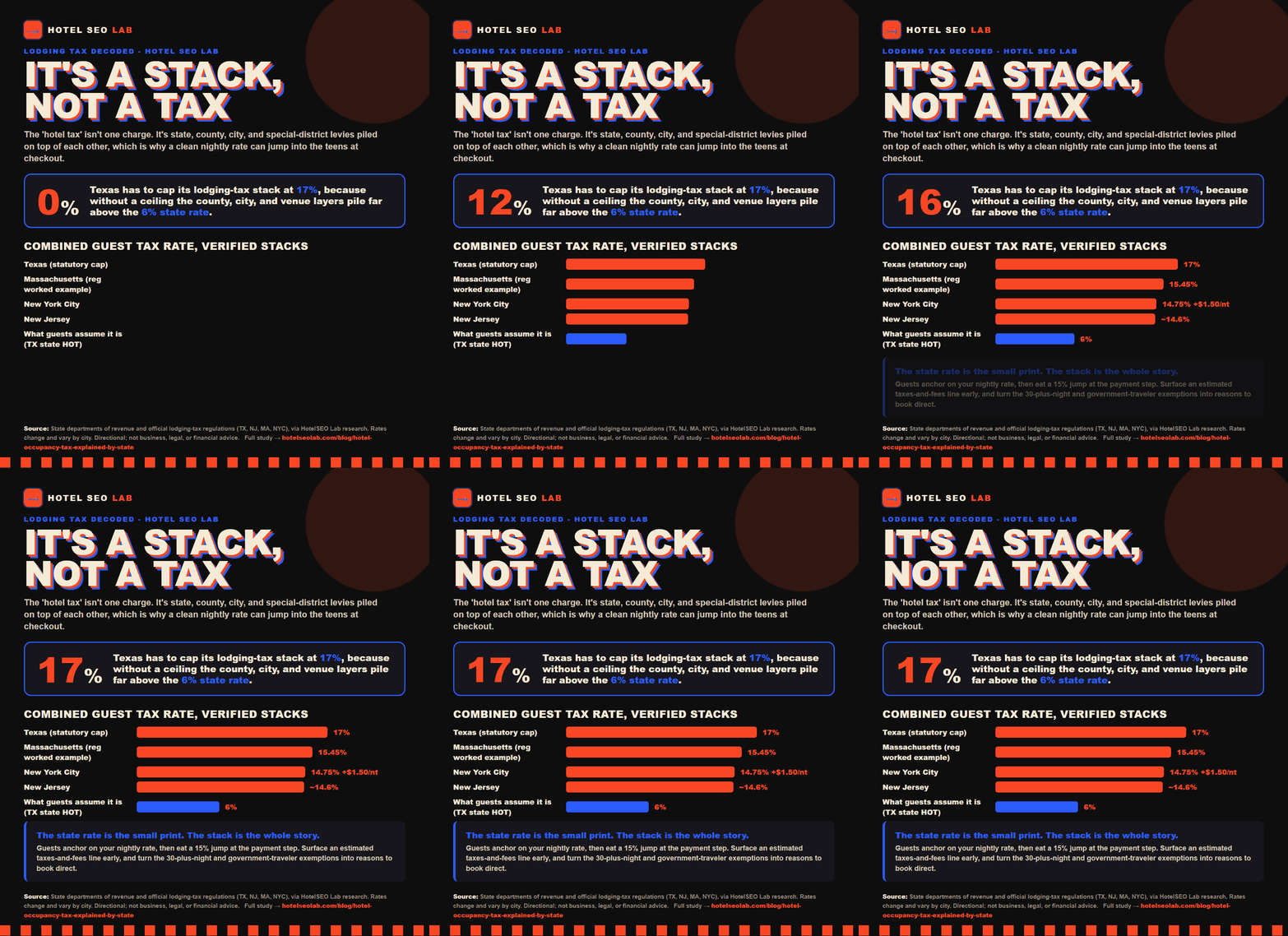
| Texas | State HOT 6% + county + city (up to 7%) + sports/community-venue (up to 2%) | Capped by statute at 17% |
| New Jersey | State Sales Tax 6.625% + State Occupancy Fee 5% + Municipal Occupancy Tax up to 3% | ~14.6%+ (carve-outs in AC, Newark, Jersey City, etc.) |
| Massachusetts | State excise 5.7% + local up to 6% (6.5% Boston) + Convention Center 2.75% + Cape Cod Water Fund 2.75% + STR Community Impact up to 3% | Reg’s own worked examples hit 11.7% and 15.45% |
| New York City | State + local sales taxes on occupancy, plus a flat $1.50 per unit, per night unit fee (itself not sales-taxed, separately stated) | ~14.75% + $1.50/night |
The Texas number is the cleanest illustration: the state portion is only 6 percent, but the law has to cap the total at 17 percent precisely because the county, city, and venue layers pile on. The cap exists because, without it, the stack would climb higher.
An honesty note on the other big cities. You’ll notice I did not put Los Angeles, San Francisco, Chicago, Las Vegas, Orlando, Miami, Atlanta, Washington DC, or Seattle in that table with hard numbers. That’s deliberate. My research verified the structure everywhere, but it did not lock down current, component-by-component primary-source rates for those specific cities — and I would rather tell you that than publish a number I can’t stand behind. For your city, pull the rate straight from your state DOR and city treasurer. That’s not a cop-out; it’s the only correct way to use any lodging-tax figure, because they change.
What’s taxable, and who gets out of it
The “permanent resident” long-stay exemption — and why it’s not uniform
Most jurisdictions stop taxing a stay once the guest becomes a “permanent resident” by staying long enough. The catch is that “long enough” varies:
- Texas: a guest with the right to occupy for at least 30 consecutive days without interruption is exempt — and any interruption in the term (or in payment) voids it.
- Colorado: exempt only with a written agreement for at least 30 consecutive days. A registration record or rent receipt counts as evidence; a cancelled check alone does not.
- Massachusetts: the excise applies only to stays of 90 consecutive days or less for hotels (31 days for short-term rentals). Exceed it and the entire stay becomes non-taxable.
So the famous “30-day rule” is common but absolutely not universal — and note this is the tax threshold, which is a separate question from when a guest becomes a legal tenant. I went deep on that distinction in when an extended-stay guest becomes a tenant; the tax line and the tenancy line often both sit near 30 days but are legally independent.
Government, military, and diplomatic exemptions
These are common but conditional, and the conditions matter:
- In Texas, U.S. government employees (including military) traveling on official business with a valid government ID are exempt from both state and local hotel taxes; foreign diplomats with a State Department exemption card are exempt unless the card specifically excludes hotel tax. Ordinary state employees and federally funded contractors generally are not exempt.
- In Pennsylvania, a federal employee on official business is exempt whether the government pays the hotel directly or the employee pays and is later reimbursed (grounded in a state case, Egner v. Commonwealth).
And exemptions come with paperwork: Texas, for example, requires Form 12-302 for most exemption claimants and four-year record retention. The lesson is that exemptions are real money but they are documented money — sloppy records are where audits bite.
How resort fees get taxed
Treatment varies by state, but a representative rule (New Jersey’s) captures the logic: a mandatory resort fee is part of the taxable room price, because the guest can’t opt out; an optional fee is non-taxable only if every component is non-taxable — bundle in one taxable item like parking and the whole optional fee becomes taxable. Colorado similarly taxes the entire amount charged for the room, including separately stated charges like cleaning. This pairs directly with the all-in display rules I covered in the resort-fee and junk-fee law piece: a mandatory fee tends to be both taxable and required to appear in your displayed price.
Who actually collects and remits (and the OTA fight)
The operator is the responsible party. You register — often fast; one New York county requires registration within three days of opening or acquiring a property — you collect from guests, you remit, and you are personally liable for the tax. The statutory definition of “operator” now routinely sweeps in short-term and vacation rentals too.
Marketplace-facilitator laws increasingly shift the collect-and-remit duty onto the booking platform. In Massachusetts, intermediaries (brokers, hosting platforms, operators’ agents) must register and remit the excises and local fees themselves. In Colorado, the marketplace facilitator collects and remits state, county lodging, and local-marketing-district taxes on the entire amount charged. Airbnb and Vrbo have done automatic collection in many places since 2019. But — and this matters — it’s jurisdiction-specific, it often requires the operator to be registered first, and you can retain residual liability. “The platform handles it” is a hypothesis to verify, not a fact to assume.
Then there’s the long-running OTA tax war. In the merchant model, a guest pays the OTA, which forwards most of it to the hotel and keeps a markup. The fight is whether occupancy tax is owed on the full retail amount the guest paid or only the wholesale amount the hotel received. As of a mid-2023 tally, courts had mostly sided with the OTAs — 39 cases across 23 states found the OTA’s service charge not taxable, versus 10 cases in 6 states plus DC finding it taxable. It remains genuinely unsettled and decided state by state, so treat that scoreboard as a snapshot, not settled law.
Now the marketing angles hiding in the tax code
This is the part nobody writes about, and it’s why a marketer cares about tax law at all. The tax stack isn’t just compliance — it shapes your displayed price, your conversion rate, and even which guests you should chase.
1. Tax is the biggest source of checkout sticker shock you don’t control. A guest anchors on your nightly rate, then watches the total jump 15 percent at the worst possible moment — the payment step. You can’t change the rate, but you can surface an estimated “taxes and fees” line early in your booking flow instead of springing it at the end. This is the one charge the all-in pricing rules generally still let you display separately, but separately-displayed shouldn’t mean hidden-until-checkout. Cutting that surprise is pure booking-funnel conversion work, and it directly reduces abandonment.
2. OTA parity now includes tax display. OTAs and metasearch render the “taxes and fees” line their own way. If your direct booking engine shows the rate one way and an OTA shows the all-in another way, the OTA can look cheaper on identical economics — and you lose the direct booking you’d actually profit from. Showing a clear, honest all-in (rate + estimated tax) on your own site protects the direct-booking margin I keep harping on.
3. The 30-day exemption is an advertisable price advantage for long stays. Where your jurisdiction drops hotel tax after the permanent-resident threshold, that’s not just a compliance footnote — it’s a marketing claim. “No hotel tax on stays of 30+ nights” (where true and verified) can be a real, quantified reason to book your extended-stay product direct. It pairs perfectly with the aparthotel and extended-stay playbook: the tax saving makes the monthly math even better, and it’s a number a relocating family or project crew will absolutely notice.
4. Tax-exempt government and military travel is a targetable demand source. If you’re near a base, a federal building, a courthouse, or a VA facility, the government-traveler exemption is a built-in reason for per-diem and official travelers to choose you — and to book direct so the exemption paperwork is handled cleanly. Build a page that speaks to official-travel logistics (exemption forms, direct billing, per-diem fit) and you’re capturing recurring, recession-resistant demand most independents ignore.
5. AI trip-cost estimates increasingly include tax. When a traveler asks an assistant “what will three nights in this city actually cost me,” the better models are starting to reason over taxes, not just rates. A property whose pricing and policies are clean and machine-legible is an easier, more accurate recommendation — one more reason your AI-search visibility benefits from pricing transparency, the same way it does in our AEO/GEO work.
The throughline: tax is a fact of the final price, so treat it as a marketing surface, not just a remittance chore. Surface it early, display it consistently across channels, and turn the exemptions into reasons to book direct.
The honest bottom line
Lodging tax isn’t one number — it’s a stack of state, county, city, and special-district levies that together can push a guest’s effective rate into the teens. The exemptions (long-stay, government, diplomatic) are real but non-uniform and documentation-dependent; the collection duty is increasingly shared with platforms but still ultimately yours; and the OTA-markup question remains unsettled. Because all of it changes and varies locally, the only safe figure is the one you pull from your own state DOR and city treasurer.
But don’t file this purely under “compliance.” The tax stack is sitting inside your guest’s final price, shaping conversion and channel choice — and the exemptions are quietly some of the most under-used marketing hooks in independent hospitality.
If you want help making your booking flow surface taxes honestly and early, keeping all-in display consistent across your direct site and the OTAs, and turning long-stay and government-traveler tax advantages into pages that actually convert, that’s our kind of work. Book a free intro call and we’ll look at your specific market and stack together.
Disclaimer, again, because it matters. This is general information for hotel operators, not legal or tax advice, and reflects my research at the time of writing. Lodging tax rates, thresholds, exemptions, and platform-collection rules change frequently and differ by state, county, and city — the examples here illustrate structure and may already be out of date. Do not rely on any figure or rule in this article for your property. Verify current rates and obligations with your state department of revenue and city finance/treasurer office, and consult a qualified tax professional or attorney for your jurisdiction.