
If you read our piece on the real cost of OTA commissions, you already know I am a little obsessed with how hotel prices get displayed, because display is where direct bookings are won and lost. So when the law around mandatory fees changed, I wanted to understand it properly rather than parrot headlines. I ran a deep, multi-source research pass across the FTC’s own materials, state attorney-general releases, statutes, and law-firm analysis, and had every key claim adversarially fact-checked before writing. Twenty-five claims went in; twenty-five survived verification. Here is the honest map.
The short version: “resort fees” did not get banned. Hiding them did. And for an independent hotel that plays it straight, that distinction might be the best competitive news you have had in a while.
Read this first — this is not legal advice. I am a hotel marketer, not an attorney, and this article is general information, accurate to the best of my research at the time of writing and not necessarily accurate now. This is one of the fastest-moving areas of consumer-protection law right now — a federal rule just took effect, states are passing their own statutes, and enforcement posture can shift. Your exact obligations depend on your jurisdiction, your channels, and facts I cannot see. Before you change how you display prices or charge fees, confirm the current rules with a licensed attorney in your state.
Download this study as a one-page PDF
What actually changed: the FTC “Junk Fees” Rule
The headline event is the FTC’s Rule on Unfair or Deceptive Fees, formally 16 C.F.R. Part 464, often called the “Junk Fees Rule.” It took effect on May 12, 2025 (the Commission approved the final rule on a 4-1 vote, it was published in the Federal Register on January 10, 2025, and became effective 120 days later).
Two things about it matter most, and both cut against the way people describe it.
First, it is narrow in scope. The rule deliberately covers exactly two industries: live-event ticketing and short-term lodging — hotels, motels, inns, and vacation/short-term rentals. The original 2023 proposal would have covered nearly every industry; the final rule was pared down to these two. If you run a hotel, you are squarely in it.
Second, it is a disclosure rule, not a ban. This is the part that gets garbled in every casual summary. In the FTC’s own words, the final rule “preserves flexibility for businesses by not prohibiting any type or amount of fee or specific pricing strategies.” It does not outlaw resort fees. What it requires is that whenever you offer, display, or advertise a price, you “clearly and conspicuously disclose the true total price inclusive of all mandatory fees,” and that the all-in total be shown more prominently than any other pricing information. Itemized breakdowns are still fine — they just cannot overshadow the real total.
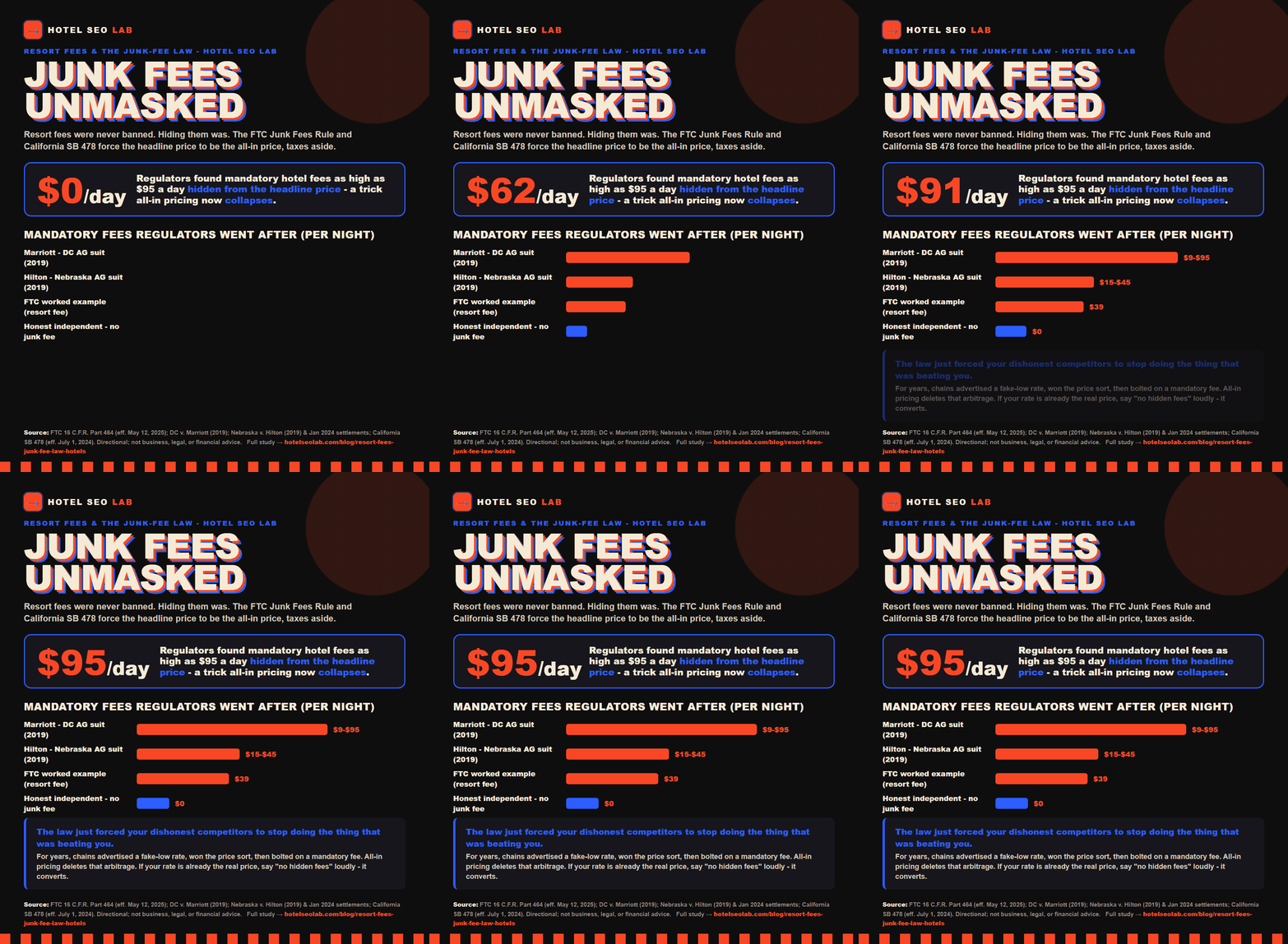
The FTC’s guidance uses a worked example that makes it concrete: a resort charging a $199 nightly rate plus a mandatory $39-per-day resort fee must fold that resort fee into the displayed total. A vacation rental’s mandatory cleaning fee, same thing. (That specific example lives in the FTC’s FAQ guidance interpreting the rule, not in the regulatory text itself — worth knowing if you are ever parsing the fine print.)
What you can still leave out of the headline number
Only three categories may be excluded from the up-front FTC total price:
- Government taxes and charges (your occupancy/lodging tax, for instance).
- Shipping charges — but not handling charges, which must be included.
- Genuinely optional ancillary goods or services the guest actively chooses to add.
And even these excludable items have to be disclosed — nature, purpose, and amount — and rolled into the final amount before you ask for payment. A mandatory resort or destination fee is none of these three things, which is exactly why it now has to live in the up-front price.
The mental model: the only number a guest sees as “the price” must be the number they will actually pay, minus government taxes. Everything mandatory rides inside that number, shown loud. You can itemize underneath. You cannot bury.
California went first, and harder: SB 478
If you take bookings from California guests, you are also dealing with state law that predates the federal rule and is arguably stricter.
California SB 478 — the “Honest Pricing Law” or “Hidden Fees Statute,” codified at Civil Code section 1770(a)(29) within the Consumers Legal Remedies Act — took effect July 1, 2024. It makes it illegal for most businesses to advertise, display, or offer a price that does not include all mandatory fees, with the only carve-outs being government taxes and reasonable shipping (handling must be included). The advertised price has to be the full price the consumer is required to pay.
Two details matter for hotels specifically. The California Attorney General’s guidance expressly lists hotels and short-term rentals as covered, and the restaurant/bar service-fee exemption that was added by a companion bill (SB 1524) does not extend to hotels or short-term rentals. And critically, you cannot comply by revealing the extra mandatory fee later in the flow. The AG’s FAQ answers this directly: a business cannot comply by disclosing additional required fees before checkout — the listed price itself must already be the full price. No “plus fees at checkout” escape hatch.
Beyond California, the landscape is an emerging patchwork. Minnesota’s price-transparency law took effect at the start of 2025, Massachusetts adopted new consumer-protection pricing rules in 2025, and other states are moving. I am not going to pretend I verified the hotel-specific contours of each one — my research nailed California cold and saw the others mostly through law-firm roundups — so treat anything outside California as “developing, confirm locally.”
This was being enforced before the rule existed
Operators sometimes assume nothing happened until the FTC acted. Not so — state attorneys general were litigating “drip pricing” years earlier, and those actions tell you what regulators consider deceptive.
- DC v. Marriott (July 2019). The District of Columbia Attorney General sued Marriott for advertising one room rate and then adding mandatory resort, amenity, or destination fees (alleged at $9 to $95 per day across 189-plus properties), under DC’s Consumer Protection Procedures Act. The framing the AG used — “hiding the true price of hotel rooms” — is the whole theory in five words.
- Nebraska v. Hilton (July 2019). Nebraska’s AG alleged Hilton had, since at least 2012, advertised lower room rates while charging undisclosed mandatory fees of $15 to $45 per night, with disclosures “hidden in obscure areas, confusingly worded, or presented in smaller print than the advertised rates.”
- The Nebraska settlements (January 30, 2024). Nebraska AG Mike Hilgers announced settlements with Hilton, Marriott, Omni, and Choice. The required remedy is the tell: prominently display the total price — room rate plus mandatory fees — on the first page of the booking site, and include those fees when guests sort by price for comparison shopping. (Hilton’s settlement also included $300,000 to the AG’s office.)
A few honest caveats on these: the 2019 suits are historical filings, not current cases, and the settlement obligations legally bind only those four chains, not every hotel. But read together with the FTC rule and SB 478, they point one direction: the headline price must be all-in, including in the sort.
The channel trap most operators miss
Here is where this stops being a legal abstraction and becomes a booking problem. The all-in requirement does not just apply to your website — it touches every surface your price appears on, and the platforms have their own rules layered on top.
Google Hotel Ads and metasearch have fee-and-tax display requirements; the major OTAs have their own total-price rules. The risk to you is inconsistency. Picture it: your own booking engine shows a tidy pre-fee nightly rate, while an OTA renders the same room all-in. To a guest scanning a metasearch grid, the OTA looks cheaper — and you just lost a direct booking to a channel that charges you commission, on a price that was actually identical. That is the exact interception dynamic I mapped out in how OTAs steal search, except now the lever is fee display.
So the practical takeaway is blunt: fee-display consistency is now part of rate parity. If your direct channel is not showing all-in the same way your OTA and metasearch listings do, you are handing away your own best-margin bookings on a technicality.
Now the part this site exists for: why honest pricing can be your edge
This is the reframe I want independents to sit with, because most coverage treats the junk-fee rules as a compliance burden. For a transparent operator, the strategic reality is closer to the opposite.
1. The hidden-fee trick was a weapon used against you. For years, the move was: advertise an artificially low room rate, win the price sort, then bolt a mandatory fee on after the guest was already anchored. A chain doing that could appear to undercut your honest rate by $30 a night while actually costing the same or more. All-in pricing collapses that arbitrage. When everyone has to show the real number, an honest independent stops being invisibly undercut. If your displayed rate is already the price people pay, the rules just deleted a tactic that was quietly beating you.
2. “No resort fees” is now a marketing asset, not just a nicety. Hidden fees are one of the most common sources of one-star-worthy guest anger, and “the price you see is the price you pay” is a genuinely persuasive promise in a category trained to expect surprises. If you do not charge junk fees, say so, loudly — on your rate pages, your booking engine, your Google Business Profile. It is exactly the kind of OTA-honest, traveler-first positioning this whole brand is built on, and it converts.
3. It feeds your AI-search visibility. When a traveler asks an assistant to “find a hotel in town under $200 a night, no hidden fees,” the models increasingly reason over all-in prices and surface transparency as a feature. A property whose pricing is clean, consistent, and clearly fee-free is an easier, safer recommendation for an AI to make. Transparent pricing is one more signal that makes you a legible, quotable entity to ChatGPT and friends — and that is the whole AEO/GEO discipline in miniature.
4. It protects the reputation that drives rankings. Surprise fees generate exactly the kind of detailed, angry reviews that scare off the next guest and drag your scores. Removing them — or at minimum showing them honestly up front — removes a recurring complaint category. Cleaner reviews support the local and content work we do in reputation, and they compound.
5. If you DO charge a resort fee, change the framing, not just the disclosure. Compliance is the floor: show it all-in, everywhere, including the sort. But the smarter move is to ask whether the fee still earns its keep now that it cannot do its old job of gaming the price sort. If the only reason it existed was display arbitrage, that reason is gone. If it funds real value, consider folding it into the rate and marketing the inclusions (“rate includes Wi-Fi, parking, and pool”) rather than itemizing a fee guests resent. Same revenue, better story.
The clean summary: the law just forced your dishonest competitors to stop doing the thing that was beating you. Don’t treat that as a chore — treat it as the moment to make transparent pricing a loud part of your pitch.
The honest bottom line
Resort fees were not outlawed; concealing them was. The FTC’s Junk Fees Rule (effective May 12, 2025) and California’s SB 478 (effective July 1, 2024) both demand the same core thing — the price you show must be the all-in price, with only government taxes carved out — and a wave of state laws and AG settlements is pushing every channel the same way. The compliance task is real and you should get it reviewed by counsel. But the strategic opportunity is just as real: for an honest independent, a world where everyone must show the true price is a world that finally stops hiding how competitive you already are.
If you want help making sure your rate displays all-in consistently across your direct site, your OTAs, and metasearch — and turning “no hidden fees” into a positioning that actually wins direct bookings — that is squarely our kind of work. Book a free intro call and we will look at your specific setup together.
Disclaimer, again, because it matters. This is general information for hotel operators, not legal advice, and reflects my research at the time of writing. This area of law is changing quickly — a federal rule just took effect, the FTC’s enforcement posture may evolve, and states are actively adding their own pricing statutes — so it may be out of date by the time you read it. Your obligations depend on your jurisdiction, your booking channels, and your specific facts. Do not act on this article alone. Consult a licensed attorney in your jurisdiction before changing how you display prices or charge mandatory fees.