
Opinion and directional analysis. This is a first-person read on an observed pattern, based on public information available at the time of writing. It may be out of date by the time you read it. Examples are illustrative observations, not claims about any specific company’s strategy or results. We are not affiliated with Marriott, Autograph Collection, or any brand named here. Nothing here is business, legal, or financial advice. There are no guarantees of ranking outcomes.
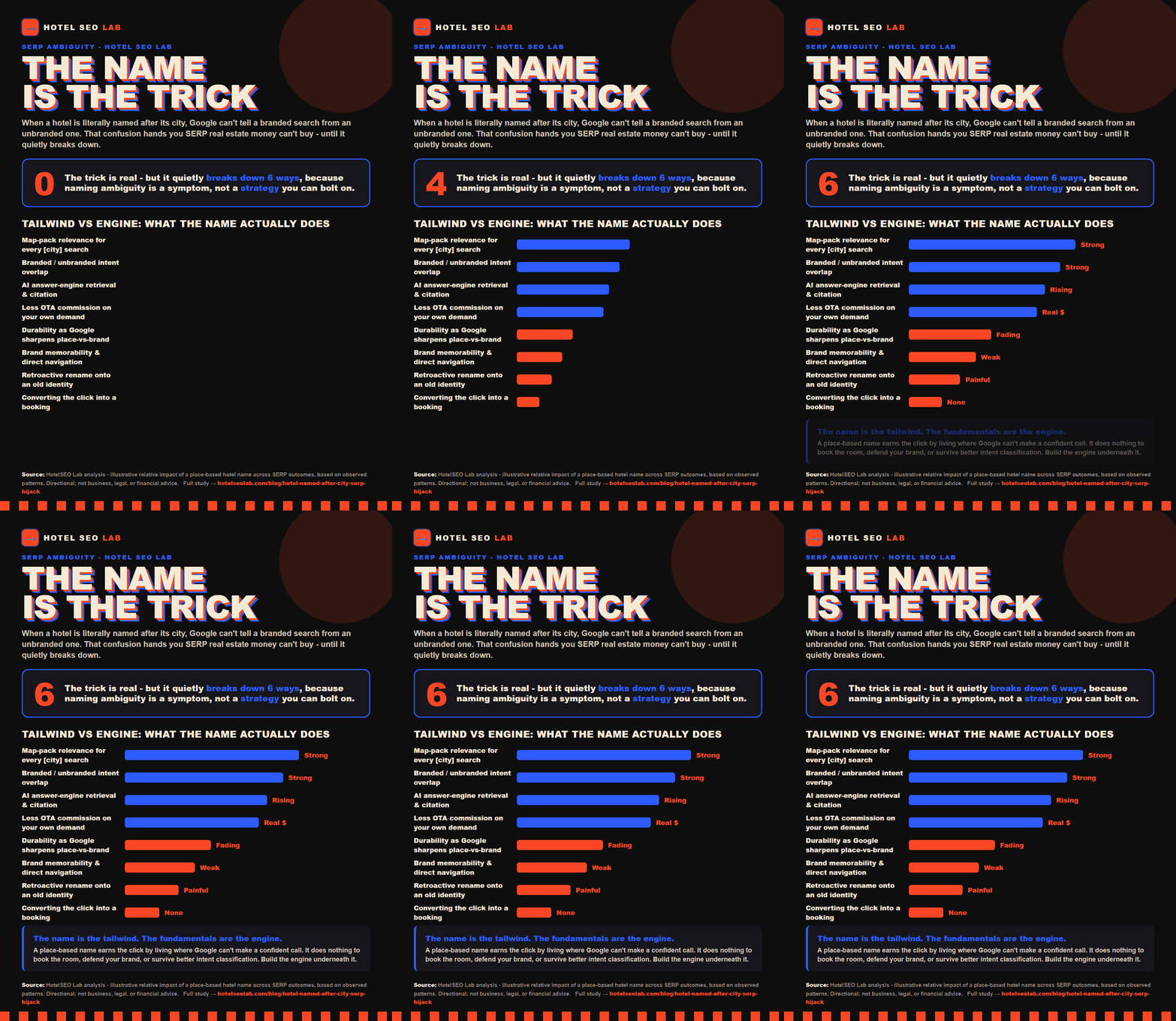
Download this study as a one-page PDF
I want to talk about a naming pattern I keep noticing, because once you see it you cannot unsee it. Some hotels rank at the very top of Google not because they out-optimized everyone, but because their name is basically the answer to the search. When your property is called something like “Hotel [City]” or “The [City] Inn,” Google has a genuinely hard time deciding whether a person searching for that name wants your business specifically or wants the whole destination. And in that confusion, you can end up owning real estate that would normally cost a fortune to compete for.
This is not a growth hack I am telling you to run out and copy. It is an observation about how search intent classification breaks down at the edges, and what independent hotels can honestly learn from it. Let me walk through the mechanics, the upside, and, more importantly, the limits and the risks, because the risks are where most of the interesting stuff lives.
The core ambiguity: branded vs unbranded search
Google spends enormous effort trying to figure out what kind of query you typed. Two of the big buckets are branded search and unbranded search.
A branded query includes a business name. Someone typing “Marriott downtown reservations” is looking for a specific company. Google is confident, so it serves that brand’s own properties near the top, plus its Business Profile, and it does not need to run a wide competitive comparison.
An unbranded query is generic. “Hotels near the convention center” or “boutique hotel [city]” signals that the searcher has no specific property in mind. Google responds with a competitive set, a map pack, ads, and a metasearch bloodbath where the OTAs usually win the click. If you have read our mega-guide on OTA destination landers that rank, you know exactly how brutal that unbranded battlefield is for an independent.
Now collapse those two buckets into one string. If your hotel is literally named after the city, the query “[city] hotel” is simultaneously a plausible branded search for your property and a textbook unbranded search for the whole market. Google cannot cleanly tell them apart. The name itself sits on the fault line between the two intents.
That ambiguity is the whole trick. You are not beating the algorithm. You are living in the one place where the algorithm cannot make a confident call.
Destination-plus-brand naming, illustrated
The cleanest real-world version of this is what I call destination-plus-brand naming: a property positioned around a place name attached to a recognized flag. Consider, as an illustrative example, a property styled along the lines of “Marriott Park City, Autograph Collection.” I am not making any claim about that specific hotel’s tactics or results. I am using the naming shape to show the mechanics.
Look at what that name is doing on the page:
- The place (“Park City”) matches the unbranded destination query that thousands of skiers type every season.
- The flag (“Marriott”) carries trust, familiarity, and a massive entity footprint that Google already understands.
- The collection tag (“Autograph Collection”) adds a distinct, brandable identity so the listing is not a generic chain box.
When someone searches the destination, the listing reads as both the answer to the place query and a legitimate branded result. Google gets to satisfy the ambiguous intent with a single property that plausibly serves both readings. The name is doing SEO work before a single meta tag is written.
Independents can borrow the structure without the flag. “The [Neighborhood] House,” “[Town] Harbor Hotel,” “[District] Guesthouse” — these tie your brand identity to a geographic entity that already has search volume and a place in Google’s knowledge graph.
Why the map pack rewards this even harder
The effect is often stronger in the local pack and on Google Business Profile than in the blue links, and there are a few reasons.
First, the business name is one of the most heavily weighted local ranking signals. This is exactly why fake “[keyword] [city] [service]” business names have been a spam problem for years. A hotel legitimately named after its city gets the keyword-in-name boost without the keyword stuffing, because the name is real.
Second, proximity plus relevance is the local ranking core, and a place-based name maximizes the relevance half for every geographic query in that area. When Google is deciding which three listings to show for “[city] hotel,” a property whose name literally contains the city reads as maximally relevant.
Third, the branded-search halo feeds the profile. When people do search your name directly, those branded searches, direct-to-profile clicks, and driving-direction requests are strong engagement signals. Because your name doubles as the destination term, some of the ambient unbranded demand gets funneled into what looks like branded engagement with your profile. Your Business Profile ends up looking more popular than a same-quality competitor with a generic name. If you want the full profile playbook, we broke it down in the GBP playbook for hotels.
The upside, stated honestly
Here is the genuine, defensible value if your property already carries a place-based name.
You compress the gap between branded and unbranded demand. Every generic destination search becomes a little more likely to surface you, and every direct search for you reinforces your entity strength. Over time that is a compounding advantage that a competitor cannot easily copy without renaming.
You also get a cleaner story for AI answer engines. When someone asks an assistant “where should I stay in [city],” a property whose name is the place is easy for a model to retrieve and cite, because the name and the destination are the same token. We have written about why hotels get left out of these answers in is your hotel invisible to ChatGPT, and naming is one of the quieter factors in getting mentioned. Our AI visibility service exists precisely because this retrieval layer is now where a lot of high-intent discovery happens.
And you lower your dependence on paying the OTA toll for your own demand. If more of the destination query resolves to you organically, fewer of those travelers get intercepted by a metasearch listing where you would otherwise pay commission to win back a guest who was already looking for your city. That is real money — the kind of money we quantify in the book-direct commission math.
Where the trick breaks down
Now the honest part, because I am not here to sell you a loophole.
It does not work retroactively without pain. If your hotel has traded under a different name for a decade, renaming to “Hotel [City]” is not a clean SEO upgrade. Your review history, citations, backlinks, and Business Profile trust are all tied to the current identity. A rename scatters those signals and can cost you rankings for months while the web reconciles the change. The properties that benefit most were usually named this way from the start.
Google keeps getting better at telling place from brand. The ambiguity that powers this is a temporary state of imperfect intent classification, not a permanent law of search. Entity understanding improves every year. Treat any lift from your name as a tailwind, not a foundation.
A generic name can dilute your brand. If your property is called “The [City] Hotel,” you may rank, but you also blend into the destination. Guests may struggle to remember or re-find you, direct-navigation traffic suffers, and you become forgettable in exactly the market you dominate on the SERP. Rankability and memorability are in tension here.
It invites impersonation and confusion. When your name is the destination, competitors, OTAs, and aggregators can build “[city] hotels” pages that look adjacent to you, and travelers can confuse you with civic or tourism entities. You will spend more time defending your identity in the SERP where OTAs already try to intercept your name.
It does nothing for conversion on its own. Ranking for the destination gets the click. It does not book the room. If your booking flow leaks, a keyword-rich name just delivers more traffic to a broken funnel. This is where our book-direct CRO work matters more than the name on the sign.
Trademark and reality checks apply. You cannot always trademark a bare geographic term, cities sometimes push back on official-sounding names, and a name that overpromises the location (“[City] Downtown Hotel” when you are twenty minutes out) invites bad reviews and, in some markets, consumer-protection scrutiny of the kind we cover in the resort-fee and junk-fee law piece.
What to actually do with this
If you are naming or rebranding a property, and only if a rename is genuinely on the table for real business reasons, consider a destination-plus-distinctive structure. Anchor to the place for relevance, then add a distinctive element so you stay memorable and defensible: “[Neighborhood] House,” “The [Landmark] [City],” “[District] Collective.” You get most of the geographic signal without becoming a generic civic noun.
If your property already has a place-based name, lean into it. Make your Business Profile bulletproof, keep your name-address-phone consistent everywhere, publish genuine content and reputation signals that reinforce the place-plus-property entity, and make sure your booking path converts the traffic your name earns you. The name is the tailwind; the fundamentals are the engine. Aparthotels and extended-stay operators can play this especially well, which we get into in the extended-stay marketing guide.
And if your name is generic and forgettable, do not panic and rename. You can build entity strength around a strong distinct brand too. Renaming purely to chase this pattern usually costs more trust than it buys.
Reminder: this is directional opinion based on observed patterns and public information at the time of writing, and it may be out of date. Illustrative examples are not claims about any named company’s strategy or results. We are not affiliated with Marriott, Autograph Collection, or any brand mentioned. Search behavior and Google’s intent classification change constantly. Nothing here guarantees a ranking outcome, and none of it is business, legal, or financial advice. Validate anything material against your own data and, where relevant, professional counsel.
How we got this: this piece contains no proprietary metrics. It is a qualitative read on publicly observable SERP and Business Profile behavior, informed by our hands-on work with independent hotels. Any patterns described are third-party observations subject to change and independent validation.
The naming trick is real, but it is a symptom of an ambiguity, not a strategy you can bolt on. If you want a straight read on whether your property’s name is helping you, hurting you, or wasting an advantage you already have, book a session with us and we will look at it with you.