
Type your hotel’s exact name into Google right now. On a phone. Not from your office Wi-Fi where you’re logged into everything — use an incognito window or ask a friend across town.
What’s the first thing a ready-to-book traveler actually sees? If the honest answer is a Booking.com ad, an Expedia listing, and a metasearch box before your own website, you have a branded-search problem. And it’s the most expensive kind, because these people already decided they want you. They typed your name. The OTAs are just standing at your front door taking a cut of guests who were walking in anyway.
This is winnable. Branded search is the one battlefield where you have structural advantages the OTAs can’t copy: you own the name, the trademark, the property, and the ability to send the strongest relevance signals Google trusts. Here’s the step-by-step playbook to take page one back.
The goal isn’t to “beat the OTAs at SEO.” It’s to make sure that when someone searches your name specifically, the cheapest-to-you booking path is also the easiest one for them to find. That’s a fight you can win with a weekend of setup and a small monthly budget.
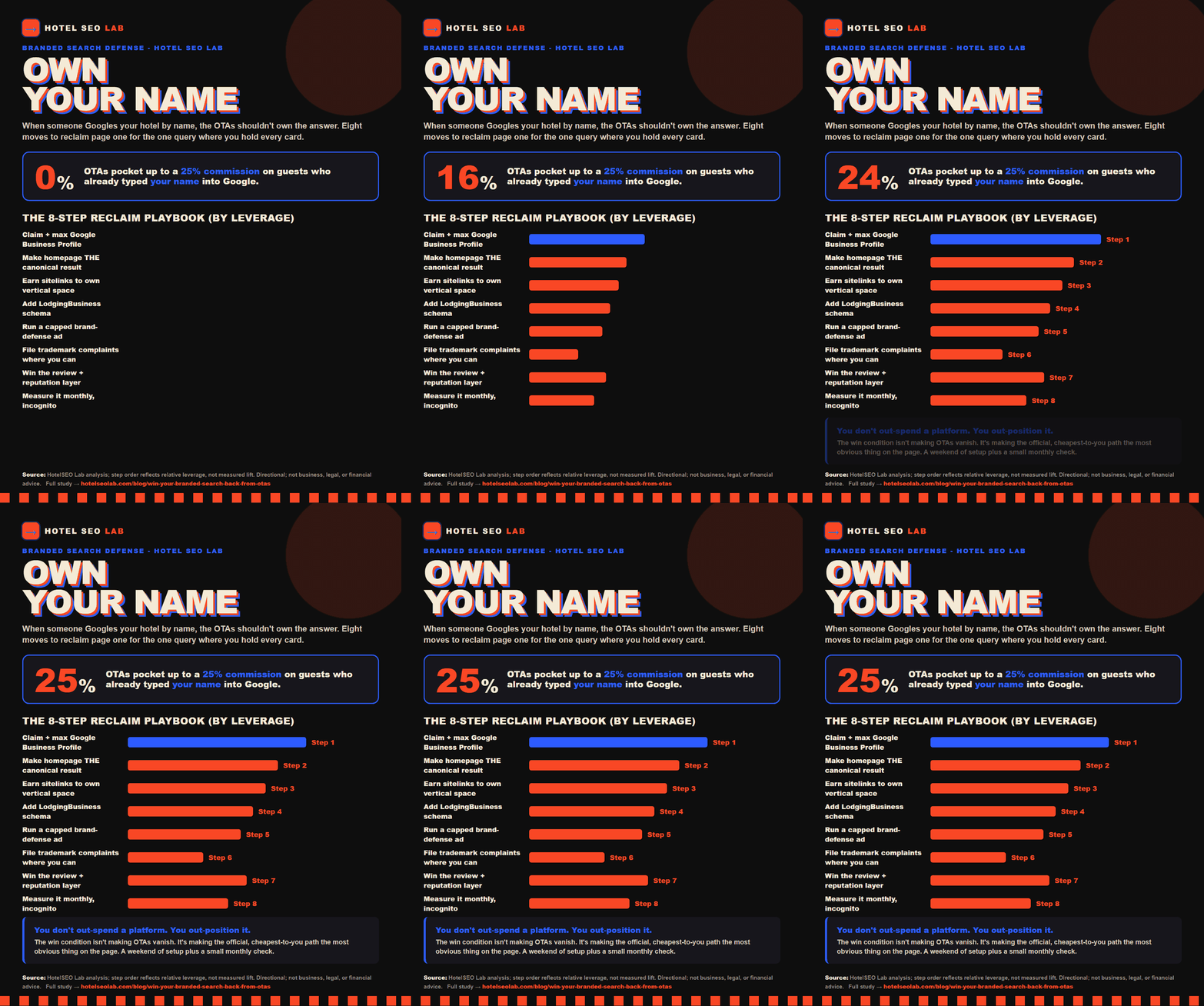
Download this study as a one-page PDF
First, understand what you’re actually fighting
Branded search — someone searching “[your hotel name]” or “[your hotel name] rooms” — is different from generic search like “boutique hotel [your city].” For generic terms, OTAs have a legitimate content and authority advantage that takes real work to challenge (that’s a longer game we cover in the OTA destination landers mega-guide).
But on your own name, the OTAs are essentially free-riding. They spend almost nothing to appear — Google already knows Booking.com is relevant to your property because they list you — and they intercept demand you created through every other channel: your Instagram, that magazine feature, the guest who told a friend. The traveler does the searching; the OTA collects the 15 to 25 percent commission. If you want the real math on what that costs you per booking, we broke it down in the book-direct math piece.
So branded search defense has two fronts:
- Organic + profile dominance — own the free real estate so completely that the official path is unmissable.
- A light paid shield — sit above OTA ads on your own name so you’re not intercepted at the top of the page.
Let’s do it in order.
Step 1: Claim and max out your Google Business Profile
For a big share of branded searches, especially on mobile, the Google Business Profile panel is the result. It’s the boxed panel on the right on desktop and the top card on mobile. Whoever controls what that panel says and where its buttons point controls the booking.
Do this:
- Verify ownership. If you’ve never claimed it, someone else’s data (or an OTA feed) may be shaping it. Claim it.
- Set the website field to your official site. This sounds obvious. It is astonishing how many independents have a metasearch or OTA URL sitting in that field.
- Fill everything. Categories, hours, amenities, description, high-quality photos, the whole thing. A thin profile invites Google to pull in third-party data you don’t control.
- Watch the “Book” / “Reserve a room” button. Google may populate booking links from connected partners — and those often route to OTAs. Connect your direct booking engine as a partner where possible so the button sends traffic to you.
The full sequence lives in our Google Business Profile playbook for hotels. Get this right before anything else; it’s the highest-leverage single move.
Step 2: Make your homepage unmistakably the result
Google needs zero doubt that yourhotelname.com is the canonical, authoritative home for “your hotel name.” Usually it already ranks you first organically — but “first organic” can still sit below three OTA ads and a map pack. Your job is to make the organic listing so strong it earns rich treatment.
- Title tag: Lead with your exact hotel name, then a short descriptor and city. Example pattern: “The Ledbury Hotel — Boutique Rooms in [your city].” Don’t bury the name behind marketing fluff.
- Homepage H1 and copy should state the name, location, and property type in plain language. This is also what AI assistants read when they answer “tell me about [your hotel]” — and yes, that matters now; see is your hotel invisible to ChatGPT.
- One canonical homepage. No duplicate http/https or www/non-www versions competing. Pick one, redirect the rest.
Step 3: Earn sitelinks so your listing owns more vertical space
Sitelinks are those indented sub-links under your main result — Rooms, Restaurant, Offers, Contact, Book Direct. You can’t force them, but you make yourself eligible, and when they appear they push OTA listings physically down the page and give the searcher direct routes into your site.
To become eligible:
- Clear, crawlable site navigation with descriptive anchor text: “Rooms & Suites,” “Dining,” “Offers,” “Book Direct” — not “Discover” or “Experience.”
- A logical URL structure — /rooms, /dining, /offers — that mirrors that nav.
- Strong internal linking from the homepage to your key pages. Your homepage should link prominently to your rooms, offers, and a dedicated “Book Direct” page.
- Submit an XML sitemap in Search Console so Google sees the full architecture.
A “Book Direct” landing page is worth building deliberately — it’s the page you want people to reach, and it’s a natural conversion surface. Pair it with the tactics in our book-direct CRO service so the traffic you reclaim actually converts instead of bouncing back to a comparison tab.
Step 4: Add structured data so Google (and AI) render you richly
Schema markup is how you hand Google machine-readable facts instead of hoping it guesses right. For a hotel, add structured data using the Hotel or LodgingBusiness type, including:
- Name, address, phone (matching your GBP exactly — consistency is a ranking and trust signal),
- Geo-coordinates, star/amenity info, price range,
- sameAs links pointing to your official social profiles,
- Aggregate rating, only if it’s genuinely from your own review process and compliant with Google’s guidelines — don’t fake it.
Add Organization or LodgingBusiness schema on the homepage and, if relevant, FAQ schema on pages answering common booking questions. This is also increasingly what feeds AI answer engines, which are becoming a real branded-discovery surface — more on that in our AI visibility (AEO/GEO) service and the FlipTo / Spacetime sleeping-giant piece on structured guest data.
Validate everything with Google’s Rich Results Test before you call it done. Broken schema helps no one.
Step 5: Run a light brand-defense ad — and cap it hard
Here’s the uncomfortable truth: even with perfect organic and a flawless profile, if OTAs are buying your name in Google Ads, the entire paid block sits above your organic listing. A searcher who already wants you can tap a Booking.com ad before they ever scroll to your free result.
The fix is a deliberately small brand-defense campaign:
- Exact-match on your brand terms only — “[your hotel name],” “[your hotel name] rooms,” “[your hotel name] book.” Nothing generic.
- Tight negative keywords so you don’t bleed into unrelated queries.
- A cap you can live with. Brand clicks are cheap because your Quality Score on your own name is high. This is typically one of the highest-ROAS lines in the entire account.
- Ad copy that OTAs can’t match: “Official Site — Best Rate Guaranteed,” free cancellation, direct-booking perks, the phone number.
Is it slightly annoying to pay for clicks you might have gotten free? Yes. But when OTAs are in the auction, the incremental margin you protect by sitting at the very top usually dwarfs the spend. Test it honestly: pause the campaign for two weeks, watch what happens to direct bookings, and let the data decide. If no one’s bidding on your name, don’t run it — pocket the money and re-check monthly.
Step 6: Fix the trademark angle where you can
You generally can’t stop an OTA from bidding on your name as a keyword — the keyword auction is fair game. But trademark law does protect your name inside the visible ad. If an OTA is using your exact hotel name in their ad headline or display URL in a way that implies they’re the official site, you can file a trademark complaint through Google Ads. It won’t stop the bidding, but it can force them to strip your name out of the visible copy, which weakens the ad’s pull.
Keep expectations realistic. This is a nudge, not a knockout. Your paid shield from Step 5 does more.
Step 7: Win the review and reputation layer
When someone searches your name, Google frequently surfaces a reviews snapshot and pulls in review-driven content. If your rating is thin or stale, that vacuum gets filled by OTA review counts — reinforcing them as the “trusted” place to book.
- Actively earn Google reviews. Volume and recency both matter for what shows in your panel.
- Respond to reviews — it signals an engaged operator and gives Google fresher content tied to your name.
- Keep your own site’s content current — an updated offers page, a recent blog post, seasonal info. Fresh, name-relevant content strengthens your organic footprint. Our content and reputation service is built around exactly this loop.
A strong first-party review presence also feeds the AI answer engines that increasingly summarize “is [your hotel] any good” — closing another door the OTAs would otherwise walk through.
Step 8: Measure it like you mean it
You can’t defend what you don’t watch. Track:
- Branded impression share in Google Ads — are you actually appearing on your own name, and who’s above you?
- Direct vs. OTA booking mix month over month.
- Search Console for branded query clicks and average position.
- A monthly incognito eyeball test from a phone, off your own network. Screenshot it. Watch how the page-one layout shifts over time.
If you run an aparthotel or extended-stay property, branded defense matters even more — those guests research longer and comparison-shop harder; see aparthotel and extended-stay marketing.
The honest bottom line
You will probably never make the OTAs vanish from your branded results entirely — and you don’t need to. The win condition is simpler: when someone searches your name, the official, cheapest-to-you path is the most obvious thing on the page. Profile locked down, organic listing rich with sitelinks, schema clean, a small ad sitting above the OTA bids, reviews fresh.
None of this requires a huge budget. It requires doing the boring things correctly and checking them monthly, because the OTAs never stop testing. This is insurgent work: you don’t out-spend a platform, you out-position it on the one query where you hold every structural card. For the bigger picture on how OTAs siphon search demand — and where else you can claw it back — read how OTAs steal search.
Want a second set of eyes on your branded SERP and a prioritized fix list? Book a call and we’ll run the incognito test with you and map exactly where you’re leaking. You can see what that looks like on our pricing page first if you’d rather.