
Let me be honest with you before we start: a brand-new independent hotel does not rank in 90 days for the terms you actually want. If someone pitched you a “guaranteed page one in three months” package, they either don’t understand hotel search or they’re counting on you not to.
What you can do in 90 days is build the entire foundation correctly, capture the demand that’s already searching for your name, and plant every seed that pays off in months four through twelve. That is a genuinely valuable outcome, and most new hotels get it wrong by either doing nothing (just handing everything to the OTAs) or doing everything in the wrong order.
This is the plan I’d run for a new property with zero domain authority, zero reviews, and zero rankings. It’s organized in three 30-day phases. Follow it in order. The sequencing matters more than the individual tactics.
The uncomfortable truth about new-hotel SEO: your competitors have 5 to 15 years of domain age, review volume, and backlinks. You cannot out-authority them in a quarter. You win by being unmistakably relevant, technically flawless, and present in the places they’ve ignored, especially the AI answer engines.
Download this study as a one-page PDF
Before day one: the two decisions that shape everything
Two things need to be locked before you touch a single tactic.
Your domain. Use your real hotel name on a clean, brandable domain. Do not build your primary site on a management-company subdomain or a builder-hosted URL you don’t own. If your property was a different hotel before, and the old domain still resolves, capture it and 301-redirect it to your new one. Inherited domain history is one of the few authority shortcuts a “new” hotel legitimately gets.
Your channel reality. You are going to lean on OTAs in month one because they have the authority you don’t. That’s fine. But go in with eyes open about what it costs. Run the numbers in our book-direct math breakdown so you know exactly what every commissioned booking is costing you, and understand how OTAs out-rank you for your own destination terms. The 90-day plan is designed to start clawing that channel mix back, not to pretend the OTAs don’t exist.
Phase 1 (Days 1–30): Foundation and the fastest wins
Month one is not about ranking for competitive terms. It’s about existing correctly and grabbing the visibility that’s genuinely available to a new property fast.
Week 1: Technical and structural setup
- Stand up a fast, crawlable site. Core Web Vitals matter, but for a new site the bigger risks are the boring ones: pages blocked in robots.txt, a staging site left set to noindex, broken canonical tags, or a JavaScript booking widget that hides your room content from crawlers. Get a clean crawl before you get a pretty one.
- Lock your NAP. Name, address, phone must be byte-for-byte identical everywhere: website footer, Google Business Profile, every directory. Inconsistency here quietly poisons local ranking for months.
- Install analytics and Search Console on day one. You cannot manage what you can’t see, and Search Console’s index-coverage data is your early-warning system for the technical problems above.
Week 2: Google Business Profile, your single highest-return asset
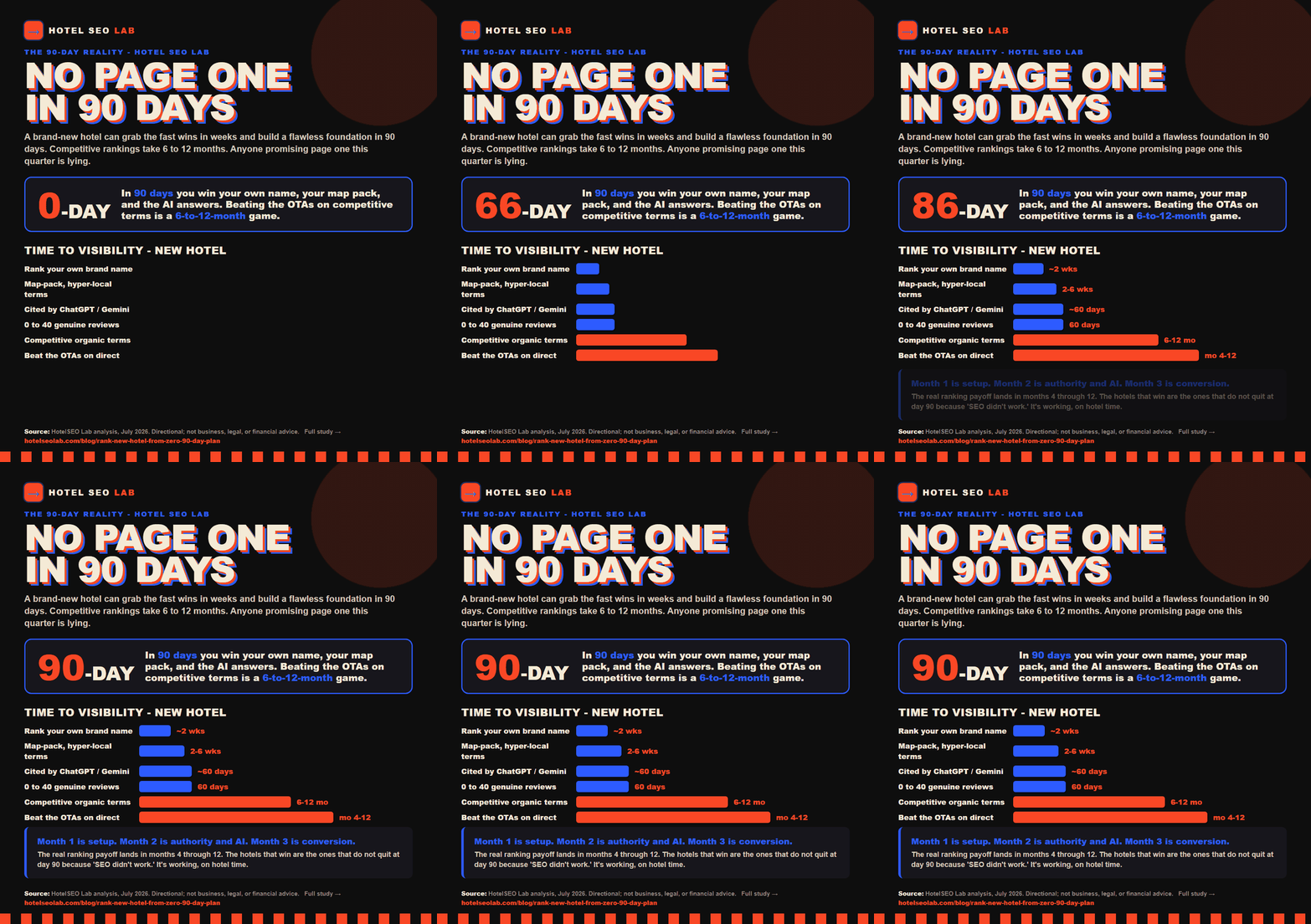
For a brand-new hotel, nothing returns faster than a fully built Google Business Profile. Map-pack presence for your own name and immediate area can show up in 2 to 6 weeks, long before organic does anything.
- Claim and verify (video verification is common for hotels now, so budget a few days).
- Choose the correct primary category (Hotel) and honest secondary categories (Boutique Hotel, Extended Stay Hotel, etc.).
- Load 20+ real, high-quality photos: exterior, lobby, every room type, amenities. Properties with strong photo sets get materially more engagement.
- Fill every field: amenities, check-in and check-out times, booking link (point it to your direct booking engine), and accessibility details.
Our GBP playbook for hotels walks the whole thing step by step. Do not treat this as a set-and-forget task; it becomes a weekly habit in Phase 2.
Weeks 3–4: The pages that must exist and be excellent
Build the core money pages first. For a new hotel that’s a short, non-negotiable list:
- Homepage — clear on what you are, where you are, and who you’re for.
- Every room-type page — one page per room type, real photos, honest descriptions, specific amenities.
- Location / neighborhood page — what’s around you, how to get there, why your block matters.
- A genuinely useful “things to do / area guide” page — this is your first real SEO play and your first AI-citation bait.
That last one matters more than new hoteliers expect. You will not out-rank Booking.com for “hotels in [your city]” this quarter. But you can become the best answer for the long-tail, intent-rich questions the big players write generic filler about: “quietest neighborhood to stay in [your city],” “hotels near [specific venue] with free parking,” “where to stay in [your city] for a first anniversary.” The OTAs win the head terms; specificity is the crack in their armor. Our mega-guide on destination landers that actually rank is the model to copy.
Phase 2 (Days 31–60): Authority, reviews, and getting into the AI answers
The foundation exists. Now you start compounding.
Reviews become a system, not an afterthought
Reviews are the single biggest lever a new hotel has that money can’t fully buy. You need volume, recency, and velocity.
- Build a post-stay review request into checkout and your confirmation emails. A short, human ask at the right moment beats a generic blast.
- Respond to every review, positive and negative, within 48 hours. Response rate is a visible signal and a conversion driver.
- Do not buy reviews. Ever. The downside risk is existential and the AI engines are getting better at sniffing out inauthentic review patterns.
A new hotel that goes from 0 to 40 genuine reviews in 60 days changes its trajectory more than almost any on-page tweak.
Get cited by ChatGPT, Gemini, and Perplexity
Here’s the shift most independent hotels haven’t clocked yet: a growing share of “where should I stay in [your city]” research now happens inside AI assistants, and those engines are often easier for a new property to break into than Google’s crowded organic results, because they reward structured, specific, extractable facts over raw domain age.
Ask yourself the question we put to every operator: is your hotel invisible to ChatGPT? In Phase 2 you make sure the answer is no.
- Add structured data (Hotel and LodgingBusiness schema) with accurate name, geo, amenities, price range, and star rating.
- Write clear, factual, extractable copy. AI engines quote specifics: “8-minute walk to the train station,” “pet-friendly with no fee,” “24-hour front desk.” Vague mood-copy doesn’t get cited.
- Build a thorough FAQ on your site answering the real questions guests ask. This is some of the most AI-liftable content you can publish.
- Make sure third-party data about you is consistent and rich, because the AI engines lean heavily on aggregated sources. There’s a real, underrated data-signal advantage in platforms like Flip.to and how they feed the AI layer.
This is the core of our AI visibility (AEO/GEO) work, and it’s where a nimble new hotel can genuinely leapfrog incumbents who are still treating “SEO” as a 2018 checklist.
First links and local relevance
You don’t need a thousand backlinks. You need a handful of relevant, real ones:
- Local tourism board, chamber of commerce, and “official” city visitor sites.
- Genuine partnerships: nearby restaurants, the wedding venue down the street, tour operators.
- Any legitimate press from your opening. A hotel launch is a news event; use it once, properly.
Quality and local relevance beat volume every time at this stage.
Phase 3 (Days 61–90): Conversion, content depth, and measurement
By now you rank for your own name, you’re accumulating reviews, you’re appearing in some AI answers, and your foundation pages are indexed. Phase 3 is about making that traffic convert and setting up the compounding engine for months four onward.
Fix the leaks before you pour in more traffic
Driving traffic to a booking flow that leaks is how new hotels waste their whole marketing budget. Make sure your direct-booking conversion path is genuinely competitive:
- Rate parity: if your direct price is higher than the OTA price for the same room, you will lose, and you’ll have taught guests to distrust your site.
- Kill surprise fees at the last step. Beyond conversion, junk-fee and resort-fee rules increasingly require honest all-in pricing anyway, and vague occupancy-tax handling at checkout is another trust-killer. Show the real total early.
- Make the “Book Direct” reason obvious: best-rate guarantee, free perk, flexible cancellation. Give people a concrete reason not to bounce to an OTA.
Deepen the content that will rank in month 6
Publish 2 to 4 more genuinely useful pieces that target the specific, intent-rich searches you can eventually own. Seasonal guides, neighborhood deep-dives, event-tied content (“where to stay for [annual local event]”). If you’re an extended-stay or apart-hotel property, there’s a whole underserved demand pool with its own marketing and search playbook worth targeting now. This is the content that won’t move this quarter but will be indexed, aged, and ready to rank when it counts. Our full hotel SEO service and content and reputation work is built around this compounding model.
Measure honestly and set realistic 6-month targets
At day 90, here’s a realistic scorecard for a well-run new hotel:
| Metric | Realistic at Day 90 | Not realistic at Day 90 |
|---|---|---|
| Ranking for your brand name | Yes, top result | (this is table stakes) |
| Map-pack for hyper-local terms | Emerging / present | Dominating the pack |
| Reviews | 30–60 genuine ones | Hundreds |
| AI-engine citations | Appearing for some specific queries | Default answer for “hotels in [your city]“ |
| Competitive organic terms | Indexed, ranking pages 3–8 | Page one |
| Direct-booking share | Slowly rising off zero | Beating the OTAs |
If your agency’s day-90 report shows you “dominating” competitive terms, be skeptical, not thrilled. Either they’re measuring vanity keywords nobody searches, or something unsustainable is going on.
The 90-day mindset: month one is survival and setup, month two is authority and AI, month three is conversion and compounding. The real ranking payoff lands in months four through twelve. The hotels that win are the ones that don’t quit at day 90 because “SEO didn’t work.” It’s working; it’s just on hotel time, not startup time.
The one-line summary
Claim and max out your Google Business Profile, build technically flawless room and neighborhood pages, systematize genuine reviews, get yourself structured and specific enough to be cited by the AI engines, fix your direct-booking leaks, and keep publishing the specific content the OTAs are too lazy to write. Do it in that order. Don’t expect page one this quarter, and don’t trust anyone who promises it.
If you want a second set of eyes on your launch plan, or you’d rather hand the 90-day build to people who run it for independents every week, book a call with us and we’ll tell you honestly where the fastest wins are for your specific property.