Directional analysis, not gospel. This piece reports a 60-query snapshot of Google’s AI Overview captured at one moment in time on US desktop and mobile. AI Overview presence and the sources it cites change constantly and vary by query wording, location, and device. The figures below are a count of what appeared in that snapshot, not a stable measurement of Google’s behavior. We are not affiliated with, endorsed by, or paid by Google, Reddit, any OTA, or any company named here. Nothing below is business, legal, or financial advice. Verify against your own market before acting.
Download this study as a one-page PDF
I wanted to answer one uncomfortable question with actual data instead of a hunch: when a traveler searches for a hotel and Google’s AI writes them an answer, who does that answer send them to?
So I ran 60 realistic hotel searches through the live Google results, waited for the AI Overview to load, and read every single source it cited. Not the blue links underneath. The sources inside the AI answer itself, the little reference chips the model uses to back up what it just told the guest.
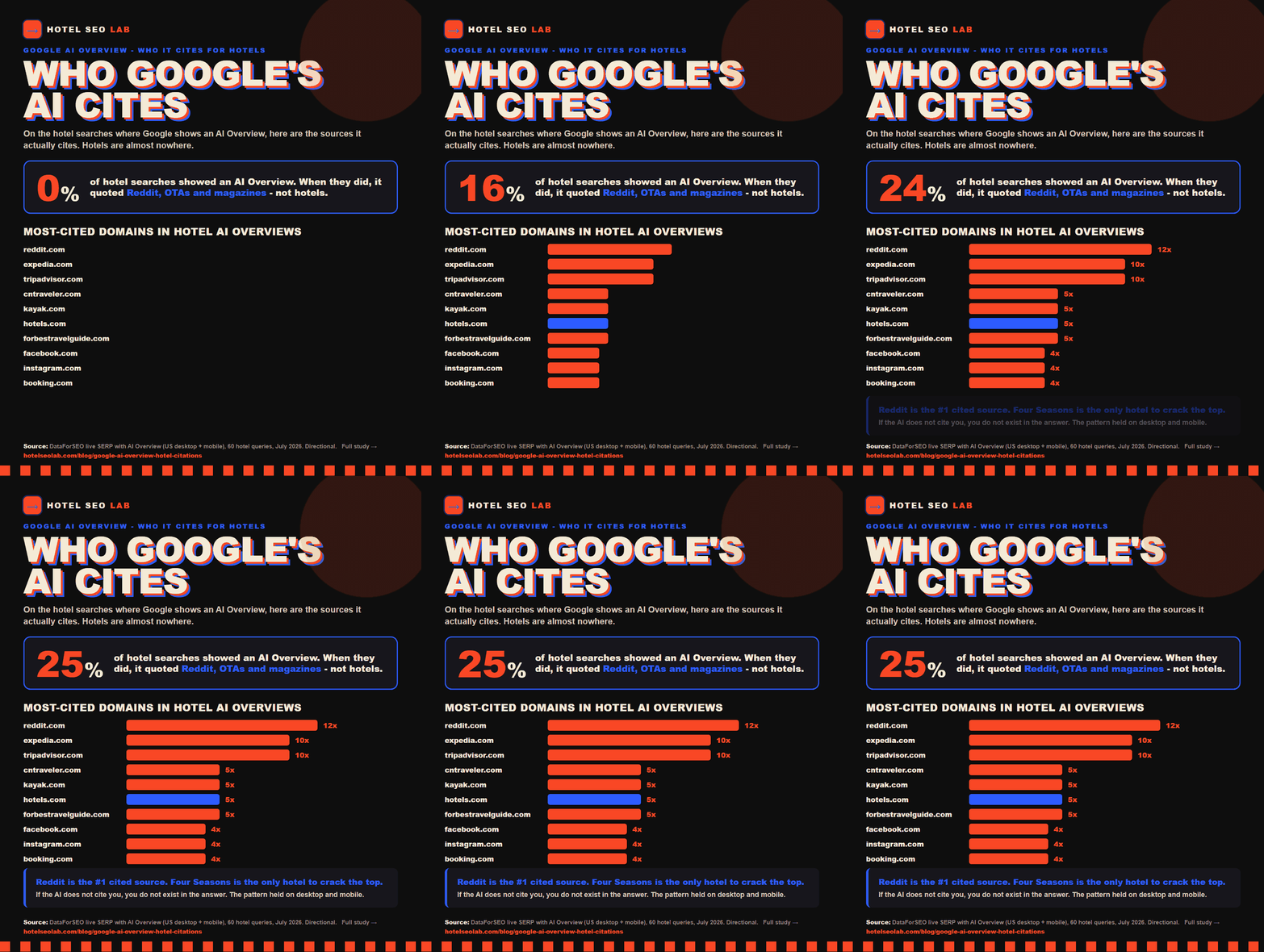
Here is the short version, and it should bother every independent hotelier reading this. When Google’s AI answered a hotel question, it handed the guest a Reddit thread more than anything else. Then an OTA. Then TripAdvisor. Then travel magazines. Actual hotels, the businesses the traveler is literally trying to book, were nearly invisible. Across every source cited in every AI Overview I read, exactly one recognizable hotel brand cracked the top of the list, and it was Four Seasons.
Your guest asked about hotels. Google’s AI answered with everyone except the hotels.
How I got this data
Let me be precise about the method, because the number 25 percent is going to get quoted and I want the caveats stapled to it.
The source is DataForSEO’s live SERP API with AI Overview loading enabled. That is the same class of tool an agency uses to pull real Google results programmatically. Live SERP means it fetches an actual Google search results page in real time rather than reading from a cache, and the AI Overview loading option tells the API to wait for and expand the AI Overview block so its contents, including the citation links, come back in the response. Without that expansion step you frequently miss the AI Overview entirely, because Google lazy-loads it.
Here is exactly what I pulled:
- 60 queries on US desktop, plus the same 60 re-run on US mobile, English, one capture per query per device.
- Three query templates: “best hotels in [city]”, “family friendly hotels in [city]”, and “cheap hotels in [city]”.
- 20 US cities, chosen to mix obvious leisure magnets and mid-size markets: New York, Orlando, Las Vegas, Los Angeles, Miami, Chicago, San Francisco, New Orleans, Nashville, Austin, San Diego, Seattle, Denver, Boston, Washington DC, Atlanta, Savannah, Charleston, Gatlinburg, and Myrtle Beach.
- For each query I recorded two things: whether an AI Overview appeared at all, and if it did, the full list of domains it cited.
- Then I bucketed every cited domain into a category: OTA and metasearch, travel media and review sites, hotel brands, and everything else.
The entire pull cost 12.2 cents in API credits. That is not a typo. Sixty live Google captures with AI Overview expansion, for the price of nothing, which is part of why I think more hoteliers should be watching this surface directly instead of taking anyone’s word for it.
One honest limitation up front: this is a snapshot. It is one capture of each query at one moment. AI Overviews are volatile. Run the same 60 queries next week and you will get different presence and different citations. So treat every number here as directional evidence of a pattern, not a precise constant.
I checked mobile, too. The obvious objection to any desktop study is that most hotel search now happens on a phone, so I re-ran the same 60 queries on US mobile. An AI Overview appeared on 10 of 60 mobile searches, about 17 percent — a little less often than the 25 percent I saw on desktop. But when it did appear, the cast was identical: OTAs and metasearch led the citations, Reddit and travel media filled the rest, and hotel brands were nearly absent again, with only three brand citations across the entire mobile set. I would not overread the desktop-versus-mobile presence gap, because both are volatile snapshots and could swap next week. The durable finding is the one that held on both devices: whatever screen your guest is holding, Google’s AI answer hands them Reddit, OTAs and magazines, not your hotel.
Finding one: the AI Overview showed up on one in four hotel searches
Of the 60 hotel searches, 15 triggered an AI Overview. That is 25 percent. Exactly one in four.
| Metric | Value |
|---|---|
| Total queries run | 60 |
| Queries that returned an AI Overview | 15 |
| Share with an AI Overview | 25% |
| Queries with no AI Overview | 45 |
Now, 25 percent might sound modest, like something you can ignore for a while longer. I would read it the other way. A quarter of high-intent hotel searches already get an AI-written answer sitting above the organic results, and that share has only moved in one direction since these features launched. The question is not whether this becomes the default surface for hotel discovery. It is how fast, and whether you are cited when it does.
The presence was also lumpy in a telling way. The AI Overview loved the “best hotels in [city]” and “cheap hotels in [city]” framings, and it fired especially in bigger or more search-heavy markets. It skipped a lot of the “family friendly” variants and several mid-size cities entirely. Which means the exact wording a guest types materially changes whether they see an AI answer at all. That volatility is not a bug in my data. It is the actual behavior, and it is why nobody should treat AI Overview presence as stable.
Finding two: Reddit is the most-cited source for your guest’s hotel search
This is the finding I keep coming back to. Here are the domains Google’s AI cited most across those 15 AI Overviews.
| Rank | Domain | Times cited | What it is |
|---|---|---|---|
| 1 | reddit.com | 12 | Social / forum |
| 2 | expedia.com | 10 | OTA |
| 2 | tripadvisor.com | 10 | Travel media / reviews |
| 4 | cntraveler.com | 5 | Travel media |
| 4 | kayak.com | 5 | Metasearch |
| 4 | hotels.com | 5 | OTA |
| 4 | forbestravelguide.com | 5 | Travel media |
| 8 | facebook.com | 4 | Social |
| 8 | instagram.com | 4 | Social |
| 8 | booking.com | 4 | OTA |
| 11 | youtube.com | 3 | Social / video |
| 11 | travelocity.com | 3 | OTA |
| 11 | fivestaralliance.com | 3 | Travel media |
| 14 | fourseasons.com | 2 | Hotel brand |
| 14 | momondo.com | 2 | Metasearch |
| 14 | agoda.com | 2 | OTA |
| 14 | trivago.com | 2 | Metasearch |
| 14 | orbitz.com | 2 | OTA |
| 14 | afar.com | 2 | Travel media |
| 14 | foratravel.com | 2 | Travel media |
| 14 | thehotelguru.com | 2 | Travel media |
| 14 | travel.usnews.com | 2 | Travel media |
Read that top row again. The single most-cited source Google’s AI used to answer hotel searches was Reddit, at 12 citations. Not an OTA. Not a hotel. A forum where strangers argue about which Vegas casino has the least depressing rooms.
Then the OTA and metasearch bloc: Expedia at 10, Kayak and Hotels.com at 5 each, Booking at 4, Travelocity at 3, then Momondo, Agoda, Trivago, and Orbitz trailing behind. And the travel media bloc: TripAdvisor at 10, Conde Nast Traveler and Forbes Travel Guide at 5 each, Five Star Alliance at 3, then AFAR, Fora Travel, The Hotel Guru, and US News rounding it out. Social platforms show up too, with Facebook and Instagram at 4 each and YouTube at 3.
And the hotels? Four Seasons, twice. That is the only recognizable hotel brand anywhere near the top of the list. Marriott appears once, buried. Everyone else in the cited set is either an individual property that happened to get name-checked in a single city’s answer, a local tourism board, or a personal travel blog.
Finding three: sort the citations by type and the picture gets worse
I bucketed every citation across all 15 AI Overviews. This counts total citations, so a domain cited in three different AI Overviews counts three times.
| Category | Total citations | Examples |
|---|---|---|
| Other (local guides, blogs, tourism boards, Q&A) | 79 | visitmyrtlebeach.com, austintexas.org, neworleans.com, personal travel blogs |
| OTA and metasearch | 43 | Expedia, Kayak, Hotels.com, Booking, Travelocity, Momondo, Agoda, Trivago |
| Travel media and reviews | 22 | TripAdvisor, Conde Nast Traveler, Forbes Travel Guide, AFAR, Five Star Alliance |
| Hotel brands | 21 | Individual property sites, with Four Seasons the only repeat major brand |
The “other” bucket is the biggest, and it is worth understanding what is in it: destination marketing sites like visitmyrtlebeach.com and austintexas.org, city tourism portals, and a long tail of personal travel blogs and Q&A pages. In other words, even the largest slice is not hotels. It is intermediaries and enthusiasts describing hotels.
The hotel-brand bucket at 21 looks almost respectable until you open it. Almost all of those 21 are individual property websites that got cited in exactly one city’s answer, typically a specific luxury or boutique property the model name-checked once. There is no chain or brand systematically showing up across markets except Four Seasons, and even that is only twice. Strip out the one-off single-property mentions and the durable hotel presence in Google’s AI answer layer rounds to almost nothing.
So the guest asks “best hotels in Charleston,” and the AI answers using Orbitz, Five Star Alliance, Vogue, TripAdvisor, Kayak, Conde Nast Traveler, Reddit, Forbes Travel Guide, and a travel agency blog. Two actual Charleston hotels get a nod. The other dozen sources are everybody who writes about hotels for a living, plus Reddit.
The contrarian takeaway: ranking was the old game
Here is the part that reframes everything. For twenty years the entire SEO industry, mine included, taught hotels to obsess over ranking. Get to page one. Get above the OTA. Win the blue link.
The AI Overview does not care about your blue link. It sits above all of them, writes a paragraph, and cites a handful of sources it decided were credible enough to quote. If you are not one of those sources, the guest can get a complete recommendation, a short list of options, and a mental model of the market without your website existing in their world at all. You can rank number three organically and still be completely absent from the answer the guest actually reads.
That is the shift from search-engine optimization to answer-engine optimization, sometimes called AEO or GEO. The unit of victory is no longer the ranking position. It is the citation. And the data says the entities winning citations in hotel searches are Reddit threads, OTAs, and travel magazines, precisely the intermediaries that independent hotels have spent a decade trying to reduce their dependence on. The AI answer layer is quietly rebuilding that dependence, one citation at a time.
This is the same disintermediation risk I have been flagging in Is Your Hotel Invisible to ChatGPT, except now I can point at a live Google surface and show you exactly who gets quoted instead of you.
The honest caveats, stated plainly
I would be doing exactly the thing I criticize other people for if I let those tables stand without a firm set of caveats. So here they are, in plain language.
This is 60 queries, once. It is a snapshot, not a census. One capture per query, one moment in time. It is enough to see a strong pattern, Reddit and OTAs dominating while hotels vanish, but it is not enough to publish a decimal-point-precise law about Google’s behavior. Do not quote these numbers as if they are stable constants.
AI Overview presence is volatile. The 25 percent figure will not replicate exactly if you rerun this. Google toggles the AI Overview on and off by query, tests aggressively, and personalizes. Presence varies by exact wording, location, device, and the phase of the moon as far as anyone outside Google can tell. Twenty-five percent is a reading, not a promise.
US only, two devices. I tested both US desktop and US mobile, and the pattern held on both — OTAs, Reddit and travel media dominate the citations while hotels vanish. But this is still one country, logged out, at one moment. Other countries differ, and logged-in versus logged-out differs. I did not test those. Do not extrapolate to the whole world from a US sample.
The citation tally counts reference links, not influence. I counted the domains listed as sources inside each AI Overview. I did not, and cannot from this data, measure how heavily the model actually weighted each source when it wrote the prose. A cited link is evidence the model consulted a source. It is not proof of how much that source shaped the answer.
Bucketing involves judgment. Sorting domains into OTA, media, hotel, and other required calls. TripAdvisor is arguably both media and an OTA-adjacent booking surface; I filed it under media because that is its research role. Reasonable people would bucket a handful of these differently. The headline pattern survives any reasonable reshuffling, but the exact bucket totals are not sacred.
If someone shows you AI Overview data without a caveats section at least this long, be suspicious. This surface is too volatile to report honestly without one.
What to actually do about it
You cannot game your way into a Google AI citation, and I am not going to pretend there is a five-step hack. But the data points at a coherent strategy, and it is the opposite of the old ranking playbook.
Get discussed where the AI already looks. Reddit was the single most-cited source in this entire study. That is not an invitation to spam subreddits, which will get you banned and cited by no one. It is a signal that genuine, organic conversation about your property in the places real travelers gather is now a discovery channel, because the AI reads those places and quotes them. Earning honest mentions in travel media and being a property people actually talk about is no longer a vanity metric. It is citation fuel.
Make your own content trivially extractable. The AI cites sources it can read cleanly and trust. That means clear, factual, well-structured pages on your own site: unambiguous descriptions of who the hotel is for, what makes it different, concrete amenities, honest positioning. Structured, specific, and free of marketing fog. A model cannot cite a claim it cannot parse, and it will not quote a paragraph that reads like a brochure.
Keep your reviews and profile clean, because the AI is reading them. TripAdvisor was cited 10 times and the travel-review layer as a whole showed up constantly. The AI is synthesizing review sentiment whether you participate or not. A clean, well-managed review presence and an accurate Google Business Profile are table stakes for being part of the answer.
Stop measuring only rank. If your entire reporting stack tracks blue-link positions and nothing else, you are grading yourself on last decade’s exam. Start watching the AI Overview on your own priority queries directly. It costs pennies, as this study proved. Watch who gets cited in your market, and treat every competitor and intermediary citation as a gap you need to close.
Treat the OTA and Reddit citations as the same lesson you already learned. Independent hotels already know the pain of an OTA sitting between them and the guest. The AI answer layer is a new intermediary doing the same thing, handing your guest a Reddit thread and an Expedia page instead of your front desk. The response is the one you already believe in: own your relationship, own your content, and become impossible to summarize around.
The bottom line
Sixty hotel searches. Fifteen AI Overviews. And in those AI answers, Google handed the guest Reddit twelve times, Expedia and TripAdvisor ten times each, a parade of magazines and metasearch engines, and almost never an actual hotel. One major hotel brand, Four Seasons, cracked the list, twice.
The guest is asking about hotels. The machine is answering with everyone but the hotels. That is the AEO problem made concrete, and it is not a future risk. It is one in four hotel searches, right now, for 12 cents a look.
Reminder, because it matters: everything above is a directional reading of a 60-query snapshot from DataForSEO’s live SERP API with AI Overview loading, captured on US desktop and mobile at one moment in time. AI Overview presence and citations change constantly and vary by query, location, and device. The counts are of reference links that appeared in that snapshot, not a stable measure of Google’s behavior or of how heavily each source was weighted. We are not affiliated with any company named here. This is not business, legal, or financial advice. Verify against your own market before you act.
If you want a read on which sources are getting cited in your specific market, and an honest plan for becoming one of them instead of watching Reddit and Expedia get your guest, book a call. No guarantees, no “#1 in the AI in a week” nonsense. Just the data and a straight answer.