
Directional analysis, not gospel. This piece is built on a single snapshot of Google search results captured on one date via a third-party data provider. Search results are personalized, localized, and volatile; they change hour to hour and will not match yours exactly. The classification of who is an OTA, an aggregator, or an editorial ranker is my own and debatable at the edges. Nothing here is a claim about any company’s finances, and none of it is business, legal, or financial advice. Verify against your own market before you act.
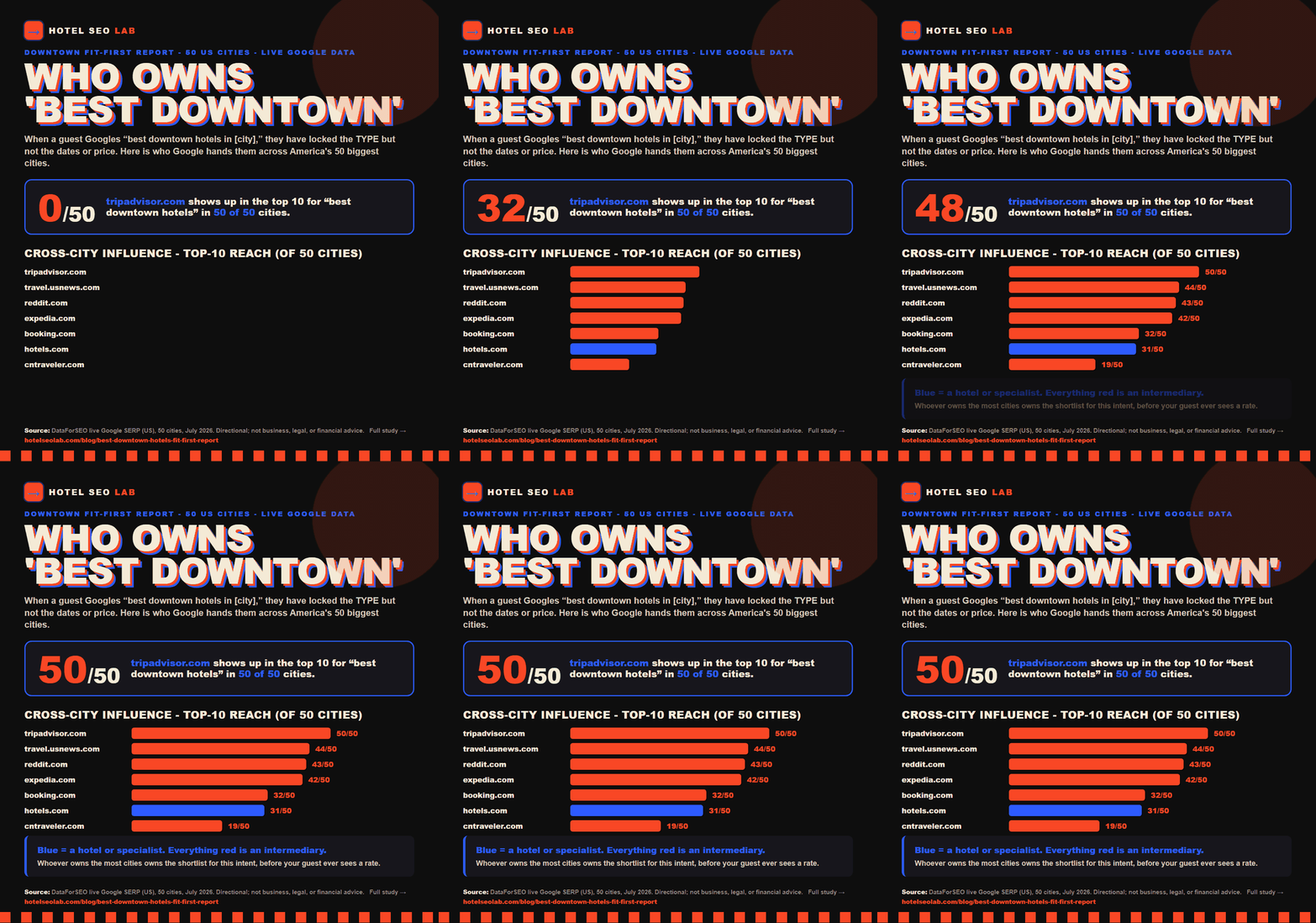
Download this study as a one-page PDF
There is a moment in every hotel booking that almost no marketing budget is aimed at, because most operators do not have a name for it.
It is not the dreaming stage, where someone is scrolling Instagram thinking maybe we should go somewhere. It is not the booking stage, where they have a date and a card out. It is the messy middle, where a person has already decided what kind of hotel they want but not which one. They have committed to a type. They have not committed to a property, a date, or a price. So they open Google and type a very specific kind of query: “best downtown hotels in Denver.” “Best downtown hotels in Nashville.” “Best downtown hotels in San Diego.”
I call this a Fit-First search: a mid-to-low-funnel query where the guest has locked in the type of hotel (downtown, family, budget, luxury, business, pet-friendly) but not the dates or the dollars. They are building a shortlist. It is the moment the shortlist forms, after dreaming and before booking, and the page of results they land on is the battleground I think about constantly. Call it the Fit-First SERP.
Downtown is a particularly interesting version of it, because it is a location-committed search. The guest is not just saying “I want a nice hotel.” They are saying “I want to be central. I want to walk out the door and be in it.” That is a high-intent, high-value signal, and if you run a property anywhere near a city center, whoever owns that search owns your most qualified prospect before they ever see your name.
So I went and measured who owns it.
How I got this data
I picked the 50 biggest US cities by population. For each one, I ran six Fit-First queries in the pattern “best [type] hotels in [city]” across six type modifiers: family, cheap, luxury, downtown, business, and pet-friendly. Fifty cities times six modifiers is 300 live Google searches.
I pulled every one of those 300 SERPs through DataForSEO, which returns the live organic results Google is actually serving, plus AI Overview citations where Google showed one. For each SERP I recorded the organic top 10 and, if an AI Overview was present, which domains it cited. Then I tallied.
The metric I care about most is what I will call cross-city influence: for a given domain, in how many of the 50 cities does it appear in the organic top 10 for that query? A domain that shows up in 5 cities got lucky in a few markets. A domain that shows up in all 50 has built something structural: one templated, programmatic footprint that Google trusts everywhere. Cross-city influence separates the local one-offs from the platforms.
This report zooms in on the downtown modifier. That is 50 SERPs, one per city, all asking the same location-committed question.
A few honest limits before the numbers. This is a snapshot from a single date. Google results are localized and personalized, so a searcher standing in Phoenix sees a slightly different set than my data-center-located query did. My bucketing of each domain as an OTA, an aggregator, an editorial ranker, or a hotel brand is a judgment call. And it is US-only. None of that invalidates the pattern, but all of it should keep you from treating any single row as gospel. Read the shape, not the decimal.
The downtown leaderboard
Here is who ranked in the organic top 10 for “best downtown hotels in [city],” counted by how many of the 50 cities they appeared in.
| Rank | Domain | Cities (of 50) | I would call it |
|---|---|---|---|
| 1 | tripadvisor.com | 50 | Review aggregator |
| 2 | travel.usnews.com | 44 | Editorial ranking |
| 3 | reddit.com | 43 | Community / UGC |
| 4 | expedia.com | 42 | OTA |
| 5 | booking.com | 32 | OTA |
| 6 | hotels.com | 31 | OTA |
| 7 | cntraveler.com | 19 | Editorial |
| 8 | forbestravelguide.com | 17 | Editorial |
| 8 | marriott.com | 17 | Hotel brand |
| 10 | kayak.com | 8 | Metasearch |
| 11 | fourseasons.com | 5 | Hotel brand |
| 11 | omnihotels.com | 5 | Hotel brand |
Sit with the top row for a second. TripAdvisor appeared in the top 10 for all 50 of 50 cities. Not 48, not 49. Every single one. There is no city in the 50 biggest in America where a downtown-committed searcher does not hit a TripAdvisor page near the top of Google.
That is not editorial brilliance. Nobody at TripAdvisor is writing a lovingly researched downtown-Milwaukee guide. It is the opposite of craft: it is a template. One URL pattern, replicated across every metro, fed by an enormous review corpus, sitting on a domain Google has trusted for fifteen years. The lesson is not “TripAdvisor writes great downtown content.” The lesson is that programmatic coverage plus domain trust is a moat you cannot climb with a single beautiful page. You climb it by being more specific than a template can ever be, which I will come back to.
The finding that should change your plan: downtown is not an OTA sweep
Here is where downtown gets genuinely interesting, and where it diverges from the intent most operators assume is the same shape.
I also ran the “cheap hotels in [city]” queries. Watch what happens to the OTAs between the two intents.
| Domain | Cheap (cities of 50) | Downtown (cities of 50) |
|---|---|---|
| expedia.com | 49 | 42 |
| booking.com | 47 | 32 |
| hotels.com | 43 | 31 |
On price-led intent, the OTAs are close to a clean sweep. Expedia hits 49 of 50, Booking 47. That makes sense: “cheap” is a pure inventory-and-price query, and an inventory-and-price grid is exactly what an OTA is. There is no editorial angle to “cheap.” There is just the cheapest room, and the machines that aggregate rooms win.
Downtown behaves differently. Booking drops from 47 cities to 32 — it is absent from the downtown top 10 in nearly two-fifths of these markets. Expedia slips from 49 to 42. The location-committed query is measurably harder for a pure aggregator to own, because “best downtown” is not a price question. It carries a point of view. Which hotels are actually central? Which ones are walkable to the good part of downtown versus technically-downtown-but-you-need-a-car? An OTA grid sorted by price does not answer that. A human with an opinion does.
And you can see the human opinions climbing the board to fill the gap. US News sits at number two with 44 cities. Conde Nast Traveler shows up in 19, Forbes Travel Guide in 17. These are editorial rankers: curated “the 12 best downtown hotels in [city]” lists written by someone with a stated point of view. They barely register on the cheap queries and they surge on downtown, because downtown rewards curation. Reddit is right up there too at 43 cities, which is its own signal: people trust other people’s lived answers to “where should I actually stay downtown.”
Put plainly: downtown intent is more winnable than price intent. Not easy. Winnable. The door that is bolted shut on “cheap” is merely heavy on “downtown.”
What the AI Overview layer is doing
Of the 300 SERPs I ran, 83 returned an AI Overview. That is a bit under a third, and it is the layer eating into the classic ten blue links. When Google did generate an AI answer, here is who it cited most across all 300 queries.
| Domain | AI Overview citations (of 83 overviews) |
|---|---|
| tripadvisor.com | 45 |
| expedia.com | 39 |
| booking.com | 27 |
| google.com | 25 |
| reddit.com | 25 |
| marriott.com | 18 |
| hotels.com | 15 |
The same handful of platforms that own the organic results also own the AI citations. TripAdvisor leads here too. Reddit and Google itself both crack the top five, which tells you the model is leaning on aggregated human opinion and Google’s own hotel surfaces to assemble its answer. If your property is not present in the sources these models trust, you are invisible in both the blue links and the paragraph above them. The AI layer is not a separate game with separate winners. It is the same incumbents, cited a second time.
Why downtown is the intent worth fighting for
Every one of these type modifiers has a different personality, and downtown’s is the one that most rewards a real, physical, opinionated hotel.
“Cheap” is a race to the bottom you cannot win against an OTA’s inventory engine, and you would not want to; those guests are shopping price, not you. “Family” and “pet-friendly” are amenity-filter queries where the aggregators with structured filters do well. “Luxury” pulls in Forbes and Conde Nast because it is inherently editorial. But “downtown” is a place query, and you are a place. You are the one entity in this whole search that literally, physically sits downtown. The guest wants to be central, and you are central. Nobody in the results has a more legitimate claim to answer “where should I stay downtown” than the hotel that is actually there.
That is the asymmetry to exploit. TripAdvisor’s page for your city is a template. US News wrote its list from an office somewhere. Reddit is a scattering of anecdotes. You have the one thing none of them has: you are on the ground, you know which three blocks are the good ones, you know the walk to the convention center is eight minutes and the walk to the arena is twelve, you know the light rail stop is around the corner. That knowledge is the raw material of a page that out-specifics every template on the board.
What this means for your hotel
You are not going to out-coverage TripAdvisor. It ranks in all 50 cities because it has one page pattern for every metro on earth and a domain age you cannot buy. Stop trying to beat the aggregator at aggregation. Here is what I would do instead, in order.
Beat the editorial rankers at specificity, not the aggregators at scale. The winnable competitors on downtown are US News, Conde Nast Traveler, and Forbes Travel Guide — the curated lists, not the templates. And you beat a general-interest ranking not by making another ranking, but by owning the one page on the internet that is genuinely, exhaustively about staying in your downtown. What “downtown” means block by block. Where the good part is. Transit, walkability, what is open late, what is a tourist trap. That is the anti-listicle move, and I have written the full method for building it in the definitive local guide playbook. A template cannot compete with a local who actually knows the ground.
Get cited by the rankers instead of only competing with them. US News and Conde Nast own 44 and 19 cities respectively. You will not replace them, but you can be one of the hotels they name. That means being genuinely, defensibly one of the best downtown options and making that case easy for an editor to verify. Being inside their list is a top-two-domain placement you did not have to rank for yourself.
Feed the AI layer, because it cites the same incumbents. A third of these searches now show an AI Overview, and it leans on TripAdvisor, Reddit, and Google’s own surfaces. Keep your review corpus clean and current, keep your Google Business Profile accurate, and make sure the factual claims about your location are consistent everywhere a model might read them. You want to be the specific, citable source the paragraph pulls from, not a listing it summarizes past.
Win your own name first. None of the above matters if a guest who finally decides on you then types your hotel name and hits an OTA ad instead of your booking page. Downtown Fit-First search is how the shortlist forms; branded search is where it converts, and it leaks if you let the OTAs sit on your name. That is a separate fight with a separate playbook, and it is the one with the fastest payback — I lay it out in winning your branded search back from the OTAs.
The takeaway
Downtown is the Fit-First search most worth your effort, precisely because it is the one the OTAs do not own outright. On “cheap,” the aggregators run the table because price has no point of view. On “downtown,” a location-committed searcher wants an opinion about a place, and that is a question a price grid cannot answer — which is why editorial climbs, Reddit climbs, and Booking quietly disappears from a third of the biggest cities in the country.
TripAdvisor will keep ranking in all 50 cities on the strength of a template and a trusted domain, and you will not dislodge it. But number two through six on this board — the rankers and the OTAs — are beatable by the one competitor in the whole SERP that is physically standing downtown. That is you. Be more specific than a template, more grounded than a list written from an office, and more useful than a grid of rooms. Downtown is the intent where being a real place is finally an advantage. Use it.
Reminder: everything above is directional analysis from a single-date snapshot of Google results captured through a third-party provider (US Google, one date). Results are localized, personalized, and volatile; yours will differ. Domain classifications are my own judgment. This is US-only and covers the 50 largest cities, not every market. Nothing here is a claim about any company’s finances, and none of it is business, legal, or financial advice. Verify against your own market before you act.
If you want to know who owns “best downtown hotels” in your specific city — and what the one page you should build to compete actually looks like — book a call and I will pull your market live. No guarantees, no number-one-in-a-week nonsense. Just an honest read of the SERP you are actually fighting in.