
A note on what this is. This is an analysis-and-opinion piece that argues a genuinely contrarian position: that Google, usually cast as the villain in hotel distribution, is actually the independent hotel’s best-aligned ally. I have tried hard to earn that argument rather than cheerlead it, so the uncomfortable data (AI Overviews eroding organic clicks) is in here alongside the good news, and I have flagged where a figure is a directional industry estimate rather than a hard primary source. Product features and dates are current as of mid-2026 and Google ships changes constantly, so verify specifics against Google’s own documentation before you act. I am not affiliated with, endorsed by, or paid by Google or anyone else named here, and nothing below is business, legal, or financial advice. I am an open admirer of what Google does for this industry, and you should read accordingly and draw your own conclusions.
Download this study as a one-page PDF
In Praise of the Giant
I spend a lot of this blog teaching independent hotels how to defend themselves, from OTAs that occupy their branded search, from review platforms whose AI summaries I would not trust to describe a vending machine, from the slow erosion of the open web. So it may surprise you that I want to spend this piece defending the biggest company in the room.
Because here is a thing I believe, and have come to believe more strongly the deeper I get into the data: of all the giants that touch a hotel’s demand, Google is the only one whose interests are genuinely, structurally aligned with an independent hotel’s. Not perfectly. Not out of charity. But in the one way that actually matters, which is how it makes its money. And once you see that alignment, a dozen of Google’s products stop looking like a toll booth and start looking like the best set of free tools an independent operator has ever been handed.
Let me make the honest case. I am going to put the uncomfortable part first, because a pro-Google essay that ducks the AI-Overview problem is not worth reading.
First, the elephant: yes, AI is eating some clicks
If you want me to earn this argument, I have to start by conceding the strongest point against it. Google’s AI Overviews are taking clicks that used to go to websites, including hotel websites. This is not vibes. It is measured.
Pew Research, in a rigorous July 2025 study of nearly 69,000 real searches, found that when an AI Overview appeared, users clicked a traditional result about 8 percent of the time versus 15 percent when it did not, that only 1 percent clicked a source cited inside the summary, and that people were markedly more likely to simply end their session. A 2026 randomized field experiment out of ISB and Carnegie Mellon put a sharper number on it: AI Overviews cut organic clicks by roughly 38 percent, with zero-click searches climbing from 54 to 72 percent when a summary showed. Ahrefs has measured a 58 percent CTR drop for the number-one organic result when an AI Overview is present.
That is real, and anyone selling you a “Google is your friend” story without that paragraph is lying by omission. So why am I still writing this?
Two reasons. First, the erosion is concentrated, and it is concentrated away from where independents actually earn. AI Overviews gut informational, “what is the capital of” style queries. The searches a hotel wins are branded (“[Your Hotel] rates”) and local-transactional (“hotels near the convention center”), and on those, the thing that answers the searcher is not a paragraph of prose, it is a map pack, a Business Profile, and a booking module, all of which Google still shows and still, crucially, gives you for free.
Second, and this is the tell that runs through the entire essay: even as Google monetizes more aggressively than ever, it keeps giving hotels free, high-intent channels it could lock behind a paywall, and in at least one enormous case it took a channel that was paid and made it free. A company purely optimizing for its own ad revenue does not do that. Let me show you the seven places it does.
Pillar 1: Google gave the direct click back, for free, on purpose
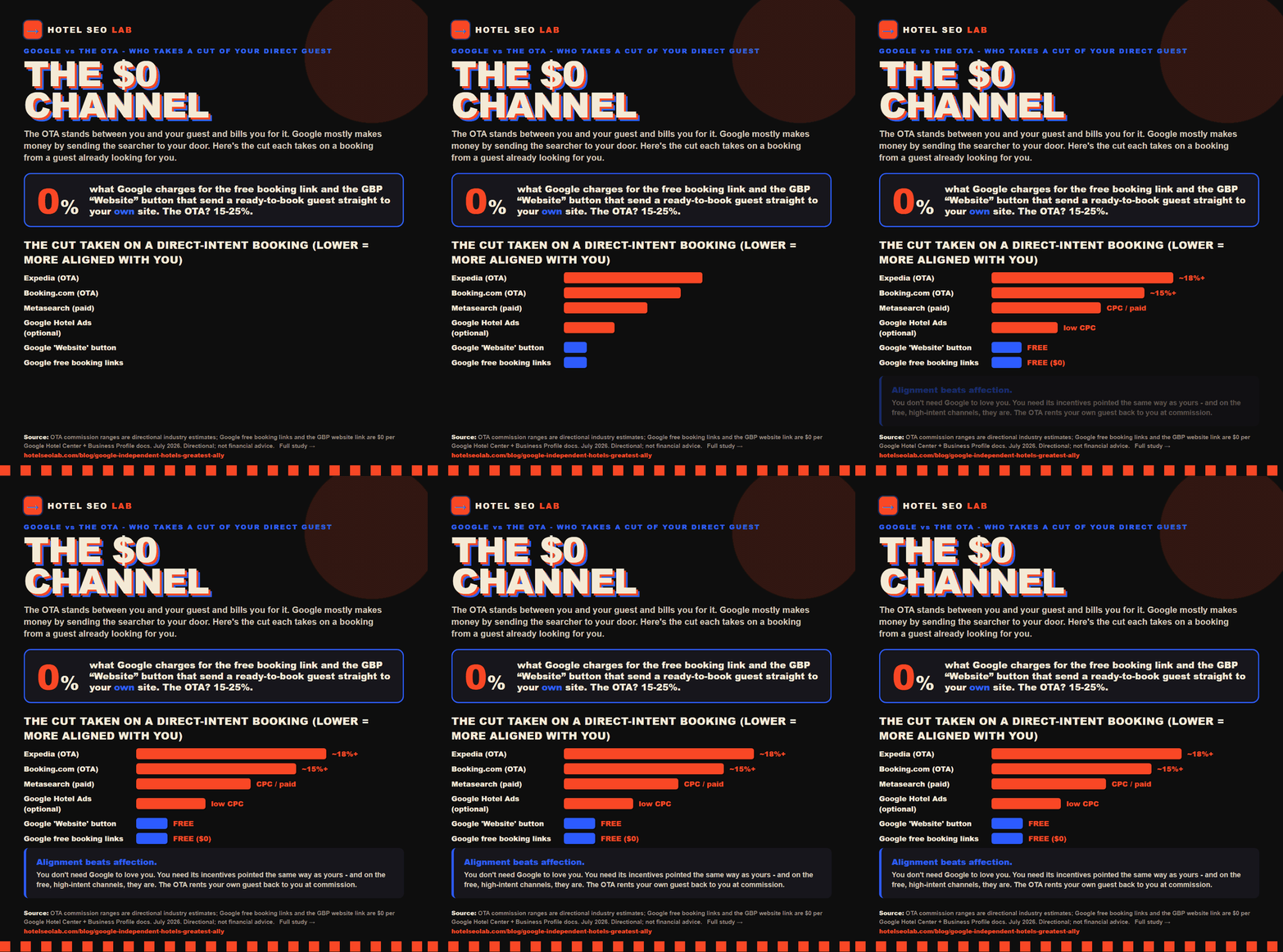
Start with the single most under-appreciated fact in hotel distribution. In March 2021, Google made it free for any hotel to appear in its booking links across Google Travel, Search, and Maps. In Google’s own words, “it’s now free for hotels and travel companies to appear in free booking links.” It attached an “Official site” badge so travelers can tell your own booking engine from the resellers, and it expanded the whole thing to mainstream Search and Maps in 2022.
Sit with what that means. Before 2021, that booking module was pay-to-play, the exclusive domain of Hotel Ads, which meant independents who could not outbid Booking.com and Expedia were simply not in it. Then Google reversed it. Per its Hotel Center documentation, there is no cost for clicks on free booking links, and, critically, “bids have no impact on the ranking of free booking links.” Ranking is by relevance and value to the user. For the first time, a twenty-room independent could show its own direct, commission-free rate right next to the OTAs, ranked on merit rather than budget.
Now hold that against how the OTAs behave. An online travel agency’s entire model is to insert itself between the traveler and your direct channel. Many bid on your own hotel’s name and dress the result up as “Official Reservations” so the guest books through them and you pay 15 to 25 percent for a customer who was already looking for you. Google, on the highest-intent surface in travel, does the opposite: it hands the searcher a free, badged link straight to your front door, and it keeps a free “Website” button on your Business Profile as the default behavior of the product.
I want to be fair, because credibility is the whole game here. OTAs do generate some indirect benefit, the well-documented “billboard effect,” where a hotel’s visibility on Expedia lifts its direct bookings too. That is real and I am not going to pretend a hotel should delist from the OTAs tomorrow. But notice the difference in kind: the OTA’s contribution is an accidental side effect of it advertising itself, for which you pay a commission on the direct bookings it can attribute; Google’s contribution is that it gives you the direct click itself, for free, with a badge that says this is the real you. One is a toll road that occasionally sends spillover traffic. The other paved you a free lane.
Pillar 2: The fairest review system, and the only open one
Reviews are the second place the alignment shows, and it shows in two ways: fairness and access.
On fairness, Google’s review policy is, for all its flaws, the most transparent and equitable at scale that hotels have. Google will remove a review only if it violates a published content policy, spam, off-topic, conflict of interest, harassment, and a genuine negative opinion stays up even when it stings. That is the correct design. It means the system adjudicates on policy, applied to every business the same way, not on whether you liked the review, and it gives you a defined reporting queue and a one-time appeal. Google reported removing or blocking more than 240 million policy-violating reviews in 2024 and even more in 2025, which is the kind of enforcement muscle a small hotel benefits from without paying for it. It is not perfect, no review system is, but “published rules applied uniformly with an appeal path” is genuinely the best deal in the business.
On access, the gap is even starker, and it is the part hoteliers underrate. Google exposes an open Business Profile API, which is why an entire ecosystem of tools, Yext, Birdeye, Reputation.com, plugs straight in and lets even a small operator monitor, respond to, and flag reviews across every location from one dashboard, with automation and AI-assisted replies. Your reputation on Google is manageable, at chain-grade sophistication, on an independent’s budget.
Compare an OTA. On Booking.com, a review comes down only in narrow structural cases, and disputes route through automated moderation that is mostly dismissed without substantive human review. There is no open API to manage your reputation programmatically, no third-party tooling layer, no real recourse. It is a closed garden where your reputation is something that happens to you. Google’s is something you can actually work with.
Pillar 3: Paid search that keeps lowering the barrier (and a privacy story that’s pro-hotel)
Google’s paid hotel products have been through real upheaval, and if you only read the headlines you would think Google was abandoning hotels. Read the substance and it is the opposite.
The old commission-based Hotel Ads model, where you paid a cut only on a completed stay, was officially deprecated on February 20, 2025. That sounds hostile until you learn why: the third-party cookie deprecation made it impossible to reliably measure a completed hotel stay, which is the exact event commission billing depended on. Google chose privacy-safe measurement over the old model, and rather than a hard cutoff it gave advertisers a nine-month reconciliation runway. The privacy-driven “why” here is pro-guest and pro-hotel, not anti.
What replaced it lowers the technical barrier. Performance Max for travel goals runs one AI-driven campaign across Search, Maps, YouTube, Gmail, Discover, and Display, and, importantly for a small operator, it does not require a standalone Hotel Center account, you link property assets to an asset group instead. Google is folding hotel formats into standard Search campaigns in 2026 under its “Search Campaigns for Travel” work, simplifying further.
I promised honesty, so here is the caveat: Performance Max is a black box. You get less control over placements and search terms than the old dedicated hotel campaigns, and automated bidding rewards budget and data, which still favors the OTAs’ deep pockets. The paid layer is not where an independent out-punches Expedia. That is exactly why the free layer, Pillar 1, is the leveler, and why the paid layer’s job for an independent is narrower and defensive: protect your own name, capture the high-intent bottom of the funnel, and let free booking links do the volume.
Pillar 4: Auction Insights — chain-grade transparency, for free
Here is a tool most independents have never opened, and it is one of the quietly radical ones. Google Ads’ Auction Insights report shows you six competitive metrics on your search campaigns: impression share, top-of-page rate, absolute top-of-page rate, overlap rate, position-above rate, and outranking share, reported against named competing domains.
Read that again. Google will tell a twenty-room independent how often it is showing up versus the property down the street, how often that competitor outranks it, how often they appear in the same auction, and what share of the available impressions it is capturing. That is share-of-voice intelligence that, a decade ago, only a brand with an agency retainer could dream of. It is free, inside a free Google Ads account, and it lets a small operator diagnose exactly why it is losing the click and to whom.
Now ask yourself: what does an OTA tell you about your competitive position on its platform? When you buy visibility on Booking.com or a metasearch site, you get no impression share, no named-competitor overlap, no outranking data, nothing about how you stack up against the hotel next door in that auction. The absence is the point. Google treats an independent’s competitive intelligence as a free utility; the OTA treats it as a secret. (That contrast is my analysis rather than a cited fact, but the asymmetry is real: one platform documents six competitive metrics for everyone, the other documents none.)
Pillar 5: GA4 and the first-party loop the OTA will never give you
If Pillar 1 is the emotional heart of this essay, Pillar 5 is its philosophical spine, so stay with me even though it starts in the least glamorous corner of the internet: analytics.
Google Analytics 4 is free, and in its free tier it does something an independent hotel should find genuinely moving. It lets you build an audience out of your own guests’ behavior on your own site, people who viewed a room but did not book, who abandoned a reservation, who are past direct guests, and then export that audience straight into Google Ads to win them back. Add data-driven attribution, which spreads conversion credit across the whole path so you can finally see that a blog visit plus a branded search plus a retargeting click together produced a direct booking, and Enhanced Conversions and Consent Mode to keep that measurement accurate under privacy law, and you have an enterprise-grade measurement-and-activation loop, for zero dollars, with a clean upgrade path to Analytics 360 when a small group needs it.
Here is why that loop is the whole argument in miniature. When a guest books through an OTA, the OTA keeps the customer. It keeps the email, it keeps the behavioral data, it keeps the right to remarket, and it hands you a masked reservation and a commission invoice. You do not own the relationship with your own guest. The Google stack is the only place where an independent both measures its own guests and re-activates them for direct bookings on data it actually owns. One model rents your guests back to you at 18 percent. The other gives you the tools to keep them. That is not a small philosophical difference. It is the entire difference.
Pillar 6: Search Console, the free tool that keeps getting better
Google Search Console is free, and unlike a lot of free software it is not standing still, it has shipped a remarkable run of upgrades that each happen to help a hotel understand its direct demand. A few of the recent ones:
- A 24-hour, near-real-time view (from late 2024) with hourly clicks, impressions, and positions, so you can see within hours whether a new offer page or a rate update is catching, instead of waiting days.
- A branded vs non-branded queries filter (November 2025) that separates “people already searching for us by name,” the direct-intent, high-conversion traffic where OTAs bid on your brand and direct revenue is won or lost, from net-new discovery. For a direct-booking strategy, that is the single most useful cut of data there is, and Google just handed it over for free.
- Query groups (October 2025) that use AI to cluster the fragmented long tail (forty variants of “hotel near [landmark] with a pool”) into a readable demand theme.
- New generative-AI performance reports (announced June 2026) that show, for the first time, whether your pages surface inside AI Overviews and AI Mode. Honest caveat: these show impressions only, not clicks or queries yet, and the rollout is staged, but it is the first official window into the new AI discovery layer, and it is free.
- And an AI-powered configuration that lets a non-technical owner describe the analysis they want in plain English and have GSC build the filters, plus the evergreen Core Web Vitals and rich-results reports that keep a small site technically healthy and eligible for the enhanced listings that lift free-click-through.
The through-line: this is a free, continuously improving instrument that tells an independent hotel exactly what questions people ask to find it, whether its pages are healthy, and now whether it shows up in the AI answers. No OTA gives you any of this about your own demand.
Pillar 7: The only fair trademark enforcement in the game
Finally, brand protection, and this one is subtle because it starts by looking unfair. Google will never restrict the use of trademarks as keywords, which means a rival or an OTA absolutely can bid on “[Your Hotel Name]” to trigger an ad. That feels like a betrayal, and it is the part hoteliers complain about.
But look at the other half of the policy, because it is the half that matters. A trademark cannot appear in a competitor’s ad headline or description unless they are the owner, an authorized reseller, or a qualifying informational site. And Google gives the brand owner a free, self-serve, worldwide trademark complaint process: if you hold a registered mark and a competitor is using it in their ad copy without authorization, you file a complaint, no lawyer and no lawsuit, and Google restricts that use on an ongoing basis for that domain. Since July 2023 you have to report each infringing advertiser individually rather than blanket-flagging an industry, which is more work, and there is a legitimate reseller exception for OTAs that genuinely sell your rooms and disclose it, so not every OTA use is a violation. It is not a magic wand.
But it is a rules-based, enforceable, free brand-protection lever tied to real registered rights, and here is the contrast that should land: no OTA or metasearch platform offers anything remotely like it. Inside those walled gardens there is no trademark complaint form, no policy stopping a rival property or the platform itself from ranking against your name, no takedown mechanism at all. Visibility there is bought or algorithm-granted, full stop. Google is effectively the only major distribution surface on Earth where an independent hotel with a registered name has an actual, enforceable, lawyer-free way to defend its brand in advertising. Given that, “you can’t stop them bidding on your keyword” starts to look less like a betrayal and more like the reasonable price of the only real brand-protection system anyone offers.
What actually unites all seven
Step back from the products and you see one pattern, and it is the reason I wrote this. Every one of these seven things flows from a single structural fact: Google mostly makes its money by being the front door and sending the searcher onward. The OTA makes its money by standing between you and your guest.
That is the whole thing. Google’s incentive is for you to be found, because a found hotel is a satisfied searcher is a healthy ad-and-discovery ecosystem. So it gives you a free direct link, free competitive intelligence, free measurement, free brand protection, and the tools to own your guest relationship, because none of that threatens how it earns. The OTA’s incentive is for you to be intermediated, because intermediation is the product. So it buries your direct link, hides your competitive position, keeps your guest’s data, and rents your own customers back to you. Two giants, two opposite relationships to your independence.
None of this makes Google a charity. It is a ruthless, profit-maximizing advertising company, it monetizes harder every year, and its AI Overviews are genuinely eroding the open web that hotels used to rely on. I put that data up top and I stand by it. But “aggressive monetizer” and “best-aligned ally an independent hotel has” are not contradictions, they are both true at once, and on the specific question of who is built to help you drive direct revenue, there is, in my honest assessment, no other company in the world remotely as well-positioned or as incentive-aligned as Google.
What to do with all of this
If you take the argument seriously, it turns into a to-do list, and conveniently it is mostly free:
- Claim and fully optimize your Google Business Profile, and make sure the “Website” button points at your own booking engine.
- Connect your rates so you appear in free booking links with the “Official site” badge, next to the OTAs, at no cost.
- Move your review gravity to Google and manage it with an open-API tool, and use the fair flagging process when a review genuinely breaks policy.
- Open Auction Insights and learn who is actually taking your clicks.
- Set up GA4, build an audience from your own guests, and activate it in Google Ads, stop renting your customers back from the OTAs.
- Live in Search Console, especially the branded-vs-non-branded filter, to see where your direct demand really is.
- Register your hotel’s name as a trademark and use Google’s complaint process the moment a competitor puts your name in their ad copy.
Every one of those is a flank in the same campaign: win the guest who is already looking for you, on the surface whose owner wants you found, before the intermediary can step in. And it pairs directly with the other side of that fight, winning your branded search back from the OTAs and, if you are ready for the contrarian view of who is not your friend, the drain-the-moat piece on TripAdvisor.
The honest caveats
Because I would rather you trust the reasoning than the enthusiasm: several of the supporting numbers here, the typical OTA commission range, average conversion rates on free booking links, the share of traffic that is still organic, are directional industry estimates rather than hard primary figures, so treat them as shape-of-the-thing, not gospel. The claims that Google “deliberately restrains organic to protect ads” or that “Auction Insights has no OTA equivalent” are my analysis, not documented fact. Google ships product changes constantly, so any specific feature or date above may have moved by the time you read this. And the AI-Overview erosion is real and worth watching closely, even if I have argued it lands mostly outside where independents earn. What survives all of that, I think, is the structural point, and it is the one worth keeping: alignment beats affection. You do not need Google to love you. You need its incentives to point the same direction as yours. On the evidence, they do.
If you want help actually running this playbook, the Business Profile and free-booking-links setup, the review and GA4 work, the Search Console and Auction Insights analysis, the brand-protection filings, that is the work we do at HotelSEO Lab. You can see how we break it down on our services page. No guarantees and no giant-worship, just an honest plan for pointing the most powerful aligned platform in travel at your own direct revenue.