
Directional analysis, not gospel. This piece splits hotel brands’ organic traffic using third-party, modeled estimates that are inherently noisy and change month to month. The branded-versus-non-branded classification is a documented judgement call, described in full below, and reasonable people would draw a few of the lines differently. The numbers are estimates subject to independent validation, based on public data at the time of writing, and may be out of date by the time you read this. We are not affiliated with, endorsed by, or paid by any company named here. Nothing below is business, legal, or financial advice.
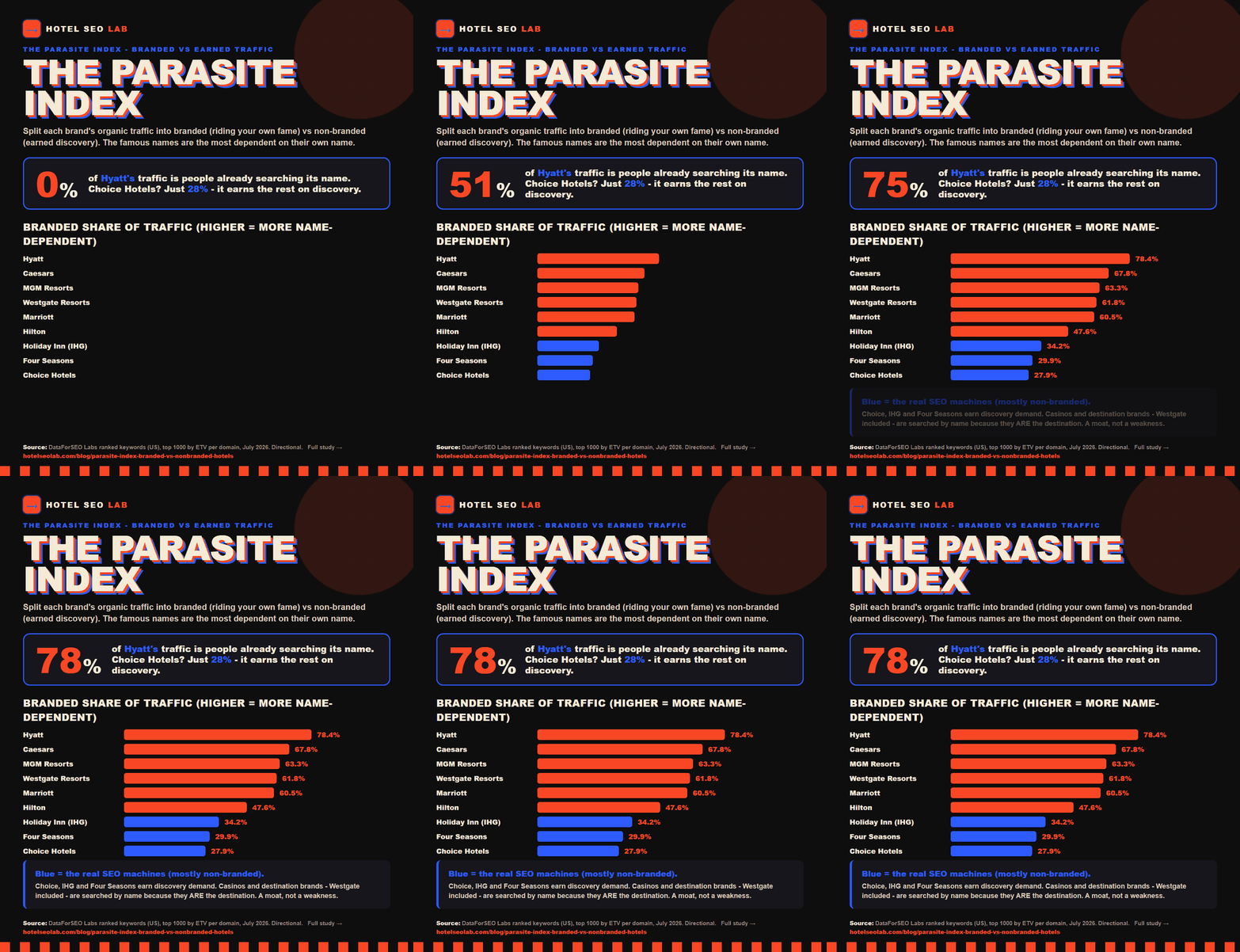
Download this study as a one-page PDF
I want to test an uncomfortable idea: that some of the most famous names in hotels are not actually good at SEO. They are just famous. Their organic traffic is not the reward for out-ranking anyone on a competitive generic term. It is the residue of a hundred years of signage, loyalty cards, TV spots, and casino floors. People already know the name and type it in. Google hands over the click. The brand calls it “organic traffic” and everybody nods.
I call that being a parasite on your own fame. And I wanted to know who is doing it the most.
So I pulled the data on fourteen major hotel and resort companies, split every keyword each one ranks for into branded searches versus generic discovery, and built what I am calling the Parasite Index. The higher the branded share, the more a brand is coasting on awareness instead of earning new demand. The result flipped my assumptions, and I think it will flip yours. The names you would bet on to dominate search are the ones most dependent on their own reputation. The real non-branded SEO machines are the unglamorous chains you never think about.
Here is exactly how I got there, what the numbers say, and every place I could be wrong.
How I got this data
The source is DataForSEO, specifically their Labs “ranked keywords” dataset for US Google, pulled at the start of July 2026. For each brand I took its primary domain — marriott.com, hilton.com, hyatt.com, and so on — and requested the keywords that domain ranks for, ordered by estimated traffic value.
For each brand I kept the top 1000 keywords by ETV (estimated traffic value, a modeled projection of monthly organic visits based on ranking position and search volume). Then I classified every one of those 1000 keywords as either branded or non-branded using a documented token list, summed the ETV in each bucket, and computed the branded share.
The classification is the whole ballgame, so let me be precise about it. A keyword counts as branded if it contains the parent brand name or one of that brand’s major sub-brand tokens. That last part is the key judgement call. Marriott is not just “marriott” — it is Courtyard, Ritz-Carlton, Westin, Sheraton, Residence Inn, and a dozen more. IHG is Holiday Inn, Crowne Plaza, Kimpton. If I only matched the parent word, I would wildly understate how much of a brand’s traffic is really awareness-driven, because a search for “Courtyard downtown” is every bit as branded as “Marriott downtown.” So the token list includes major sub-brands. Everything else — “hotels in [city],” “hotels near me,” “cheap motels,” “all inclusive resorts in punta cana” — is non-branded.
A few honest consequences of that method, stated up front:
- A sub-brand searched without the parent name is only counted as branded if its specific token made my list. If I missed a sub-brand, its searches got miscounted as generic discovery. That biases the branded share downward for the sprawling portfolio companies, which is worth remembering when you look at Choice and IHG.
- Top-1000-by-ETV is a sample, not the full footprint. Marriott ranks for over 1.2 million keywords; I looked at the 1000 that drive the most estimated traffic. That captures the bulk of the traffic but truncates the long tail. For most of these brands the top 1000 keywords account for the large majority of modeled ETV, so I am comfortable with it as a portrait of where the traffic actually concentrates.
- ETV is a model, not billing truth. It is DataForSEO’s estimate of traffic from ranking data, not a feed from anyone’s analytics. Every number in this article inherits that uncertainty. Treat the ranking of brands as more reliable than any single figure.
Total cost of the pull, for the transparency nerds: about 1.85 dollars in API credits. This was cheap to run and you could reproduce it.
The Parasite Index: branded share of traffic, ranked
Here is the headline table. Branded share is branded ETV divided by total ETV across each brand’s sampled top-1000 keywords. Higher means more dependent on its own name.
| Rank | Brand | Primary domain | Branded share of traffic | Non-branded (earned) share |
|---|---|---|---|---|
| 1 | Hyatt | hyatt.com | 78.4% | 21.6% |
| 2 | Caesars | caesars.com | 67.8% | 32.2% |
| 3 | MGM Resorts | mgmresorts.com | 63.3% | 36.7% |
| 4 | Westgate Resorts | westgateresorts.com | 61.8% | 38.2% |
| 5 | Marriott | marriott.com | 60.5% | 39.5% |
| 6 | Best Western | bestwestern.com | 60.4% | 39.6% |
| 7 | Wyndham | wyndhamhotels.com | 56.6% | 43.4% |
| 8 | Omni Hotels | omnihotels.com | 54.7% | 45.3% |
| 9 | Ritz-Carlton | ritzcarlton.com | 52.6% | 47.4% |
| 10 | Motel 6 | motel6.com | 52.3% | 47.7% |
| 11 | Hilton | hilton.com | 47.6% | 52.4% |
| 12 | Holiday Inn (IHG) | ihg.com | 34.2% | 65.8% |
| 13 | Four Seasons | fourseasons.com | 29.9% | 70.1% |
| 14 | Choice Hotels | choicehotels.com | 27.9% | 72.1% |
Look at the top of that list and then look at the bottom, because the gap is the whole story.
The five most brand-dependent names are a murderer’s row of fame: Hyatt, three casino-resort operators, and Marriott. The five least brand-dependent include Choice Hotels, IHG, and — the one genuine surprise — Four Seasons. The brands you associate with prestige and scale are riding their own reputation. The brands you can barely picture a logo for are the ones actually winning generic search.
The famous names are parasites on their own fame
Start with Hyatt at 78.4 percent branded. Nearly four out of every five estimated organic visits to hyatt.com come from someone who already typed some form of Hyatt. In raw modeled terms that is about 8.98 million branded ETV against just 2.48 million non-branded. Hyatt is a destination brand. People decide they want a Hyatt Regency or a Park Hyatt and go get one. That is a beautiful position to be in commercially — and a precarious one for SEO, because it means the domain is barely competing for the traveler who has not chosen yet.
The casinos tell the same story even more starkly, and for an obvious reason. Caesars sits at 67.8 percent branded, MGM at 63.3 percent. Nobody discovers a Las Vegas casino resort by searching “hotels near me.” They search “Caesars Palace,” or “New York New York Las Vegas,” or “MGM Grand.” When you scan the top non-branded keywords these domains rank for, you find things like “hotel caesar palace las vegas” and “hotel new york new york en las vegas” — which are only classified non-branded on a technicality, because they describe a specific famous property rather than containing the corporate token. If anything, my method understates how brand-and-destination-dependent the casinos really are. Their whole model is being the thing people search for on purpose. Generic discovery is almost irrelevant to them.
Westgate at 61.8 percent and Marriott at 60.5 percent round out the top five — and Westgate belongs with the destination names, not the parasites. It is a resort and timeshare brand, and like the casinos, its guests seek it out by name because a Westgate resort is the destination itself, not an interchangeable room. Sitting up here alongside Hyatt and the casino operators is a signal of demand Westgate has built, not discovery it has failed to win — and it still pulls a real 919,000 in non-branded ETV, a healthy discovery footprint for a brand whose whole model is being a place people choose on purpose. Marriott is the interesting one, because it is enormous — 12.89 million branded ETV, the largest branded pile in the dataset — and it still earns a real 8.41 million in non-branded traffic. Marriott is not a pure parasite. But even the biggest hotel company on earth, with an entire portfolio of sub-brands feeding its footprint, only manages to make about 40 percent of its sampled traffic come from people who did not already know the name. The awareness flywheel is doing most of the work.
Even here, notice what the non-branded traffic that does exist looks like. For most of these brands, the biggest “earned” keywords are the raw head terms “hotel” and “hotels” — Marriott ranks for “hotel” at over 2.1 million ETV and “hotels” at over 1.1 million. Ranking for the single word “hotels” is real, but it is also the kind of position that only a domain of massive authority holds, which is itself a byproduct of brand strength. The fame compounds even inside the non-branded column.
The unglamorous chains are the actual SEO machines
Now the flip. Choice Hotels is only 27.9 percent branded. Almost three-quarters of its sampled traffic — 5.17 million non-branded ETV against 2.0 million branded — comes from generic discovery. When you look at what it ranks for, the picture is immediate: “hotels” at over 1.5 million ETV, “hotels near me” at over 731,000, “hotel” at over 682,000. Choice is not famous. Quick, picture the Choice Hotels logo. You cannot, and it does not matter, because Choice runs a stack of mid-market brands — Comfort Inn, Quality Inn, Sleep Inn, Econo Lodge and more — with thousands of individual location pages engineered to intercept exactly the “I need a room in this town” query. That is earned demand. That is SEO doing its actual job.
IHG, the Holiday Inn parent, is right behind at 34.2 percent branded — 6.8 million non-branded ETV, the second-largest earned pile in the whole study. Its top non-branded keyword is “hotels near me” at a staggering 1.8 million estimated ETV. Same mechanic as Choice: a broad mid-market portfolio, industrialized location pages, and a genuine grip on generic accommodation intent. These two companies are the closest thing in the dataset to pure non-branded SEO operations.
Then the one that genuinely surprised me: Four Seasons at 29.9 percent branded. I expected the ultimate luxury name to be a Hyatt-style destination brand, all reputation. Instead it earns 6.49 million non-branded ETV against 2.76 million branded. How? Look at the keywords: it ranks for the head term “hotels” at nearly 3 million ETV, and for a cluster of aspirational destination queries like “bora bora” and “bora bora french polynesia.” Four Seasons is pulling in dreamers searching destinations, not just people who already decided on the brand. Whether that is a deliberate content strategy or a quirk of a few very high-value destination pages, the result is a domain that captures discovery demand far better than its prestige peers.
And do not skip Hilton at 47.6 percent branded, because it is the most impressive number in the table once you weight it by size. Hilton is the only genuinely famous mega-brand that earns more non-branded traffic than branded: 14.91 million non-branded ETV against 13.54 million branded. That non-branded figure is the single largest earned-traffic pile in the entire study — bigger than Choice’s and IHG’s — and it ranks for “hotels” at 7.37 million ETV and “hotels near me” at over 520,000. Hilton has the fame of a Hyatt and an SEO engine that behaves like Choice. That combination is the actual goal, and almost nobody else in the dataset pulls it off.
Why the pattern exists
The split is not random. It maps cleanly onto business model.
Portfolio breadth plus location pages equals non-branded traffic. Choice and IHG win generic search because they operate dozens of mid-tier properties in secondary and tertiary markets, each with a page targeting “hotels in [that town].” Multiply thousands of location pages by “hotels near me” intent and you get an organic machine that does not need anyone to know the corporate parent’s name. This is the same programmatic-lander mechanic I broke down in the OTA destination landers mega-guide — the OTAs perfected it, and the mid-market chains are the hotel companies that copied it best.
Destination brands and casinos win by being the destination. Hyatt, Westgate, Caesars, and MGM do not compete for “hotels near me” because their guest does not search that way. Their guest searches for the brand, the property, or the city-plus-property. Their marketing spend goes into building that name recognition, and the branded search that results is the return on it. The traffic is real and valuable — it is just awareness cashed out as clicks, not discovery won on the SERP.
The dangerous middle is the famous brand with a high branded share and no discovery engine underneath. If most of your organic traffic is people typing your name, then the entire base is exposed to anyone who intercepts your name — most obviously the OTAs bidding on your branded terms. A brand at 78 percent branded with a weak non-branded footprint is one aggressive competitor bid away from paying to reacquire travelers who were already looking for it. I wrote a whole playbook on plugging that leak in win your branded search back from the OTAs, and this data is the argument for why it matters: the more brand-dependent you are, the more of your traffic sits in the exact zone competitors love to poach.
The honest caveats
I promised transparency, so here is where this study is soft, in plain language.
The token classification is imperfect, and it is the load-bearing assumption. Every result depends on my branded-versus-non-branded line, and that line involves judgement. I included major sub-brands, but “major” is a call I made. If I missed a sub-brand token, its traffic got miscounted as non-branded, which inflates the earned share for the portfolio companies. That means Choice and IHG might be slightly more brand-dependent than they look. It does not come close to closing the gap with Hyatt, but it is real. In the other direction, some keywords I counted as non-branded — “hotel caesar palace las vegas” — are really branded-in-spirit, which means the casinos are probably more parasitic than the table shows. The errors do not all point the same way.
Top-1000-by-ETV is a sample. It captures where the traffic concentrates, not the full long tail. A brand with an unusually fat tail of tiny-volume generic pages would have a higher true non-branded share than its top-1000 slice suggests. I do not think that changes the ranking materially, but I cannot prove it from a 1000-keyword window.
ETV is a model, not money. Nothing here is a hotel’s actual analytics or revenue. It is DataForSEO’s traffic estimate derived from ranking positions and search volumes. Positions move weekly. The absolute numbers will drift. Read the shape of the finding — famous names skew branded, mid-market portfolios skew earned — as the durable takeaway, and treat any single figure as a snapshot with error bars around it.
This is US Google only. International footprints would tell a different story, especially for the global luxury and mega-brands. Do not extrapolate these ratios to other markets.
If you strip away every soft spot, the finding that survives is robust: the correlation between fame and branded dependence is strong, and the mid-market portfolio operators are genuinely better at non-branded discovery than the prestige names. The individual decimals are negotiable. The pattern is not.
What to do about it if you run a hotel
You are not Hyatt and you are not Choice, but the Parasite Index is a mirror you can hold up to your own property. Here is the practical version.
First, run your own split. Pull your ranked keywords — DataForSEO, Ahrefs, Semrush, or even a careful read of Google Search Console — and bucket them into “contains my property or brand name” versus “generic discovery.” The ratio is your personal Parasite Index. If 80 percent of your organic traffic is people typing your hotel’s name, you have a Hyatt problem at small scale: lots of awareness, no discovery engine.
Second, decide whether that ratio is a choice or an accident. A famous downtown landmark hotel should have high branded share, and that is fine — as long as you are defending it. A brand-dependent property with no plan to capture “hotels in [my city]” or “[my neighborhood] boutique hotel” is leaving the entire discovery funnel to the OTAs, who are delighted to take it.
Third, if you are too branded, build the non-branded engine the mid-market chains use. That means location and neighborhood pages, honest “best hotels in [area] for [use case]” content, and pages targeting the amenity and trip-type queries your ideal guest actually types before they know who you are. Choice and IHG did not win generic search with fame. They won it with pages. You can build pages.
Fourth, if you are too branded, defend the branded traffic you have. High branded share is only a strength if you are the one capturing it. Make sure your own site out-ranks the OTAs for your name, that your Google Business Profile is airtight, and that the booking path converts the searcher who was already sold. Branded traffic you let an OTA intercept is worse than no branded traffic, because you paid the marketing cost and someone else banked the commission.
Fifth, aim for the Hilton position, not the Hyatt one. The goal is not to abandon your brand equity — it is to have both engines running. Fame that brings people who type your name, and content that catches people who do not know it yet. Hilton is the one big brand in this dataset that does both, and it is not a coincidence that it also earns the largest non-branded traffic pile of anyone here. Both jobs. Always both jobs.
The takeaway
The brands you assume dominate hotel search mostly dominate their own name. Hyatt at 78 percent branded, the casinos in the high 60s, Marriott at 60 — these are awareness businesses cashing reputation out as clicks. The real non-branded SEO machines are the ones nobody frames on a wall: Choice at 28 percent branded, Four Seasons at 30, IHG at 34, all winning the generic discovery war with breadth and location pages. And Hilton, quietly, is the only giant doing both at once.
For an independent hotel the lesson is not “be like Choice” or “be like Hyatt.” It is: know which one you are. Measure your branded share, decide if it is a strategy or a blind spot, and make sure the traffic you depend on is traffic you actually control. Fame is a wonderful thing to have. It is a terrible thing to be the only thing you have.
Reminder, because it matters: everything above is directional analysis built on third-party, modeled estimates (DataForSEO Labs ranked keywords, US Google, top 1000 keywords by ETV per domain, captured July 2026). The branded-versus-non-branded classification is a documented judgement call and the single biggest source of uncertainty in the study. Figures are estimates subject to independent validation and change, not analytics or billing data. We are not affiliated with any company named here. None of this is business, legal, or financial advice. Verify against your own data before acting.
If you want help running this split on your own property — and building the non-branded engine that stops the OTAs from owning your discovery funnel — book a call and bring your keyword export. We will tell you honestly whether you have a fame problem, a discovery problem, or both.