
Directional analysis, not gospel. This piece is built on a single live SERP snapshot (US desktop, captured via DataForSEO in July 2026) plus modeled click estimates. Search results move day to day, positions differ by location and device, and the click figures are estimates derived from a third-party CTR curve, not measured traffic. We are not affiliated with, endorsed by, or paid by any hotel brand or OTA named here. Nothing below is business, legal, or financial advice. Verify against your own market before acting.
Type a hotel brand’s own name into Google and you would expect the brand to own the page. It is their name. Their trademark. Their front door.
For half the brands I looked at, that front door has other people’s furniture in it.
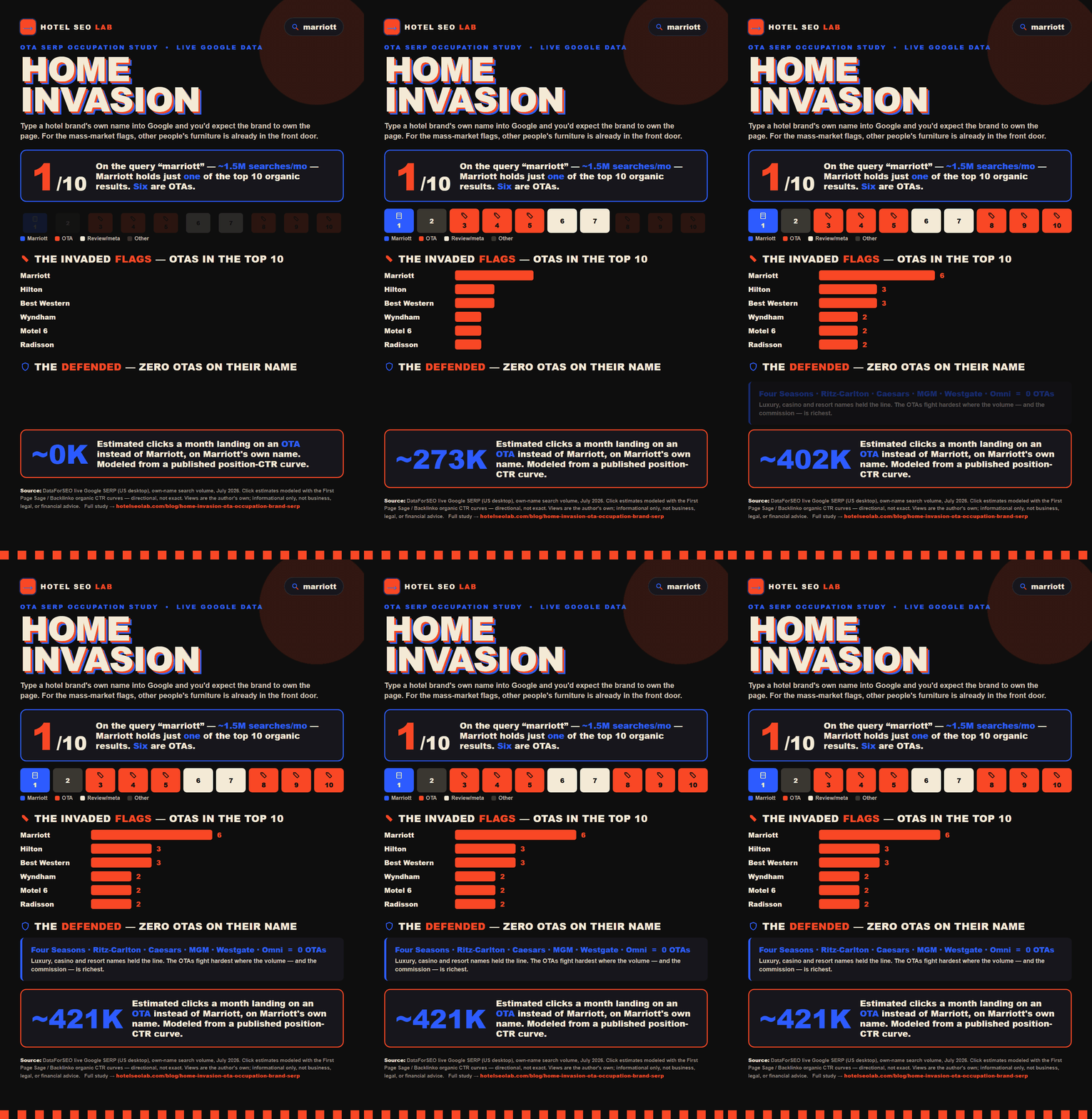
I pulled the live top 10 organic results for 16 hotel brands searching their own name, and the split is almost comically clean. The mass-market flags have been invaded. Marriott, one of the most valuable hospitality brands on earth, holds exactly one of the top 10 organic results on the query “marriott.” Six of the other nine belong to online travel agencies. Hilton holds one of six visible results, with three OTAs stacked underneath it. Meanwhile Four Seasons, Ritz-Carlton, Caesars and MGM have zero OTAs anywhere in their top 10.
This is not a story about luxury being better at SEO. It is a story about where the OTAs choose to fight, and it has a very specific lesson for anyone running an independent hotel. Let me show you the data first, then the click math, then the caveats, then what to actually do.
Download this study as a one-page PDF
How I got this data
The source is DataForSEO, the same SERP API I use for most of the studies on this site. Here is exactly what I pulled, so you can judge it.
For each of 16 hotel brands I queried its own brand name as a search term (for example “marriott,” “hilton,” “four seasons,” “caesars”) against Google’s US database on desktop. For each query I captured:
- The top 10 organic results in order, with the ranking domain for each position.
- The brand’s own-name monthly search volume (DataForSEO’s modeled average monthly US search count for that exact query).
Then I bucketed every ranking domain into one of four categories:
- Brand — the hotel company’s own domains (marriott.com, hilton.com, the parent like ihg.com for Holiday Inn, careers and sub-property sites the brand owns).
- OTA — online travel agencies: Booking, Expedia, Hotels.com, Hotwire, Travelocity, Orbitz, Kayak, Trivago, HotelPlanner and the like.
- Meta / reviews — TripAdvisor, Yelp, Trustpilot, and the social platforms that function as review or directory surfaces here (Facebook, Instagram).
- Other — Wikipedia, press, YouTube, careers portals, franchise-owned timeshare sites, and everything that is neither the brand, an OTA, nor a review site.
One honest note on method up front: bucketing is a judgment call at the edges. I counted a brand’s owned sub-property and franchise domains as “brand,” and I counted social profiles as “meta.” Reasonable people could bucket a couple of these differently. It would not move the headline, because the headline is about OTAs, and an OTA is unambiguous.
What this measures, and what it does not. This is the single top-level brand query and nothing below it. I searched the bare name — “marriott,” “hilton,” “four seasons” — as one query each. I did not pull individual property searches like “marriott marquis times square” or “jw marriott orlando,” and I did not roll up a brand’s entire search footprint. At the property level, these brands generally still own their own results. The claim here is deliberately narrow, and sharper for it: on the one query where a brand should be untouchable — its own marquee name — the mass-market flags are not. That query is the front door: the highest-volume, highest-intent brand search a hotel has. Leaking slots there is not the same as losing search overall, but it is the most valuable and most embarrassing place to lose them.
The results: who actually owns their own name
Here is the full board, sorted so the invaded flags sit at the top. “OTAs in top 10” is the number that matters.
| Brand | Own-name searches/mo | Brand results | OTA results | Review/meta | Other |
|---|---|---|---|---|---|
| Marriott | 1,500,000 | 1 | 6 | 2 | 1 |
| Hilton | 1,500,000 | 1 | 3 | 2 | 0 |
| Best Western | 550,000 | 4 | 3 | 2 | 1 |
| Wyndham | 110,000 | 1 | 2 | 4 | 3 |
| Motel 6 | 550,000 | 1 | 2 | 5 | 2 |
| Radisson | 33,100 | 1 | 2 | 4 | 3 |
| Holiday Inn | 673,000 | 3 | 2 | 3 | 2 |
| Hyatt | 673,000 | 1 | 1 | 3 | 3 |
| Choice Hotels | 368,000 | 1 | 1 | 6 | 2 |
| Hard Rock Hotels | 60,500 | 2 | 1 | 1 | 6 |
| Westgate Resorts | 74,000 | 1 | 0 | 4 | 5 |
| Omni Hotels | 110,000 | 1 | 0 | 3 | 6 |
| Four Seasons | 246,000 | 1 | 0 | 3 | 6 |
| Caesars | 201,000 | 1 | 0 | 3 | 6 |
| Ritz-Carlton | 165,000 | 1 | 0 | 3 | 6 |
| MGM Resorts | 40,500 | 3 | 0 | 2 | 5 |
Note that Hilton’s row only sums to six because that query returned six organic results in our snapshot before Google handed the rest of the page to non-organic modules. That is itself telling: on a query as commercial as “hilton,” Google fills the page with panels, and three of the six organic slots that remain are OTAs.
The pattern is impossible to miss once you sort it this way. Every brand with OTAs on its own name is a mass-market flag. Every brand with zero OTAs is luxury, casino, or resort.
Marriott is the extreme case and worth staring at. On the single query “marriott” — an estimated 1.5 million searches a month — the brand ranks once, at position 1. Positions 3, 4, 5, 8, 9 and 10 are booking.com, hotelplanner.com, hotwire.com, expedia.com, travelocity.com and orbitz.com respectively. Six OTA results on Marriott’s own name. Position 2 is not even Marriott corporate; it is a Marriott vacations sub-site.
Why the flags get invaded and the luxury names do not
Two forces, and the data shows both.
Force one: volume is a magnet for optimization. OTAs are rational. They pour brand-page effort, internal links and dedicated “Marriott hotels” style landing pages at the names that return the most money per unit of ranking effort. “Marriott” and “hilton” at 1.5 million searches each are the richest targets in the set. “Four seasons” at 246,000 and “caesars” at 201,000 are real volume, but a fraction of the flags, and a name like “mgm resorts” at 40,500 is not worth an OTA building a bespoke brand lander for. So the OTAs optimize hardest exactly where we see them: the high-volume flags.
Force two: the luxury and casino SERPs fill with their own world. Look at what actually occupies the luxury top 10s. Four Seasons’ results are Wikipedia, IMDb and Netflix (the movie franchise competes for the name), press, and the brand itself. Caesars’ page is Instagram, TripAdvisor, X, Wikipedia, Google Play and NBC News. MGM Resorts fills its top three with mgmresorts.com and its careers subdomain, then Wikipedia, LinkedIn and a corporate-responsibility page. These names are more brand-controlled and more editorial. Their SERPs are crowded with sub-properties, press and social, which leaves no soft slot for an OTA to slide into. A casino brand’s name is an entertainment and corporate query as much as a booking query, and that dilutes the transactional intent OTAs feed on.
There is a third, quieter force worth naming: brands like Best Western (four of its own results, positions 1, 2, 3 and 5) and Holiday Inn via ihg.com (three of its own, positions 1, 2, 3) are defending better because they hold multiple organic slots. Marriott and Hilton, oddly, do not — they rank once each and cede the rest. Owning your own name is partly about having enough indexable, rankable owned pages to fill the board before an OTA can.
Modeling the clicks: what the invasion actually costs
Occupying a position is only interesting if that position gets clicked. So let me put numbers on it, and cite the source honestly.
To estimate clicks I used a published position-by-position organic click-through-rate curve. The primary source is First Page Sage’s Google organic CTR study (their ongoing “Google Click-Through Rates” analysis), which I cross-referenced against Backlinko’s large-scale CTR study for sanity. The approximate curve from First Page Sage looks like this:
| Position | Approx. organic CTR |
|---|---|
| 1 | 39.8% |
| 2 | 18.7% |
| 3 | 10.2% |
| 4 | 7.2% |
| 5 | 5.1% |
| 6 | 4.4% |
| 7 | 3.0% |
| 8 | 2.1% |
| 9 | 1.9% |
| 10 | 1.6% |
Position 1 sits near 40% in the First Page Sage data and closer to 28% in Backlinko’s, which is the range the reader should hold in mind: somewhere in the high-20s to roughly 40% for the top slot, decaying to low single digits by position 10. I used the First Page Sage figures for the worked math below. You can find both studies by name; I am deliberately not inventing a precise number I cannot stand behind.
One worked example: Marriott
- Own-name searches: 1,500,000 / month.
- Marriott ranks at position 1, CTR approx 39.8%. Modeled brand clicks: about 597,000 / month.
- OTAs occupy positions 3, 4, 5, 8, 9 and 10. Summing those CTRs: 10.2 + 7.2 + 5.1 + 2.1 + 1.9 + 1.6 = 28.1%.
- Modeled clicks flowing to the six OTA positions: 28.1% of 1,500,000 = about 421,000 / month.
Read that again. On Marriott’s own trademark, the model estimates roughly 421,000 clicks a month landing on an OTA rather than on Marriott. Some of those searchers will still book Marriott — but many will book the same room through Booking or Expedia, and Marriott pays commission on a guest who typed “marriott” into Google. That is the home invasion in one number.
The invaded flags, ranked by intercepted clicks
Applying the same method — brand search volume times the summed CTR of the OTA-held positions — here is the estimated monthly click interception for every flag that has OTAs on its own name.
| Brand | OTA positions held | Summed OTA CTR | Own-name searches/mo | Est. clicks intercepted/mo |
|---|---|---|---|---|
| Hilton | 2, 4, 5 | 31.0% | 1,500,000 | ~465,000 |
| Marriott | 3, 4, 5, 8, 9, 10 | 28.1% | 1,500,000 | ~421,000 |
| Hyatt | 6 | 4.4% | 673,000 | ~30,000 |
| Holiday Inn | 8, 9 | 4.0% | 673,000 | ~27,000 |
| Motel 6 | 7, 10 | 4.6% | 550,000 | ~25,000 |
| Best Western | 6, 8, 10 | 8.1% | 550,000 | ~45,000 |
| Choice Hotels | 8 | 2.1% | 368,000 | ~8,000 |
| Wyndham | 7, 9 | 4.9% | 110,000 | ~5,000 |
| Radisson | 5, 9 | 7.0% | 33,100 | ~2,300 |
| Hard Rock Hotels | 9 | 1.9% | 60,500 | ~1,200 |
Add those up and the model puts roughly 1.0 million clicks a month flowing to OTA positions across these ten brand names — traffic that started as someone deliberately searching for the hotel by name. Hilton is interesting: it has only three OTAs versus Marriott’s six, but because one of them sits at position 2 (an 18.7% slot), Hilton’s estimated interception is actually higher than Marriott’s. Position matters more than count.
The honest caveats, stated plainly
I would be doing exactly what I criticize others for if I let those numbers stand without the asterisks. Three of them are important.
1. Branded queries skew even harder to position 1 than a generic CTR curve implies. The First Page Sage and Backlinko curves are averages across all query types. When someone searches a brand by name, they usually intend to reach that brand, and click-through to the number-one result on a navigational branded query tends to run well above the generic average. That means my model probably understates the brand’s real share and overstates the OTAs’ capture. The direction of the error favors the brand. So treat the interception figures as a ceiling on the damage, not a measured loss. The point is directional: OTAs are positioned to skim a meaningful slice, not that they literally take 421,000 Marriott searchers a month.
2. This is one live snapshot. Everything here is a single US-desktop capture from July 2026. SERPs move daily, they differ on mobile, they differ by city and by the searcher’s history. Run the same queries next week and a position or two will have shuffled. The composition pattern (flags invaded, luxury not) is stable enough that I trust it as a trend; the exact positions are not.
3. Paid ads sit above all of this, and our snapshot captured almost none. This study is organic only. In our capture the branded queries returned essentially no ads, but that is a quirk of the snapshot, not a law of nature. OTAs have historically bid on hotel brand names in Google Hotel Ads and paid search, and when they do, they sit above the organic results this whole article is about. So if anything, the organic-only view here is the optimistic version. The paid layer can make the invasion worse on any given day, which is a fight I cover in win your branded search back from the OTAs.
What to do about it if you run a hotel
You are probably not Marriott. But the mechanic that lets Booking rank third on “marriott” is the same one that lets an OTA rank second on your independent hotel’s name, and at your scale a single intercepted branded searcher hurts more, because you have fewer of them and you pay the commission out of a thinner margin.
Here is the playbook, in order of leverage.
-
Fill your own branded SERP with owned pages. The brands that defend best (Best Western, Holiday Inn) do it by holding multiple organic slots. You want your homepage, a strong Google Business Profile, and a couple of genuinely useful owned pages — an offers page, a rooms page, a location page — all indexable and all ranking for your name so there is simply less room for an OTA to occupy.
-
Win the Google Business Profile. For an independent, the map pack and knowledge panel on your own name are prime real estate an OTA cannot take. A complete, active GBP with photos, posts and reviews often outweighs an OTA listing in the searcher’s eye and pushes the OTA down the visible page.
-
Make yourself quotable with structured data. Marking up your hotel with schema helps Google (and AI answer engines) treat your own site as the authoritative source for your name, rather than deferring to the aggregator that happens to have more links. This is the same move that keeps you visible as search shifts toward AI answers.
-
Give the branded searcher a reason not to click the OTA. Price parity plus a visible direct-booking perk — a member rate, free breakfast, flexible cancellation — on the page that ranks for your name converts the person who was one click from Booking. If your direct offer is identical to the OTA’s, you have handed them no reason to stay.
-
Only bid on your own name if the math says so. Some hotels defend the top of the page with a branded paid search or Hotel Ads bid. Sometimes that is worth it to sit above an OTA that is bidding on you; sometimes it is paying for a click you would have gotten free. Measure it before you commit budget.
The uncomfortable truth underneath all of this: an OTA ranking on your own name is not stealing, it is out-competing you on the one search term you should never lose. The flags let it happen because at 1.5 million searches a month, ceding a slice still leaves a fortune. You do not have that luxury. Own your name.
The takeaway
The mass-market flags have been quietly occupied on their own trademarks — Marriott holds one of ten, Hilton one of six, and OTAs pull an estimated million-plus branded clicks a month across the invaded names. The luxury, casino and resort brands — Four Seasons, Ritz-Carlton, Caesars, MGM, Westgate, Omni — hold their own name completely, not because they are SEO geniuses but because their names are lower-volume, more editorial, and their SERPs fill with their own world before an OTA can wedge in.
The lesson for an independent is not to panic about the giants. It is to notice that owning your branded search is a choice, the OTAs will make it for you if you do not, and at your scale the invasion is cheaper to prevent than it looks.
Reminder, because it matters: everything above rests on a single US-desktop SERP snapshot (DataForSEO, July 2026) and click figures modeled from a third-party CTR curve (First Page Sage, cross-referenced with Backlinko), not measured traffic. Branded queries skew harder to position 1 than the generic curve shows, so the brand’s real share is probably higher and the interception figures are an upper bound. Positions move, mobile differs, and paid ads can sit above everything here. We are not affiliated with any brand or OTA named. This is not business, legal, or financial advice. Verify against your own market before acting.
If you want to see exactly how much of your own branded SERP you actually own — and a plan to take back the slots an OTA is renting on your name — book a call and bring your hotel’s name. We will pull the live results together and tell you honestly where you stand.