
Directional analysis, not gospel. This piece is built on a single-day, third-party snapshot of live Google results captured through DataForSEO for US desktop searches in early July 2026. Search results are volatile, personalized, and change without notice, so these numbers are a directional read of one moment, not a permanent ranking, and they may be out of date by the time you read this. Domain classification into OTA, metasearch, brand, or forum is our own judgment call and is inherently fuzzy. We are not affiliated with, endorsed by, or paid by any company named here. Nothing below is business, legal, or financial advice. Verify against your own market before acting.
Download this study as a one-page PDF
There is a specific search that decides who a value-conscious traveler will even consider, and almost no independent hotel is present when it happens.
It looks like this: someone types “best cheap hotels in [city]” into Google. They have already decided the shape of their trip. They are not dreaming about a destination anymore, and they have not yet locked in dates or a nightly rate. They have committed to one thing only, that this trip is going to be a budget trip, and now they want a shortlist. That single query is where the shortlist gets built. And when I pulled the live results for that query across the 50 largest cities in America, I found something that should bother every independent operator who competes on value: not one hotel-brand domain, and not one individual hotel, appears in the top 12 most-repeated winners. The budget shortlist is assembled entirely by companies that do not own a single room.
Let me show you exactly who does own it, how I measured it, and what a hotel that lives and dies on being the affordable option is supposed to do about it.
First, the term I want you to steal: Fit-First search
I keep needing a name for this specific moment, so I am going to give it one and use it for the rest of this piece.
A Fit-First search is a mid-to-low-funnel query where the guest has committed to the type of hotel they want, but not yet to dates or price. Family. Budget or cheap. Luxury. Downtown. Business. Pet-friendly. The guest has settled the category. What they have not settled is which specific property, on which specific nights, at which specific rate. So they Google “best [type] hotels in [city]” to build a shortlist. Fit comes first. Dates and price come later.
It is the moment after dreaming and before booking. It is where the consideration set is drawn, and everything downstream, every rate comparison, every direct-versus-OTA decision, every abandoned cart, happens inside the shortlist that this query produces. If your hotel is not on the shortlist, none of your booking-engine cleverness matters, because you were never a candidate. I call the battleground the Fit-First SERP, and today we are looking at one slice of it: the budget slice, the “cheap” modifier, where the guest has pre-committed to spending as little as possible.
That pre-commitment matters, because it changes who Google decides to trust.
How I got this data
I wanted to see the Fit-First SERP the way a real traveler sees it, not the way a keyword tool summarizes it. So I ran live searches.
I took the 50 largest US cities by population and crossed them with six Fit-First templates, one per hotel type: “best family hotels in [city],” “best cheap hotels in [city],” “best luxury hotels in [city],” “best downtown hotels in [city],” “best business hotels in [city],” and “best pet-friendly hotels in [city].” Fifty cities times six query types is 300 distinct Google searches. I pulled each one as a live US desktop result set through DataForSEO, a search-data provider that returns the actual SERP, then tallied two things for every result page: which domains appeared in the organic top 10, and which domains got cited inside Google’s AI Overview when one showed up.
The headline metric I care about is cross-city influence: for a given query type, in how many of the 50 cities does a domain appear in the organic top 10? A domain that shows up in 49 of 50 cities is not winning a keyword, it is winning a category nationwide. That is the number that tells you who genuinely owns the budget Fit-First SERP versus who got lucky in one town.
Two honest notes on scope before the numbers. This whole run cost me about 69 cents in API calls and took one afternoon, so it is a snapshot, not a longitudinal study. And an AI Overview appeared on only 83 of the 300 searches, so the AI-citation data below is thinner and more directional than the organic data. I will come back to both caveats, because they matter.
This piece focuses on the cheap cut. If you want the way I think a small property should respond to being locked out of a list-shaped query, my anti-listicle guide to building the definitive local guide is the companion playbook to this data.
The budget leaderboard: who owns “best cheap hotels in [city]”
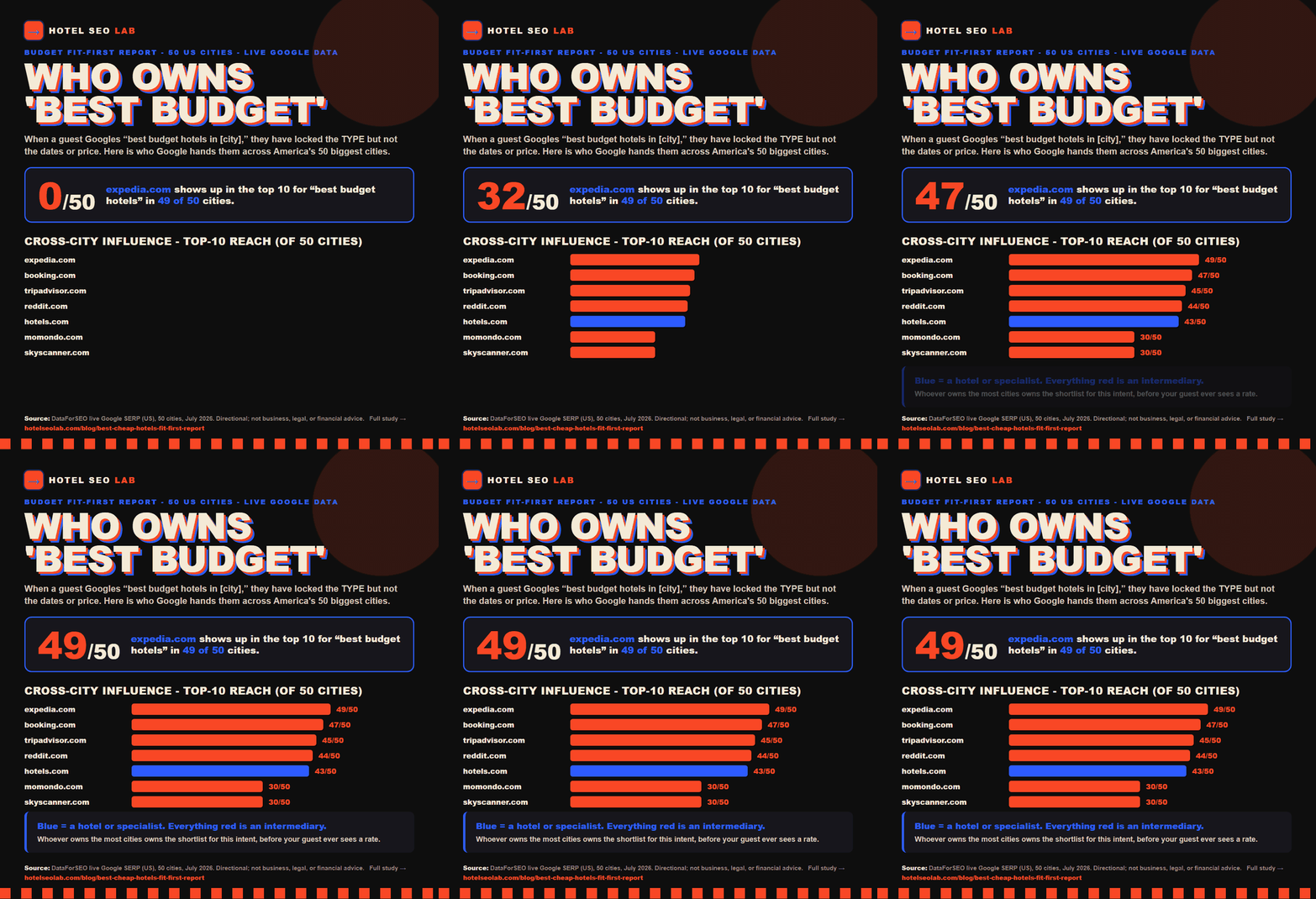
Here is the cross-city influence table for the cheap modifier. Read the middle column as “appeared in the organic top 10 in this many of the 50 largest US cities.”
| Rank | Domain | Cities (of 50) | What it is |
|---|---|---|---|
| 1 | expedia.com | 49 | OTA |
| 2 | booking.com | 47 | OTA |
| 3 | tripadvisor.com | 45 | Reviews / meta |
| 4 | reddit.com | 44 | Forum |
| 5 | hotels.com | 43 | OTA |
| 6 | momondo.com | 30 | Metasearch |
| 6 | skyscanner.com | 30 | Metasearch |
| 8 | hotwire.com | 29 | OTA / opaque deals |
| 9 | trivago.com | 26 | Metasearch |
| 10 | kayak.com | 18 | Metasearch |
| 11 | hoteltonight.com | 16 | OTA / last-minute |
| 12 | travel.usnews.com | 13 | Editorial list |
Look at what is not there. No Marriott. No Hilton. No IHG. No Four Seasons. No single independent property. The entire top 12 for the budget shortlist is intermediaries: online travel agencies, metasearch engines, a reviews aggregator, a Reddit forum, and one editorial list. Every domain on that table makes its money by standing between the guest and the hotel. Not one of them sets a nightly rate or turns down a bed.
Compare that to the other Fit-First types I measured, and the anomaly sharpens. In the family cut, Marriott appears in 28 cities. In the business cut, Marriott appears in 25 and IHG in 11. In the pet-friendly cut, Marriott hits 36, IHG 34, and Hilton 27, because branded chains have real pet policies worth citing. Hotel brands show up as legitimate answers for family, business, and pet-friendly. For cheap, they vanish. Google has decided that when a guest says budget, the trustworthy answer is not a hotel. It is a price comparison.
The metasearch tell: “cheap” is the only word that summons them
Here is the single most interesting pattern in the whole dataset, and it is the reason I wrote this piece.
Four pure metasearch engines, Momondo, Skyscanner, Hotwire, and Trivago, appear on the cheap leaderboard at 30, 30, 29, and 26 cities. Now look at how often those same domains appear across all 300 searches combined: Momondo 30, Skyscanner 30, Hotwire 29, Trivago 26. The numbers are identical. Every single time those metasearch engines rank in my entire study, it is on a cheap query. They are essentially absent from family, luxury, downtown, business, and pet-friendly. The word “cheap” is the only word that summons them.
That is not a coincidence, it is Google reading intent. The word “cheap” is a price-comparison signal, and price comparison is the exact job metasearch was built to do. When a guest signals budget intent, Google appears to re-interpret the query from “recommend me good hotels” into “help me find the lowest rate across every seller,” and it rewards the aggregators that promise to shop the whole market at once. Kayak reinforces this, appearing in 18 cheap cities out of a total of 25 across all query types. HotelTonight, the last-minute deals app, shows up in 16 cities and, like the metasearch engines, appears essentially nowhere else in the study.
So the budget Fit-First SERP is structurally different from every other Fit-First SERP. It is the one place where an entire additional layer of intermediary, metasearch, muscles in on top of the OTAs. The value-committed searcher is the most heavily intermediated searcher on the internet. Two rows of middlemen stand between them and your rate, and that is before Google’s own hotel module even enters the frame.
The AI Overview layer, thin but pointing the same way
Across all 300 searches, an AI Overview surfaced on only 83 of them, so treat this as directional. But when Google did generate an AI answer for a Fit-First query, here is who it cited most, counted across all six query types:
| Rank | Domain cited in AI Overview | Times cited |
|---|---|---|
| 1 | tripadvisor.com | 45 |
| 2 | expedia.com | 39 |
| 3 | booking.com | 27 |
| 4 | google.com | 25 |
| 4 | reddit.com | 25 |
| 6 | bringfido.com | 20 |
| 7 | marriott.com | 18 |
| 8 | hotels.com | 15 |
The AI layer does not rescue the independent. It cites the same aggregators, plus Reddit, plus Google citing itself. Tripadvisor, Expedia, and Booking sit at the top of both the organic world and the AI-summarized world. If anything, the AI Overview compresses the shortlist further, because a paragraph names three or four sources where a page of blue links named ten. Fewer slots, same owners. The guest who used to scroll a list of results now gets handed a synthesized answer built from Tripadvisor and Expedia, and the click that used to be up for grabs is increasingly not a click at all.
What the data does not say
I owe you the limits of this before you act on any of it, because a leaderboard this clean is exactly the kind of thing that gets over-read.
It is one day. Search results move. A domain at 30 cities today might be at 24 next month after a core update. The relative story, OTAs and metasearch own budget, is stable and consistent across 50 cities, which is why I trust the shape. The exact integers are not gospel.
It is desktop, US, and English. Mobile SERPs differ, the map pack behaves differently, and international markets have entirely different aggregators. If you operate outside the US, this specific cast of characters will not match your results, though the structural lesson usually does.
Classification is my judgment. Calling Tripadvisor a reviews-and-meta hybrid, or Hotwire an OTA with opaque deals, involves line-drawing that a reasonable person could dispute. The clean “OTA versus metasearch versus brand” buckets are a simplification of a messier reality.
Cross-city influence is not traffic. Appearing in the top 10 for 49 cities means broad presence, not that a domain captures most of the clicks. Position one and position nine both count as an appearance in my tally, and they are worth wildly different amounts of traffic. I am measuring footprint, not revenue.
None of those caveats change the core finding, because the core finding is not a fragile number. It is an absence. Zero hotel-brand domains in the top 12 is not a rounding error you can caveat away.
What this means for your hotel
If you compete on value, the instinct is to try to rank for “best cheap hotels in [your city].” Kill that instinct. That query is plural, list-shaped, and owned by companies with domain authority and page counts you cannot match this decade. You are not going to outrank Expedia’s programmatic city page with a single property page. That is not defeatism, it is triage. Spend the energy where it converts.
Here is where I would actually put it.
Get named inside the lists that already rank. The winners on that leaderboard are shortlists, and shortlists have entries. A Tripadvisor budget list, a US News roundup, a Reddit thread where locals name the honest-value spots, these are all pages where your property can be a line item without you owning the page. Being the third bullet in the ranking article is a completely different, and far more attainable, goal than being the ranking article. Earn the mention, the review, the local citation.
Win the searches one notch more specific. “Best cheap hotels in [city]” is brutally contested. “Cheap hotels near [specific neighborhood or landmark],” “affordable hotels near [convention center],” and your own branded terms are winnable, and they carry higher booking intent anyway. The Fit-First head term builds the shortlist, but the neighborhood-level and branded queries are where a committed guest actually converts, and they are where a small site can genuinely compete.
Assume the guest arrives pre-intermediated, and win the last step. In the budget SERP, there is a real chance the guest found you through an OTA or a metasearch engine that shopped your rate against everyone else’s. That is fine as an acquisition channel, as long as you convert that person into a direct, repeat guest instead of paying commission forever. The whole discipline of clawing the second booking back from the intermediary is what I cover in winning your branded search back from the OTAs, and for a value property it is not optional, it is the margin.
Do not let “cheap” be the only value story you tell. The reason metasearch owns this SERP is that “cheap” collapses your entire offer into a single number, price, and a number is the one thing an aggregator will always present better than you. The escape is to compete on specific value rather than raw cheapness: free parking that the downtown chains charge for, walkable location, an included breakfast, no resort fee. Those are reasons a guest picks you that a price-comparison grid cannot fully flatten, and they are the terms on which an independent can actually win a value-committed traveler.
The uncomfortable summary is this. The budget Fit-First SERP is the most intermediated real estate in hotel search. Two full layers of middlemen, OTAs and metasearch, stand between the value-committed guest and your published rate, and the AI Overview is quietly compressing the shortlist even further. You will not win that head term. You can absolutely win the guest, but only by getting named inside the lists that rank, capturing the more specific queries underneath, and converting the intercepted booking into a direct relationship before the aggregator captures it for good.
The shortlist forms whether you are on it or not. Your job is to make sure that when it does, someone with real authority is saying your name.
Reminder, because it matters: everything above is a directional read of a single-day, US-desktop snapshot pulled through DataForSEO in early July 2026. Search results are volatile and personalized, domain classifications are our own fuzzy judgment, cross-city presence is not the same as traffic or revenue, and the AI Overview sample was thin at 83 of 300 searches. We are not affiliated with any company named here, and none of this is business, legal, or financial advice. Test it against your own market before you change anything.
If you want to know where your property actually sits inside the Fit-First SERPs that matter for your city, and which of the winnable queries underneath the head term are worth your energy, book a call and bring your market. We will read the live results with you, honestly, and tell you where the shortlist is really being built.