
Opinion and directional analysis. This is an op-ed based on public information available at the time of writing, and it may be out of date by the time you read it. Any figures referenced are third-party estimates subject to change and independent validation. We are not affiliated with TripAdvisor, Booking, Expedia, Google, OpenAI, or any company named here. Nothing below is a claim of fact about any company’s financial health, and none of it is business, legal, or financial advice.
Download this study as a one-page PDF
Is TripAdvisor Dying? An SEO Post-Mortem in Progress
Let me be honest about the title before we start: I do not know whether TripAdvisor is dying, and neither does anyone else who is not sitting in their board meetings. “Dying” is a financial and strategic verdict, and I am not qualified to render it. What I can do — what I do every week for independent hotels — is read search results, watch how AI answer engines behave, and count landing pages. And when I read those tea leaves, I see a company under real structural pressure from the same forces that are quietly reshaping who owns the traveler’s first question.
So think of this less as an obituary and more as a post-mortem in progress: an autopsy on a patient who is still walking around, arguing that the reports of their decline are greatly exaggerated. They might be right. But the SEO signals deserve a hard look, because whatever happens to TripAdvisor happens to a channel that a lot of hotels still lean on.
Where TripAdvisor came from — and why it mattered
For roughly fifteen years, TripAdvisor owned a specific and enormously valuable piece of the funnel: the “is this place any good” question. Before you booked, before you even chose a destination sometimes, you went and read a wall of reviews from strangers. That was a genuine innovation, and it built one of the most link-dense, crawlable, keyword-rich properties on the travel web.
The moat was reviews plus forums plus a bottomless supply of long-tail pages — “things to do in [your city],” “best restaurants near [landmark],” hotel pages, and the sprawling destination forums where obsessives answered the same questions a thousand times. Google loved it because it was deep, fresh, and answered real intent. Travelers loved it because it felt like crowd wisdom instead of marketing.
The problem with a moat made of user-generated content is that its value depends entirely on two things staying true: that people keep contributing, and that the click keeps arriving. Both of those assumptions are now in question.
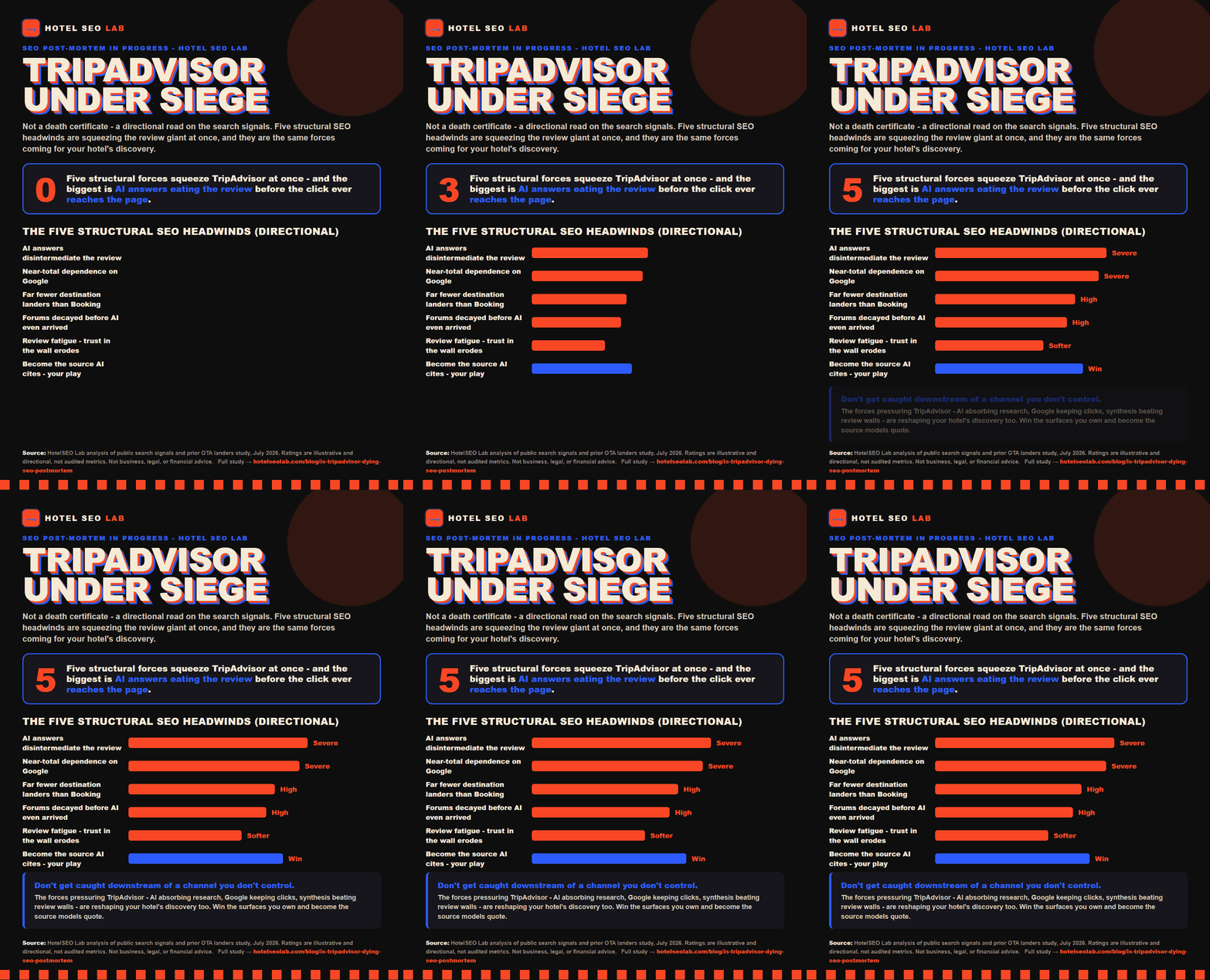
Point one: AI answers are disintermediating the review
Here is the mechanic that worries me most for any aggregator whose whole job is summarizing other people’s opinions. When you ask ChatGPT or Gemini “what is the best small hotel in [your city] for a couples’ weekend, walkable to dinner, quiet at night,” you do not get a link to a review index. You get a paragraph. The model has already read the reviews — TripAdvisor’s included — digested them, and handed you the synthesis. The aggregation layer that TripAdvisor monetized has been absorbed into the model.
This is the same disintermediation risk I keep flagging for hotels themselves in Is Your Hotel Invisible to ChatGPT, except the exposure is arguably worse for a pure aggregator. A hotel has a physical product, a direct booking path, and a reason to exist even if the research layer changes. A review index whose entire value proposition is “we gathered the opinions so you don’t have to” is precisely the thing a large language model does natively, for free, without the click.
I am not saying TripAdvisor reviews stop mattering. They matter more than ever as training and citation fodder — the models are reading them, so the sentiment still propagates. What changes is who captures the visit. The review can shape the answer without anyone ever landing on the page that hosts it. That is a brutal position for an ad-and-referral business model that historically needed the pageview.
Point two: the forums decayed before AI even showed up
The destination forums were once TripAdvisor’s secret weapon — thousands of hyper-specific, human-answered threads that ranked for questions no marketer would ever think to target. “Is it safe to walk from the station to the old town after dark.” “Which terminal for the airport bus.” Pure long-tail gold, and deeply defensible because it was real human knowledge accreting over years.
That layer had been thinning for a long time before ChatGPT arrived. Community Q and A across the web migrated to Reddit, to Facebook groups, to Discord, to specialized subreddits where the conversation felt more alive. A forum that is not actively contributed to does not just stop growing — it rots. Threads go stale, advice ages badly, and Google’s freshness signals stop rewarding it. When your long-tail content is a decade old and your community has drifted elsewhere, you are defending a castle whose walls are quietly crumbling from the inside.
The uncomfortable part is that AI answers now finish what the community migration started. The last reason to click into a dusty forum thread was that it might contain the one specific answer you needed. Now the model gives you that answer directly. Two erosions, stacked.
Point three: they rank far fewer destination landers than Booking
This is the point where I can put something closer to data on the table, and it is the observation that first made me want to write this. When we ran our study of how OTAs build and rank programmatic destination landing pages — the full teardown lives in the OTA destination landers mega-guide — one pattern jumped out. Booking and Expedia have built enormous, tightly-templated networks of city and neighborhood landing pages engineered to intercept “hotels in [your city]” style searches. TripAdvisor, by comparison, had a noticeably thinner and less optimized footprint of that specific page type.
How we got this: the comparison comes from our own manual and tool-assisted review of ranking pages for a sample of destination and “hotels in [city]” queries during that landers study. It is a directional, third-party snapshot, not an audited index count, and it will drift as everyone re-templates. Validate it against your own market before acting on it.
Why does that matter for a company’s SEO health? Because the “hotels in [destination]” query class is the commercial heart of travel search — it is where booking intent and ad revenue concentrate. Booking and Expedia treated those landers as core infrastructure and industrialized them. TripAdvisor’s strength was always reviews and things-to-do, not the transactional accommodation-index lander. In a search environment where Google increasingly hands the top of those results to a couple of dominant OTAs and its own hotel module, being under-built on the most commercial page type is a genuine structural disadvantage — and it is exactly the mechanic I break down in How OTAs Steal Search.
To be fair to TripAdvisor: they never tried to be Booking. Their pages were designed for a different intent. But intents converge under pressure, and if the review moat is eroding from the AI side, the natural retreat would be toward transactional queries — the very queries where they are least fortified.
Point four: near-total dependence on Google
Every point above is amplified by a single dependency. Like most content-and-referral businesses of its generation, TripAdvisor’s traffic has historically leaned heavily on Google organic and on Google feeding its hotel and things-to-do surfaces. When your demand is landlord-dependent, you are exposed to every move the landlord makes — and Google has spent the last two years aggressively building its own answer layer.
AI Overviews, the expanded hotel panels, Google’s own travel and things-to-do modules — each one is Google keeping the click inside its own walls instead of passing it to a third-party aggregator. A business that depends on Google for the majority of its discovery, and whose core value (aggregated opinion) is exactly what Google’s AI features now reproduce inline, is squeezed from two directions at once. That is not a TripAdvisor-specific problem; it is the defining risk of the entire “we rank in Google and monetize the visit” model. But TripAdvisor sits close to the center of the blast radius.
Point five: review fatigue is real
There is a softer, human factor underneath all the mechanics: people trust review walls less than they used to. Years of incentivized reviews, review-gating, fake five-stars, and competitors sabotaging each other have taught travelers to read review scores with a raised eyebrow. When the crowd wisdom starts to feel gamed, the emotional pull of “let me go read 400 reviews” weakens. And a model that gives you a calm, synthesized “here is the consensus, here are the two consistent complaints” feels, to many people, more trustworthy than scrolling a wall of strangers with unclear motives.
I do not think reviews are dead — social proof is eternal. But the format of reading raw review walls on a dedicated site is losing to the synthesized answer, and that format was TripAdvisor’s home turf.
The honest counter-argument
Let me argue the other side, because a post-mortem that only reads the bearish signals is just a hit piece. TripAdvisor still has an enormous brand, a genuinely deep review corpus that the AI models are actively ingesting, and a business that has been diversifying well beyond the flagship site for years — experiences and bookings being the obvious pivots. A brand that famous does not evaporate because its SEO footprint shifts. Being cited by AI models is itself a form of durable value, even when the click does not arrive, because it keeps the brand woven into the answers travelers receive.
And “the aggregator is threatened by AI” is a story you could tell about half the web right now. Being under pressure is not the same as dying. Companies re-platform, pivot, and find new revenue under exactly these conditions all the time. So I will hold my conclusion loosely: the SEO signals are genuinely concerning, and simultaneously insufficient to declare a death. Both things are true.
What this actually means for your independent hotel
Here is the part that matters for you, because your job is not to grade TripAdvisor — it is to not get caught downstream of its decline. The lesson is the same one I preach about the book-direct math: never let a channel you do not control become your center of gravity.
- Keep your TripAdvisor listing clean, but stop treating it as a growth engine. Manage the reviews, respond like a human, keep the facts accurate — because the AI models are reading it. Then stop over-investing there.
- Move your energy to surfaces you own or can win. Your own site, a ruthlessly optimized Google Business Profile, and being genuinely quotable by AI answer engines. That is where the intercepted click is going.
- Become the source, not the reviewed. The hotels that win the AI era are the ones the models cite directly. That is the whole thesis behind our AI visibility, AEO and GEO work and the reason we treat first-party content and reputation as one system in content and reputation.
- Fix the conversion path so the traffic you do earn books direct. None of the discovery work pays off if the booking leaks back to an OTA at the last step — which is exactly what book-direct CRO exists to prevent.
- Diversify the same way you would want any smart business to. If the lesson of TripAdvisor is “do not depend on one Google-fed channel,” then apply it to yourself first. That is the core of our hotel SEO approach.
The meta-point is simple and a little uncomfortable: the exact forces putting structural pressure on TripAdvisor — AI answers eating the research layer, Google keeping clicks in-house, review formats losing to synthesis — are the same forces reshaping your hotel’s discovery. Watching a giant get squeezed is a free lesson in what to build before the squeeze reaches you.
Reminder, because it matters: everything above is opinion and directional analysis based on public information at the time of writing, and it may already be out of date. Figures referenced are third-party estimates subject to change and independent validation. We are not affiliated with TripAdvisor or any company named here, this is not a claim of fact about anyone’s financial condition, and none of it is business, legal, or financial advice. Verify against your own market before you act.
If you want a clear-eyed read on which channels actually deserve your attention this year — and how to make your hotel the source AI engines quote instead of a listing they summarize — book a call and we will map it to your specific market. No guarantees, no “#1 in a week” nonsense. Just an honest plan.