Directional analysis, not gospel. The TripAdvisor numbers below come from a single snapshot of live Google results, 300 “best [type] hotels in [city]” searches captured on one date across the 50 biggest US cities, and search moves constantly. They are appearance and citation counts from that snapshot, not audited index figures, and they will drift. Domain classification is our own judgment. We are not affiliated with, endorsed by, or paid by TripAdvisor or any company named here, and nothing here is a statement of fact about any company’s conduct. Nothing below is business, legal, or financial advice. Validate against your own market before acting.
Download this study as a one-page PDF
How to Break TripAdvisor’s ‘Best-of’ Moat on Google
Let me show you the single most intimidating number in independent-hotel SEO, and then let me tell you why it is not as permanent as it looks.
I ran 300 live Google searches, the 50 biggest US cities crossed with six “best [type] hotels in [city]” modifiers, and tallied every domain that showed up. One domain appeared in the top 10 of all 50 cities and racked up 267 total appearances across the 300 results, more than Expedia, more than Booking, more than Reddit, more than any hotel brand on earth. That domain is TripAdvisor. It is not the biggest OTA on this page. It is bigger than the OTAs. On the exact page where your future guest decides which kind of hotel they want and starts building a shortlist, TripAdvisor is not a competitor. It is the terrain.
That is what a moat looks like in a search result. And if you have ever tried to out-rank it by “publishing more content” or “doing SEO harder,” you already know how that fight ends. You do not beat TripAdvisor domain-on-domain. Nobody does.
So this piece is not going to promise you that you will. That would be exactly the kind of guarantee I built this blog to mock. Instead I am going to do something more useful: take the moat apart and show you what it is physically made of, because a moat made of specific, identifiable materials has specific, identifiable weak points. Then I am going to give you seven honest plays that attack those weak points, none of which require you to win a domain-authority contest you were always going to lose.
One thing up front, because it changes the whole calculation: this moat is already draining. I wrote a full post-mortem on it, Is TripAdvisor Dying? An SEO Post-Mortem in Progress. The short version is that the mid-funnel intent TripAdvisor used to own is being quietly rerouted to Google’s own surfaces, to AI answers, and to Reddit, and the review moat that once made it un-Googleable is visibly leaking. You are not trying to breach a wall at the height of its power. You are trying to accelerate an erosion that is already underway.
First, respect the moat, because it is real
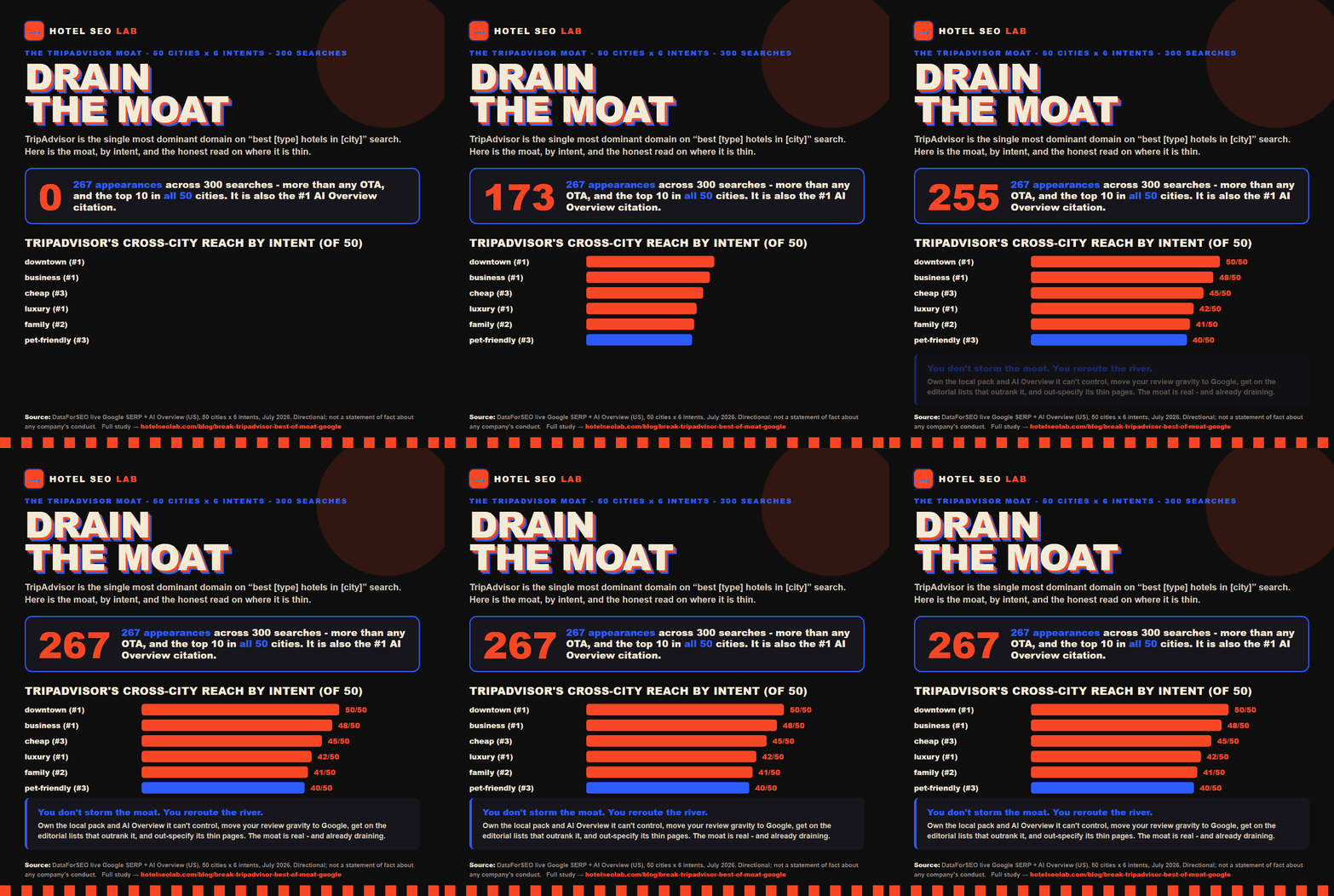
Before the optimism, the honest picture. Here is how TripAdvisor performed across the six Fit-First modifiers in the snapshot, measured by how many of the 50 cities it cracked the top 10 for.
| Modifier | TripAdvisor rank | Cities reached (of 50) |
|---|---|---|
| downtown | #1 | 50 |
| business | #1 | 48 |
| luxury | #1 | 42 |
| cheap | #3 | 45 |
| family | #2 | 41 |
| pet-friendly | #3 | 40 |
It leads three of the six modifiers outright and never falls out of the top three of any of them. It is the only domain in the entire study that reached all 50 cities on the “downtown” query. And on the AI Overview layer, the block Google is increasingly putting above the blue links, TripAdvisor was the single most-cited source, 45 of the 83 times an AI Overview appeared. Not only does it own the organic results, it is the source Google’s own answer engine reaches for most.
I am not going to soft-pedal that. If your plan is “we’ll just outrank tripadvisor.com for best downtown hotels in Chicago,” throw the plan away. That is a frontal assault on a fortified position, and it is how independents burn two years of budget and win nothing.
What the moat is actually made of
Moats are not magic. This one is made of five materials, and naming them is the whole game, because each material has a flank.
1. A review corpus at impossible scale. TripAdvisor’s core asset is millions of reviews accumulated over two decades. You cannot out-volume that. But volume on TripAdvisor’s domain is not the same as volume on the surface Google trusts most, and that gap is a door.
2. Programmatic “best-of” list pages. TripAdvisor has an auto-generated “best [type] hotels in [city]” page for essentially every city and modifier, populated by its own ratings. That structural coverage is why it shows up in all 50 cities. But those pages are generic by design, thin on genuine local specifics, and that thinness is exactly what a real guide can out-rank on the long tail.
3. Entity and domain trust. Google extends enormous trust to established aggregated-review indexes for “best of” queries. That trust is decades deep and you will not replicate it. But entity trust is not exclusive, Google can trust your property as an entity too, and it increasingly wants first-party and local signals it did not used to weight.
4. Freshness and engagement signals. Constant user activity keeps TripAdvisor’s pages looking alive to Google. This is the material that is decaying fastest, per the post-mortem, as engagement migrates elsewhere.
5. Travelers’ Choice awards and its own list ecosystem. TripAdvisor feeds its rankings with its own awards program, a closed loop that reinforces its authority. You cannot join the loop, but you can get onto the other lists that outrank it, which is Play 3.
Look at that list again. Two of the five materials (freshness, and the relevance of its programmatic pages) are actively softening. The other three you cannot copy, but you can route around. That is the strategy in one breath: you do not storm the moat, you reroute the river that fills it.
The seven plays
Everything above is diagnosis. Here is what you actually do.
Play 1: Take the surfaces TripAdvisor does not control, starting with the local pack
This is the highest-leverage move on the list, and most hoteliers walk right past it. TripAdvisor lives in the organic results. But sitting physically above the organic results on a huge share of these queries is the Google local pack, the map with three listings, and TripAdvisor does not own a single pixel of it. Your Google Business Profile does.
When a search carries local intent, and “best hotels in [city]” screams local intent, Google frequently renders the map pack first. A ruthlessly optimized Business Profile can appear there, above the entire organic result set where TripAdvisor is fighting. You did not beat TripAdvisor’s domain authority. You went over its head to a surface it cannot compete for. Get your profile category, attributes, photos, and posts genuinely complete, the full field-by-field version is in the Google Business Profile playbook.
Play 2: Move your review gravity to Google
TripAdvisor’s whole moat is reviews. So stop donating to it. Every review you actively steer to your Google Business Profile instead of TripAdvisor does two things at once: it strengthens the exact signal that wins Play 1’s local pack, and it is a review that happened on a surface TripAdvisor cannot gate, monetize, or count. Reviews are a zero-sum store of guest attention, and right now most hotels passively let TripAdvisor collect the deposit.
This is not about suppressing anyone or gaming anything, both of which are against the rules and beneath you. It is about where you point the ask. A guest who had a great stay will leave a review wherever you make it easiest. Make it easiest on the surface that feeds Google directly. Do that for a year and you have quietly reallocated your own review corpus to the platform that actually decides the ranking.
Play 3: Get placed on the editorial lists that already outrank TripAdvisor
You will not out-rank TripAdvisor. But U.S. News, Forbes Travel Guide, and Conde Nast Traveler sometimes do, and they are on these pages right next to it. In the snapshot, U.S. News reached 49 of 50 cities, and on “luxury,” “downtown,” and “business,” editorial listicles ran genuinely deep. If your property is on those lists, you are inside a result that already competes with TripAdvisor, borrowing an authority you could never build alone.
This is earned-media and PR work, not keyword work: press kits, pitches to the regional editors who maintain those rankings, awards submissions, and the underlying merit that makes the placement defensible. Aim at the two or three lists that actually rank in your city for your modifier. One real placement on a list that outranks TripAdvisor is worth more than a hundred blog posts that do not.
Play 4: Win Reddit, the surface actively eating TripAdvisor
Here is the most important trend in the whole dataset: Reddit reached all 50 cities and posted 216 appearances, and it is climbing. Reddit is not just another competitor, it is a chunk of the exact “real people, real opinions” trust that used to be TripAdvisor’s entire reason to exist, migrating to a platform TripAdvisor does not own. When Google and its AI answer cite Reddit, they are citing the thing they used to cite TripAdvisor for.
You cannot buy your way in, and you should never astroturf, it backfires and it is against the rules. But you can be genuinely present: a real, non-spammy account that actually helps in your city’s travel and local subreddits over months, an honest answer when someone asks about your neighborhood, a property that is good enough to get recommended by strangers. Being organically mentioned in the threads Google now trusts is a direct transfer of authority away from TripAdvisor and toward you.
Play 5: Become a source the AI Overview cites
The AI Overview showed up on 83 of the 300 results and cited TripAdvisor most, 45 times. But it did not cite TripAdvisor exclusively, it leaned on the whole review-and-list corpus plus Reddit and travel media. That means there is room in the answer, and the answer increasingly is the page. If Google’s AI writes the recommendation and cites five sources, being one of the five keeps you in front of the guest even when TripAdvisor is also there.
The work is the same work: clean structured data on your own site so a model can read your facts without guessing, a steady flow of specific recent reviews, accurate entity information on every surface a crawler touches, and genuine mentions in the media and Reddit threads the models ingest. That is answer-engine optimization, and the full pattern is in Who Google’s AI cites for hotels. You do not prompt your way into the answer, you earn your way into its sources.
Play 6: Out-specify TripAdvisor’s thin pages on the long tail
TripAdvisor wins the head term “best downtown hotels in Denver.” It does not win “quiet boutique hotels walkable to the Denver convention center with free parking.” Its programmatic pages are a mile wide and an inch deep, generic by construction. The counter is to build the thing those pages only pretend to be: the definitive local guide a concierge would actually hand a guest, neighborhood by neighborhood, with the specific answers your front desk gives every day.
That content ranks for hundreds of long-tail queries TripAdvisor’s thin pages never satisfy, and it earns the internal links that turn a guide into a booking path. The full framework is The Anti-Listicle. You are not beating TripAdvisor on its keyword. You are winning the thousand keywords it was too generic to serve.
Play 7: Build entity strength so Google sees your hotel, not just your listing
TripAdvisor benefits from Google understanding “this is a real, trusted entity.” You can earn a slice of that same understanding. Complete, consistent structured data (the hotel JSON-LD library walks through it), a Wikidata and knowledge-panel presence (entity SEO for hotels), and identical name, address, and category everywhere a crawler looks, all of it tells Google your property is a first-class entity in its own right, not merely a row inside somebody else’s index. The more Google understands you directly, the less it needs to route through TripAdvisor to understand you at all.
Put it in order
Seven plays is a lot, so here is the sequence that compounds fastest.
Start with Plays 1 and 2 together, own the local pack and move your review gravity to Google, because they are the cheapest, they reinforce each other, and they attack the moat’s core material (reviews) while going over its head (the map). Then run Play 5 and Play 7 in parallel as the always-on foundation, structured data, entity consistency, and AEO presence, because they make every other play work better. Then invest in the slower, PR-shaped plays, 3, 4, and 6, editorial placement, Reddit presence, and definitive long-tail content, which pay off over quarters, not weeks, but which erode TripAdvisor’s actual relevance rather than just routing around it.
Notice what is not on the list: “publish a ‘best hotels in our city’ page and try to outrank TripAdvisor.” That is the one move that feels like fighting the moat and is actually just donating to it, you become one more thin best-of page for Google to ignore in favor of the domain that already owns the format.
The honest caveats
I would rather you trust the method than the marketing, so hold the limits in view.
This is one snapshot, one date, 300 US-English queries, and search reshuffles daily, a rerun next month would move the numbers even if it would not move the shape. The appearance and citation counts are tallies from live results, not audited index data. Domain classification is my judgment. AI Overviews appeared on only 83 of 300 results, so that layer is real but not yet universal and it is a fast-moving target. And most importantly: none of these plays will let you “beat” TripAdvisor on its own head term, and anyone who tells you otherwise is selling something. What they will do, run patiently and together, is siphon the intent, the reviews, and the citations that fill its moat, on surfaces where its dominance does not reach and its relevance is already slipping.
The moat is real. It is also draining. Your job is not to storm it, it is to help it drain faster while you catch the water.
If you want help running these plays, the Google Business Profile and review work behind Plays 1 and 2, the AEO and entity work behind Plays 5 and 7, the content behind Play 6, or the digital-PR motion behind Plays 3 and 4, that is the work we do at HotelSEO Lab. You can see how we break it down on our services page. No guarantees, no “outrank TripAdvisor in 30 days” nonsense, just an honest plan mapped to the moat in your specific market.