
Directional analysis, not gospel. This is a single-snapshot study of live Google results captured on one date in a US search context, using third-party SERP data that is inherently noisy and changes constantly. The classification of what counts as a “business” result, and which domains are “editorial” versus “OTA” versus “brand,” is my own judgment call and is debatable. I am not affiliated with, endorsed by, or paid by any company named here. Nothing below is business, legal, or financial advice. Validate against your own market before you act on any of it.
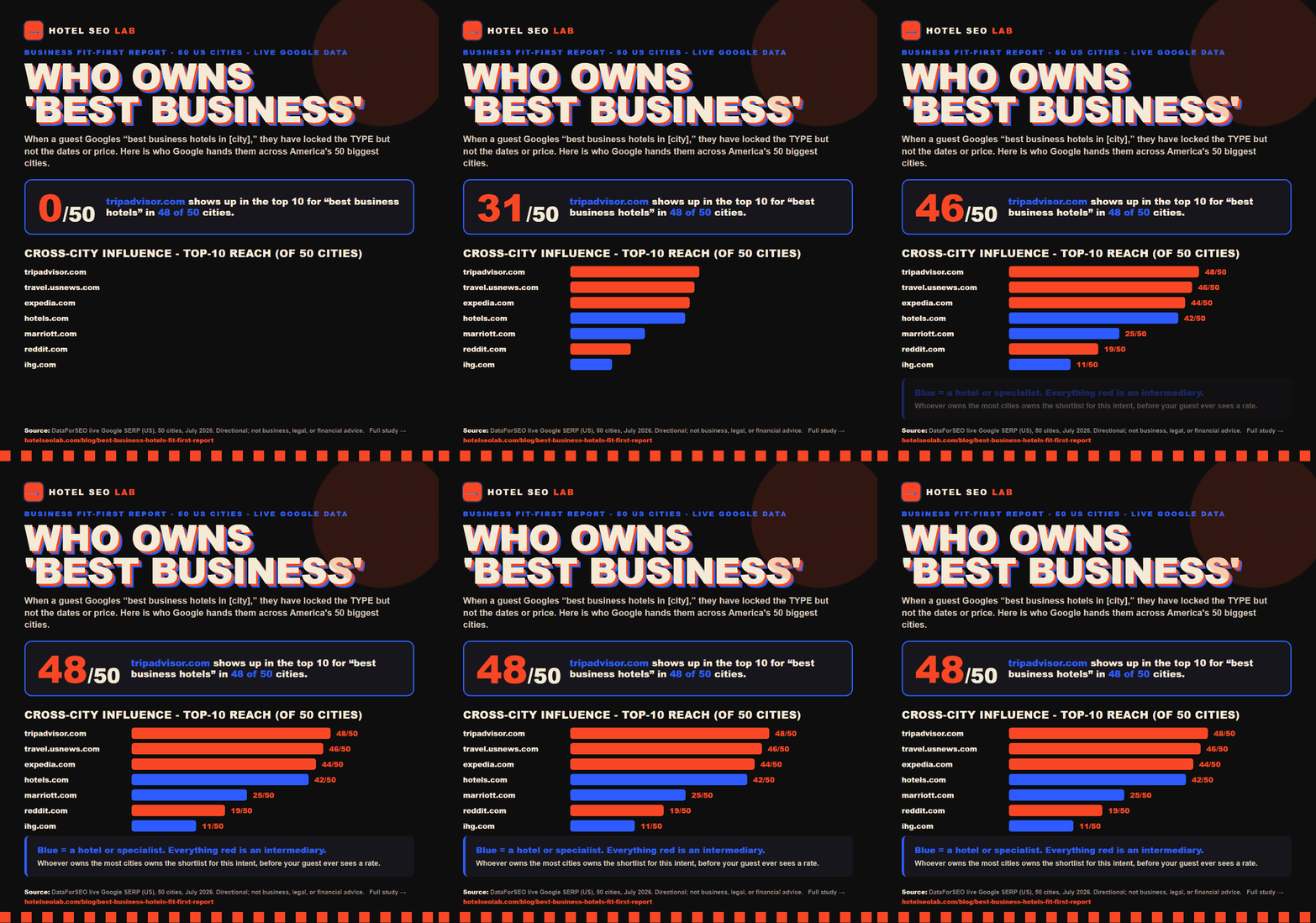
Download this study as a one-page PDF
Every hotel marketer has a story about the “best hotels in [city]” search. You Google your own market, you scroll past four OTAs and a review site, and you do not see yourself. Then you close the tab and quietly rage.
I wanted to stop guessing about that page and actually measure it. So I ran the experiment at scale, and this report is the business-traveler slice of it: who Google surfaces when someone types “best business hotels in [city]” across the 50 biggest cities in America. It is the most interesting slice of the whole study, because the business SERP behaves almost nothing like the others — and the way it differs is exactly the opening an independent operator has been waiting for.
First, the term: Fit-First search
Let me define the thing this whole report is about, because it does not have a good name and it deserves one.
A Fit-First search is a mid-to-low-funnel query where the guest has committed to the TYPE of hotel they want, but not yet to dates or price. Family. Budget. Luxury. Downtown. Business. Pet-friendly. They have made the hardest decision already — what kind of stay this is — and now they are Googling “best [type] hotels in [city]” to build a shortlist.
This is not top-of-funnel dreaming (“where should I go”). It is not bottom-of-funnel transaction (“Hilton Austin March 3 to 5 rate”). It is the moment in between, the moment the shortlist forms: after dreaming, before booking. I call the page that answers it the Fit-First SERP, and I would argue it is the single most valuable piece of organic real estate an independent hotel can realistically contest. The searcher has told Google exactly what they want and exactly where. All that is left is to name the winners.
“Best business hotels in [city]” is a pure Fit-First query. The traveler is not browsing. They have a trip, a reason, and a checklist — walkable to the client office or the convention center, a desk that works, fast wifi, a bar to close a deal in, loyalty points that matter to their employer. They are picking. The only question is who Google lets them pick from.
How I got this data
Here is the method, in full, because a leaderboard with a hidden method is just an opinion in a table.
I took the 50 largest US cities by population and paired each one with six Fit-First modifiers — family, cheap, luxury, downtown, business, and pet-friendly — to build 300 queries of the form “best [modifier] hotels in [city].” I then pulled the live Google results for all 300 through DataForSEO, a SERP data provider, in a US search context on a single date. For each query I recorded the organic top 10 and the domains cited in Google’s AI Overview when one appeared.
The headline metric is cross-city influence: for a given modifier, how many of the 50 cities does a domain appear in the organic top 10 for? A domain that shows up in 48 of 50 cities is not ranking by luck or by local relevance — it has an industrial, templated, national position on that query class. That is the thing worth measuring, because it tells you who has systematized the Fit-First SERP versus who wins one city by accident.
This report zooms into one of those six modifiers: business. Where useful I compare it against the other five, because the contrast is where the real story lives. And to be clear about the ceiling of this data: it is one snapshot, one country, one date, and one person’s classification of results. It is a photograph, not a documentary.
The business Fit-First leaderboard
Here is who owns “best business hotels in [city]” across the 50 biggest US cities, ranked by how many of those 50 cities each domain cracked the organic top 10 in.
| Rank | Domain | Cities (of 50) | Type |
|---|---|---|---|
| 1 | tripadvisor.com | 48 | Review aggregator |
| 2 | travel.usnews.com | 46 | Editorial ranking |
| 3 | expedia.com | 44 | OTA |
| 4 | hotels.com | 42 | OTA |
| 5 | marriott.com | 25 | Brand.com |
| 6 | reddit.com | 19 | Forum / UGC |
| 7 | ihg.com | 11 | Brand.com |
| 7 | ca.trip.com | 11 | OTA |
| 9 | booking.com | 10 | OTA |
| 10 | fivestaralliance.com | 9 | Editorial / luxury |
| 11 | omnihotels.com | 8 | Brand.com |
| 11 | partyslate.com | 8 | Events / venues |
Four domains — TripAdvisor, US News, Expedia, and Hotels.com — are in 42 or more of the 50 cities. That is the wall. Those four are close to omnipresent, and if you are an independent hotel, they are the layer above you that you are trying to get cited inside, not the layer you are going to displace.
But the interesting story in the business SERP is not the wall. It is everything that is different about it once you get past the wall.
What makes the business SERP weird (and winnable)
I looked at all six modifiers side by side, and business is the outlier. Three things break the pattern.
One: the forum layer collapses. This is the single most important finding in the report. Reddit is a monster on the emotional Fit-First queries — it appeared in the top 10 for 42 of 50 cities on family, 44 on cheap, 43 on downtown, and 39 on luxury. On business, it falls to 19. Here is that collapse in one table:
| Modifier | Reddit cities (of 50) |
|---|---|
| cheap | 44 |
| family | 42 |
| downtown | 43 |
| luxury | 39 |
| pet-friendly | 21 |
| business | 19 |
Business is the modifier where the crowd-wisdom layer is weakest by a wide margin. My read: choosing a business hotel is a specification-driven, professional decision, and Google seems to reward structured editorial and brand pages over a stranger’s first-person weekend story for that intent. Nobody wants “here’s my vibe” when they need “walkable to the convention center, reliable desk, and my company’s preferred rate.” The emotional-proof engine that dominates the family and cheap SERPs is running at half power here — and that is precisely the gap where deliberate, well-structured content can slip in.
Two: editorial surges. US News (travel.usnews.com) is second across 46 of 50 cities, its strongest showing of any modifier — it hits 44 on downtown and 33 on luxury but only 13 on cheap and does not even chart on family or pet-friendly. Editorial “best business hotels” rankings are catnip to Google here. The business traveler wants an authority to have pre-vetted the list, and Google obliges. That tells you the format that wins this SERP is the curated, criteria-driven ranking — not the listicle-of-vibes and not the raw review dump.
Three: brand.com breaks in. Marriott lands in 25 of 50 cities on business, cracking the top 5 — a level of brand.com strength you do not see on the softer modifiers, where Marriott sits at 9 on luxury and 9 on downtown. Add IHG at 11 and Omni at 8, and the business SERP is visibly friendlier to a hotel’s own domain than any other Fit-First query in the study. Business travelers search brands and book on loyalty, Google knows it, and the algorithm leaves room for the brand’s own pages. For an independent, the lesson is not “become Marriott.” It is that on this specific query, Google is demonstrably willing to rank a hotel’s own site — which is more than you can say for the cheap SERP, where OTAs and metasearch swallow the page whole.
And notice who is weak here. Booking.com, which is in 47 of 50 cities on cheap, collapses to 10 on business — it barely competes for the business traveler. The OTA that owns price-shopping does not own the professional shortlist. That asymmetry is a strategic gift if you know how to use it.
There is also some noise worth naming honestly: partyslate.com (an events and venue platform) charts at 8, and ca.trip.com (a Canadian subdomain) at 11. Those are partly a classification artifact — “business hotels” bleeds into “meeting and event venues,” and international subdomains leak into US results. I am not going to pretend those are clean signals. They are exactly the kind of edge case a single-snapshot study surfaces, and I would rather show them to you than quietly delete them.
The AI Overview layer
Google returned an AI Overview on 83 of the 300 queries in the full study — a little over a quarter of the time. When it did, the citations skewed to the same heavyweights: across all modifiers, TripAdvisor was cited in 45 AI Overviews, Expedia in 39, Booking in 27, and Google’s own properties and Reddit in 25 each.
I want to be careful not to over-claim here: 83 is the count across all six modifiers, not a business-only figure, so I will not pretend to a precise business AI Overview number I did not isolate. But the direction is clear and it matters. The AI answer layer is being fed by the same aggregators and editorial sources that own the organic page. Getting cited by the models is not a separate game from ranking — it is the same sources, re-summarized. If you are invisible to the organic Fit-First SERP, you are very likely invisible to the AI Overview that sits on top of it.
The honest caveats
Let me be blunt about what this report is not, because the failure mode of a study like this is that people quote the table and forget the fine print.
It is a snapshot, on one date. SERPs churn. Run these same 300 queries next month and the numbers will drift — a few cities flip, a domain gains or loses two or three. The shape of the finding (business behaves differently, forums collapse, editorial and brand surge) is more durable than any single cell in the table. Trust the pattern more than the exact integer.
It is US-only and English-only. Fifty US cities in a US search context. If your market is Toronto or Manchester, the cast of characters changes, and the ca.trip.com leakage in my own data is a live reminder that borders are messy.
The classification is a judgment call. I decided what counts as a “business” result, which domains are “editorial” versus “OTA” versus “brand,” and how to treat oddballs like PartySlate. Reasonable people would draw some of those lines differently. The leaderboard is only as clean as those calls.
Visibility is not victory. This measures who Google surfaces, full stop. It says nothing about who converts the click, who wins the booking, or who the guest is happiest with. A domain can own the shortlist and lose the sale. That gap — between being seen and being chosen — is the entire discipline, and no SERP export captures it.
What this means for your hotel
If you run an independent property that competes for business travelers, here is what I would actually do with this.
Treat the business Fit-First SERP as your best organic bet, and act like it. Of the six modifiers I studied, this is the one where the two things blocking independents everywhere else — the Reddit forum wall and total OTA saturation — are both weakest. The door is more open here than on any other Fit-First query. That is not a reason to relax; it is a reason to concentrate.
Get inside the editorial lists, because Google trusts them here. US News and the criteria-driven rankings are the surging format on this query. You do not out-rank US News; you get into the piece US News and its equivalents publish, and into the local business-press “best hotels for business travel” roundups that feed the same intent. The way you earn that is by being genuinely, specifically the best answer for a stated business need — and by making that case in structured, quotable content on your own site. I laid out the full method for building the definitive local resource instead of a thin listicle in Anti-Listicle: Build the Definitive Local Guide, and it maps almost perfectly onto this SERP.
Lean into the format the business searcher rewards: specification, not vibe. The forum collapse is telling you something. Publish the desk dimensions, the wifi speed, the walk time to the convention center in minutes, the meeting-room capacities, the corporate-rate and loyalty details, the late-checkout policy for the red-eye crowd. Structured, factual, criteria-first content is what wins here — it is also exactly what the AI Overview wants to cite.
Since brand.com can rank on this query, defend and build your own domain. Business is the modifier where Google demonstrably lets a hotel’s own site in. That makes your owned pages a real asset instead of a formality — which only pays off if the branded searches that follow do not leak straight to an OTA. If you have not already, plug that leak first; I walk through exactly how in Win Your Branded Search Back From OTAs.
Aim realistically. You are almost certainly not going to displace TripAdvisor, US News, Expedia, and Hotels.com from the top of the page. The winnable prizes are: inclusion inside those editorial and OTA lists, the AI Overview citation, and an organic slot in the long tail below the wall where the forum layer has vacated the field. On the business SERP, all three are more reachable than they are anywhere else in the Fit-First landscape.
The takeaway
The business Fit-First SERP is the exception that proves the rule. On the emotional queries — family, cheap, luxury — a stranger on Reddit and four OTAs own the shortlist, and an independent hotel is mostly locked out. On business, the crowd layer collapses, editorial authority surges, brand.com breaks in, and even Booking.com loses interest. That combination is the closest thing to an open lane that an independent operator gets in organic search.
It will not last forever, and it will not fall into your lap. But if you are going to pour content and structured-data effort into one Fit-First query this year, the data says make it the one where the wall is lowest. For a lot of you, that is “best business hotels in [your city].”
Reminder, because it matters: everything above is a single-date, US-only, English-only snapshot built on third-party SERP data that is noisy and constantly changing, interpreted through my own debatable classification of results. It measures visibility, not bookings, revenue, or guest satisfaction. I am not affiliated with any company named here. This is not business, legal, or financial advice. Re-run it for your own market before you make a decision on it.
If you want the same 300-query teardown run for your specific city and property type — and an honest read on whether the business Fit-First lane is actually open in your market — book a call. No “#1 in a week” nonsense. Just the data and a plan.