
Directional analysis, not gospel. This piece is built on a single snapshot of live search results captured on one date via a third-party data provider. Search is personalized, localized, and constantly changing, so your results may differ and these numbers will drift. Domain classifications (which sites are OTAs, editorial, or hotel brands) are my own judgment calls. I am not affiliated with, endorsed by, or paid by any company named here. Nothing below is business, legal, or financial advice. Verify against your own market before acting.
Download this study as a one-page PDF
There is a specific search a person types when they have decided to spend real money and have not yet decided where. It looks like this: best luxury hotels in Miami. Best luxury hotels in Chicago. Best luxury hotels in Seattle.
The guest doing that search is not dreaming anymore and not booking yet. They have committed to the TYPE of stay: luxury. They have not committed to dates, to a price, or to a property. They are building a shortlist. And the businesses that show up on the first page of that search get to decide which hotels make the list and which do not.
I wanted to know who actually owns that moment for luxury. Not who thinks they own it. Who Google actually shows. So I pulled the data: the 50 biggest cities in the United States, the same luxury query for each, live from Google, and I counted who appears.
The short version, before we get into the method: the luxury hotels themselves mostly lose this search. Editorial gatekeepers and review aggregators win it. And exactly one hotel brand in America has enough domain muscle to force its way onto the page.
What “Fit-First search” means, and why luxury is the sharpest example
Let me define the term I keep using, because it is the whole frame.
Fit-First search is a mid-to-low-funnel query where the guest has committed to the TYPE of hotel they want (family, budget, luxury, downtown, business, pet-friendly) but NOT yet to dates or price. They Google best [type] hotels in [city] to build a shortlist. It is the moment the shortlist forms: after dreaming, before booking. I call the first page of results for that query the Fit-First SERP, and it is a battleground most hotels never consciously fight for.
Luxury is the sharpest version of this because the stakes per booking are highest and the guest is least price-sensitive. A person searching best cheap hotels is going to a metasearch grid to compare prices. A person searching best luxury hotels is looking for a curated opinion about which properties are actually worth it. That is an editorial job, and it turns out the editorial players know it.
Here is who structurally owns that job right now.
How I got this data
I used DataForSEO to pull live Google organic results for six Fit-First query types across the 50 largest US cities by population. Six modifiers (family, cheap, luxury, downtown, business, pet-friendly) times 50 cities equals 300 live SERPs, captured on a single date in early July 2026, US Google, desktop, top 10 organic positions plus any AI Overview citations recorded.
For each result I tallied two things:
- Cross-city influence: how many of the 50 cities a given domain appears in the top 10 for on a given query type. This is the important number. A domain that ranks in 42 of 50 cities is not winning one lucky market. It is structurally installed across the country.
- AI Overview citations: which domains Google’s AI Overview cited, when it chose to show one at all.
This report focuses on the luxury slice: the 50 best-luxury-hotels searches, one per city. Where it is useful I will contrast luxury against the all-query picture. The full run cost me well under a dollar in API spend, which is worth stating plainly, because the barrier to knowing this about your own market is basically zero and most hotels still operate on vibes.
One honest note up front on classification. Deciding whether a domain is an OTA, an editorial publisher, a review aggregator, or a hotel brand is my judgment, and a few sites blur the lines. I have tried to be consistent. Disagree where you like.
The luxury Fit-First leaderboard
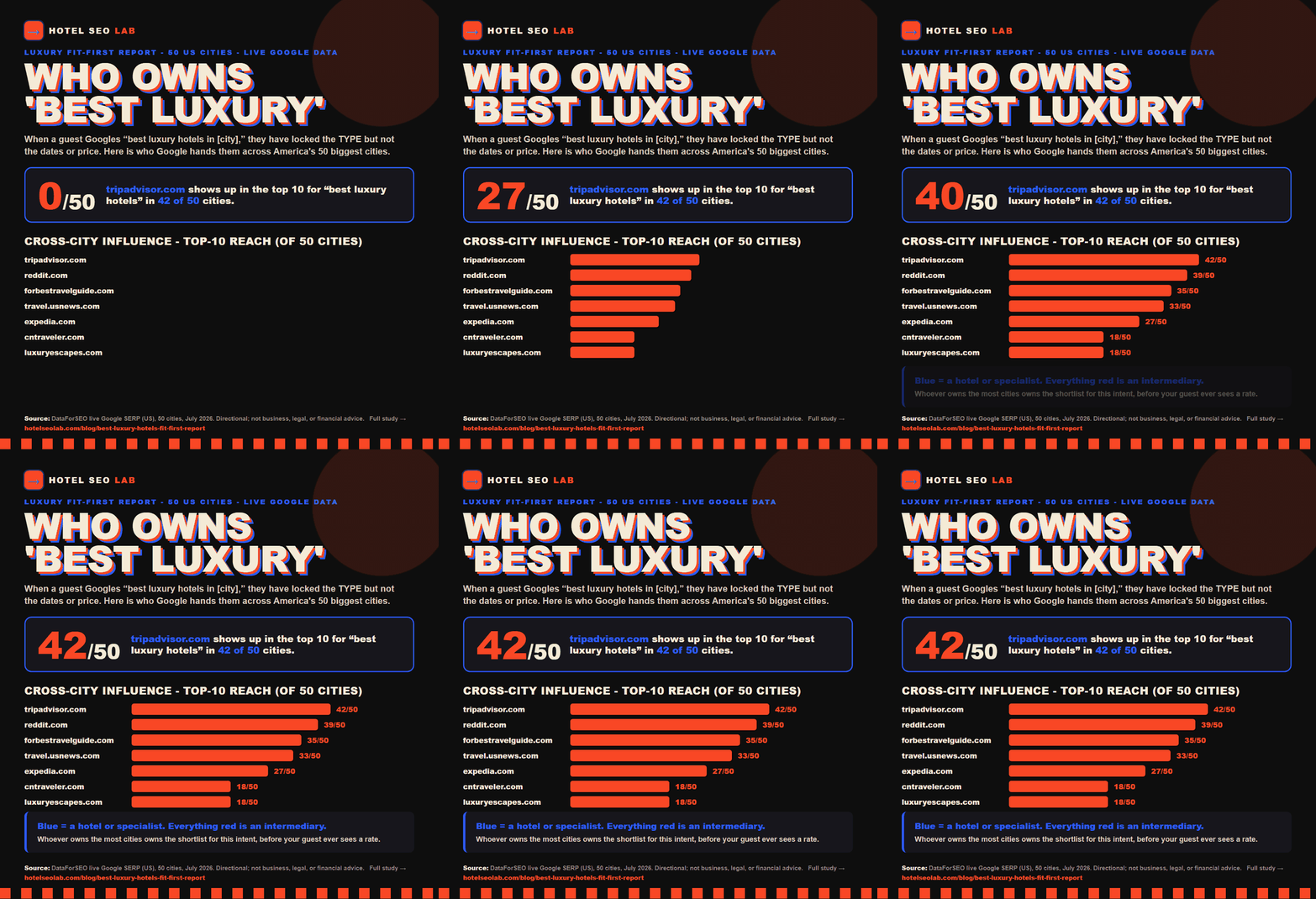
This is the ranking that matters. Each number is the count of cities, out of 50, where that domain appeared in the organic top 10 for the best-luxury-hotels query.
| Rank | Domain | Cities (of 50) | Type |
|---|---|---|---|
| 1 | tripadvisor.com | 42 | Review aggregator |
| 2 | reddit.com | 39 | Community / UGC |
| 3 | forbestravelguide.com | 35 | Editorial gatekeeper |
| 4 | travel.usnews.com | 33 | Editorial gatekeeper |
| 5 | expedia.com | 27 | OTA |
| 6 | cntraveler.com | 18 | Editorial (Conde Nast) |
| 6 | luxuryescapes.com | 18 | OTA (luxury) |
| 8 | fourseasons.com | 13 | Hotel brand |
| 9 | hotels.com | 12 | OTA |
| 10 | luxurylink.com | 11 | OTA (luxury) |
| 10 | tablethotels.com | 11 | Editorial / booking (luxury) |
| 12 | marriott.com | 9 | Hotel brand (portfolio) |
Read that table slowly, because almost every expectation about a luxury audience being different is wrong.
TripAdvisor still wins, on a query where you would least expect it. The conventional wisdom is that affluent travelers do not trust review walls, that they want curation, not crowds. Maybe they do want curation. But Google still put TripAdvisor in the top 10 in 42 of 50 cities, more than any editorial brand. Ranking is not a popularity contest among the wealthy. It is about crawlable depth and authority, and TripAdvisor has a luxury-tagged city page for basically everywhere. The trust erosion I have written about elsewhere is real, but it shows up in clicks and in AI answers, not yet in raw position.
Reddit is second, even here. Thirty-nine of fifty cities. Affluent guests crowdsource too. When someone is about to drop four figures a night, “what did real people actually think” is exactly the reassurance they want, and Google has decided Reddit threads answer it. If you had told a luxury hotelier in 2019 that a forum would out-rank Conde Nast Traveler on best luxury hotels, they would have laughed. It does, more than twice as often.
Then the gatekeepers, exactly as predicted. Forbes Travel Guide in 35 cities, U.S. News in 33, Conde Nast Traveler in 18. This is the affluent-media establishment doing precisely what it exists to do: standing between the guest and the hotel, holding the “which ones are actually worth it” verdict. Combined, the three classic luxury-editorial brands touch a huge share of these SERPs. For the luxury category specifically, the gatekeepers are stronger than in any other Fit-First segment I measured. That is the affluence signal showing up in the data: high-consideration purchases pull in curated editorial authority.
And now the part that should stop every luxury operator cold. Look for the hotels. Scroll the whole table. There is exactly one individual luxury hotel brand that breaks through at scale: Four Seasons, in 13 of 50 cities. Marriott shows up in 9, and that is a portfolio site standing in for Ritz-Carlton, St. Regis, JW, and the rest of its luxury tier under one enormous domain. That is it. No independent luxury property. No boutique five-star. No single iconic hotel out-ranking the lists in its own city. The luxury hotels do not own “best luxury hotels.” The people who write ABOUT luxury hotels own it.
Why Four Seasons is the exception that proves the rule
Four Seasons breaking through in 13 cities is not a fluke, and it is not because their properties are objectively the best (that is unmeasurable and not my claim). It is domain authority at portfolio scale. Four Seasons operates dedicated, well-structured city and property pages under one heavily-linked domain that has accrued authority for decades. When Google needs a hotel-brand result to diversify a page full of aggregators, Four Seasons is the brand with the SEO infrastructure to be that result.
That is the lesson, and it is a hard one for independents. The reason you are not on the luxury Fit-First SERP is not that your property is not luxurious enough. It is that best luxury hotels in [city] is a head term dominated by domains with authority you cannot match head-on: a global review corpus, national editorial brands, and one hotel company with portfolio-scale link equity. An independent going straight at that keyword is bringing a knife to an artillery duel.
I have made this argument before in a different register: stop writing the same thin listicle everyone else writes and instead build the definitive local guide that earns its own authority. For luxury, the corollary is that the head term may simply not be your battlefield. Your battlefield is narrower and more winnable, which I will get to.
The AI Overview is a different game, and luxury hotels are winning it
Here is where the story turns, and where I would spend my attention if I ran a luxury property.
Google showed an AI Overview on only 83 of the 300 searches, about 28 percent. So the AI answer is not yet omnipresent on Fit-First queries. But when it appeared, something interesting happened. Look at who gets cited.
| Domain | AIO citations (of 83 overviews) | Type |
|---|---|---|
| tripadvisor.com | 45 | Review aggregator |
| expedia.com | 39 | OTA |
| booking.com | 27 | OTA |
| google.com | 25 | Google-owned |
| reddit.com | 25 | Community / UGC |
| bringfido.com | 20 | Pet-friendly niche |
| marriott.com | 18 | Hotel brand |
| hotels.com | 15 | OTA |
| travel.usnews.com | 12 | Editorial gatekeeper |
| cntraveler.com | 8 | Editorial (Conde Nast) |
| forbestravelguide.com | 6 | Editorial gatekeeper |
| fourseasons.com | 4 | Hotel brand |
| ritzcarlton.com | 4 | Hotel brand |
| loewshotels.com | 4 | Hotel brand |
Two things jump out when you compare this to the organic leaderboard.
The editorial gatekeepers are weaker in the AI layer than in organic. Forbes Travel Guide dominated the organic luxury SERP at 35 cities, but was cited in just 6 AI Overviews across all 300 queries. U.S. News, so strong organically, drops to 12. The AI Overview does not defer to the luxury-media establishment the way the ten blue links do. It synthesizes from a broader, flatter pool and leans heavily on aggregators and OTAs for structured facts.
Individual hotel brands start appearing directly. In the classic organic results, the only hotel names were Four Seasons and the Marriott portfolio. In the AI Overview, individual luxury brands surface on their own: Four Seasons, Ritz-Carlton, and Loews each cited multiple times, with Four Seasons even appearing under its press subdomain. These are small numbers, four citations here and there out of 83 overviews. But directionally it is the opposite of the organic picture. The organic SERP is a wall the hotels cannot climb. The AI Overview has a door.
I do not want to oversell four citations. This is early, thin, and noisy, and it will change. But if you are a luxury operator asking “where is the gap I can actually fit through,” the honest answer from this data is: not the organic head term, where Forbes and TripAdvisor are entrenched, and increasingly the AI answer, where the model will cite a specific well-structured hotel brand instead of deferring to a list.
The honest caveats
I would be violating my own brand if I did not spend real words here, so:
It is a single snapshot on one date. Search results shuffle constantly. The same query tomorrow, or from a different location, or on mobile, can return a different page. These counts are a photograph, not a video. Do not treat any single position as permanent.
It is US-only and desktop. Fifty US cities, US Google. International luxury markets behave differently, and mobile SERPs allocate space differently. If your market is Dubai or the Maldives, run your own pull.
Classification is my judgment. Is Tablet Hotels editorial, an OTA, or a booking platform? I called it editorial-leaning luxury booking. Is Luxury Escapes an OTA? I say yes. Reasonable people will bucket these differently, and that would shift the “editorial versus OTA versus hotel” narrative at the margins. The city counts themselves are just counts and are not subjective.
Cross-city influence is a reach metric, not a quality metric. A domain ranking in 42 cities is structurally installed. It says nothing about whether its luxury recommendations are any good, or whether it converts, or whether the guest trusts it once they click. It measures footprint, full stop.
AI Overview presence is volatile. Twenty-eight percent presence today could be sixty percent in six months or could retract. The citation counts are small and early. Read the direction, not the decimals.
What this means for your hotel
If you run or market a luxury property, here is what I would actually take from this.
Stop trying to win the head term head-on. Best luxury hotels in [your city] is owned by TripAdvisor, Forbes Travel Guide, U.S. News, Reddit, and the OTAs, with Four Seasons as the lone brand exception on portfolio authority. You are not going to out-authority Forbes on that exact phrase this year. Pouring budget into ranking a single page for it is the most common and least productive thing luxury hotels do.
Get placed ON the gatekeepers’ lists. Since the editorial brands own the organic result, being included in their rankings is distribution. Forbes Travel Guide, U.S. News, and Conde Nast placements are worth pursuing precisely because those pages are what the guest sees. That is a PR and relationships play, not an SEO play, and this data is the argument for funding it.
Win the searches you actually can win. Your branded search, your neighborhood-level term (best luxury hotels in [specific district]), your amenity-and-occasion long tail (luxury hotels with rooftop pool, best luxury hotel for anniversary in [city]). Those are less contested than the metro head term, and they catch the same Fit-First guest slightly further down the funnel. And do not cede your own name: the OTAs bid on your brand, and clawing that back is its own fight, which I cover in win your branded search back from OTAs.
Build for the AI Overview now, while it is thin. This is the real opportunity in the data. The AI answer is showing on only 28 percent of these queries and already citing individual luxury hotel brands directly, something the organic SERP does not do. That means well-structured, factual, richly-described hotel pages can get quoted by the model even when they cannot out-rank Forbes in the blue links. Clear location and neighborhood context, specific amenities, honest positioning, structured data. Be the source the model reaches for when it assembles a luxury shortlist. The window where this is uncontested will not stay open.
Reconcile yourself to sharing the shortlist. Even winning all of the above, the guest is going to see a TripAdvisor list and a Forbes list and a Reddit thread on their way to you. The goal is not to eliminate the gatekeepers. It is to make sure that when the shortlist forms, your property is on every version of it: the editorial list, the branded search, and the AI answer.
The takeaway
The luxury Fit-First SERP is not owned by luxury hotels. It is owned by the people who rank and review luxury hotels. TripAdvisor leads in 42 of 50 cities, Reddit is second, and the classic gatekeepers (Forbes Travel Guide, U.S. News, Conde Nast) are stronger here than in any other category I measured, exactly as you would expect from a high-consideration, low-price-sensitivity audience. Exactly one hotel brand, Four Seasons, forces its way in at scale, and it does so on portfolio-grade domain authority, not on being fancier.
The one crack in the wall is the AI Overview, where the editorial establishment is weaker and individual hotel brands are starting to be cited by name. That is early and thin. It is also the most winnable ground on the board, and it is the ground almost no one is fighting for yet.
Reminder, because it matters: everything above is a directional read of a single-date snapshot of live search results from a third-party provider, US Google, desktop, early July 2026. Numbers will drift, your market may differ, and the domain-type labels are my own classifications. Cross-city and citation counts measure footprint and reach, not quality, conversion, or trust. I am not affiliated with any company named. This is not business, legal, or financial advice. Run your own pull before you make a budget decision.
If you want this same analysis run on your specific market and your real competitive set, or an honest read on which of these battles is actually worth your budget, book a call. No guarantees, no “number one in a week” nonsense. Just the data and a straight opinion.