
Directional analysis, not gospel. This report is a one-day, one-country snapshot of Google search results captured through a third-party SERP dataset. Search results are personalized, volatile, and change without notice, so your view may differ and these standings will drift. Domain classification (specialist, OTA, brand, editorial) is our own judgement. We are not affiliated with, endorsed by, or paid by any company named here, BringFido included. Nothing below is business, legal, or financial advice. Verify against your own market before acting.
Download this study as a one-page PDF
The Pet-Friendly Fit-First Report
Here is a sentence I did not expect to write: a website most hoteliers have never heard of beats TripAdvisor, Marriott, Hilton, IHG, Hotels.com and Booking.com on one of the most valuable searches in travel. Not by a nose. In 48 of the 50 biggest cities in America.
The search is “best pet-friendly hotels in [city]”. The website is BringFido. And the story of how a niche pet-travel site quietly occupied that entire result page, while the giants fought over everything else, is the most useful thing I have found in a long time for any independent hotel trying to get noticed.
Let me explain what this query class actually is, because it has a name I want you to start using, then I will show you the data, then I will tell you exactly where the data stops being trustworthy.
The moment the shortlist forms: Fit-First search
Most of what gets written about hotel SEO obsesses over two extremes. There is the dreamy top of the funnel, “where should I go on holiday”, and there is the transactional bottom, the branded search where someone types your hotel’s name plus “book” and an OTA ambushes them. Both matter. Both get endless attention.
The middle gets ignored, and the middle is where the decision actually happens.
A Fit-First search is a mid-to-low-funnel query where the guest has already committed to the TYPE of hotel they want, family, budget, luxury, downtown, business, or pet-friendly, but has not yet committed to dates or a price. They know what kind of stay they need. They do not yet know which specific hotel. So they Google “best [type] hotels in [city]” and start building a shortlist from whatever the page hands them.
That is the moment the shortlist forms. After the dreaming, before the booking. It is the single most consequential page in the whole journey, because a hotel that is not on the shortlist never gets compared, never gets clicked, and never gets the room-night. I call the result page for that query the Fit-First SERP, and the fight to appear on it is the fight most independents do not even know they are losing.
“Pet-friendly” is the purest Fit-First modifier of them all. A traveller with a dog has a hard, non-negotiable filter. They are not browsing for inspiration. They have decided the type of hotel, one that takes the dog, and everything else, city, dates, budget, is downstream of that one requirement. If you win that guest’s shortlist, the commitment is already half made.
So I went and measured who wins it.
How I got this data
I wanted to know, empirically, who occupies the Fit-First SERP across the country, not who claims to. So I built a straightforward study and ran it against live Google results.
The method:
- I took the 50 biggest US cities by population.
- I paired each city with six Fit-First modifiers: family, cheap, luxury, downtown, business, and pet-friendly, in the form “best [modifier] hotels in [city]”.
- That is 50 cities times 6 modifiers, which is 300 live Google search results pages.
- I pulled each SERP through DataForSEO, a third-party search-data provider that returns the real organic results and any AI Overview for a query, then I tallied two things: which domains appear in the organic top 10, and which domains get cited inside the AI Overview.
The headline metric is cross-city influence: for a given modifier, how many of the 50 cities does a domain appear in the top ten for. A domain that shows up in 48 cities is not getting lucky in one market. It has a structural, repeatable grip on that intent nationwide. That is the number that separates a genuine Fit-First landlord from a one-city fluke.
Total cost of the pull, for the transparency-minded, was about 69 cents of API credit. This is not expensive research. It is just research nobody bothers to do, which is exactly why the findings are worth something.
One number to frame everything below: of the 300 SERPs, 83 returned an AI Overview. So the AI answer layer is already present on more than a quarter of these Fit-First queries, and it leans on a different, smaller set of sources than the blue links do. Hold that thought.
The pet-friendly leaderboard
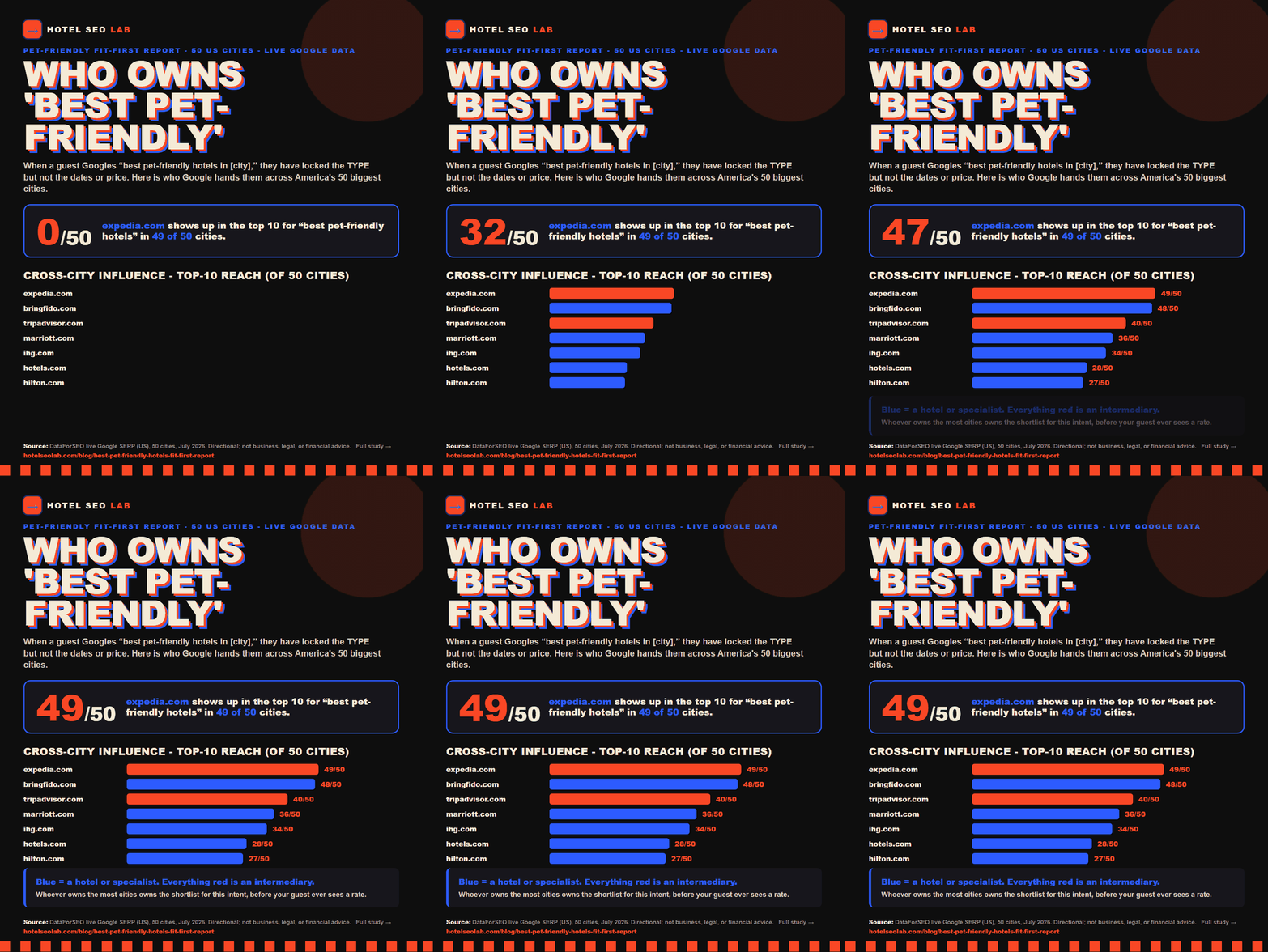
Here is the cross-city standings for “best pet-friendly hotels in [city]”, ranked by how many of the 50 cities each domain cracked the organic top ten in.
| Rank | Domain | Cities (of 50) | Type |
|---|---|---|---|
| 1 | expedia.com | 49 | OTA |
| 2 | bringfido.com | 48 | Pet-travel specialist |
| 3 | tripadvisor.com | 40 | Reviews / OTA |
| 4 | marriott.com | 36 | Hotel brand |
| 5 | ihg.com | 34 | Hotel brand |
| 6 | hotels.com | 28 | OTA |
| 7 | hilton.com | 27 | Hotel brand |
| 8 | reddit.com | 21 | Community |
| 9 | booking.com | 11 | OTA |
| 10 | mrandmrssmith.com | 6 | Editorial / boutique |
| 11 | petswelcome.com | 5 | Pet-travel specialist |
| 12 | yelp.com | 4 | Directory |
Read that table again slowly, because it breaks the usual pattern.
On almost every other Fit-First modifier we ran, the top of the page is the expected cartel: Expedia, TripAdvisor, Booking, Hotels.com, US News, trading the top slots. The giants win because they are giant. Domain authority sprayed across thousands of templated city pages beats everyone.
On pet-friendly, one specialist walks straight into second place and pushes the entire cartel down a rung. BringFido appears in the top ten for 48 of the 50 biggest cities. It beats TripAdvisor by eight cities. It beats Marriott by twelve. It beats Hilton by twenty-one. It beats Booking.com, a company worth north of a hundred billion dollars, by thirty-seven cities. The only domain ahead of it is Expedia, and only by a single city.
Now look at a second number, because it is the tell. In the full study I also counted total appearances, how many of the 300 SERPs each domain showed up in at all. TripAdvisor racked up 267 appearances across the six modifiers. Expedia, 247. These are sprawling operations that rank for everything, everywhere.
BringFido’s total across all 300 SERPs? 48. Every single one of them is a pet-friendly result. It does not rank for family, or cheap, or luxury, or downtown, or business. It has no presence on five of the six modifiers whatsoever. It has spent zero effort trying to be everything, and it has spent all of its effort being the one thing completely.
That is the entire lesson in one data point. BringFido owns an intent, not a category.
Why owning ONE intent works: the specialist’s structural advantage
How does a niche site beat companies a thousand times its size on their own turf, inside Google, in 2026? It is not magic and it is not a loophole. It is focus expressed through every ranking signal at once.
Think about what Google sees when it crawls BringFido versus when it crawls Booking.com. Booking has to be about hotels, and flights, and cars, and apartments, and every city on earth, and every conceivable amenity, in forty languages. Its authority is real but it is diluted across a near-infinite surface. When someone searches for pet-friendly hotels in Columbus, Booking is bringing general-purpose authority to a hyper-specific question.
BringFido brings the opposite. Every page title says pet. Every filter is a dog-weight limit or a pet fee. The reviews are written by people travelling with animals. The internal links all point between pet-travel pages. The schema, the URLs, the images, the anchor text, the freshness, all of it screams a single intent in perfect unison. To Google’s relevance model, that coherence reads as expertise, and expertise on a specific query is precisely what the algorithm is built to reward. The specialist is not out-muscling the giant. It is out-focusing it.
This is the Fit-First insight that should change how independent hoteliers think. You do not have to beat Expedia at being Expedia. You have to find the one intent where breadth is a weakness and depth is a moat, and then go deeper on it than anyone with a hundred other priorities ever will. Pet-friendly is a textbook case because the requirement is narrow, emotional, and under-served by generalists. There are others in every market. The anti-listicle approach I lay out in build the definitive local guide is the same principle applied at the city level: win by being the most complete, not the most famous.
The AI Overview layer tells the same story, louder
Now bring back that number: 83 of the 300 queries returned an AI Overview. When I tallied which domains Google’s AI answer actually cited across all 300 SERPs, the pet specialists showed up in a way that should make every generalist nervous.
Here are the most-cited domains inside the AI Overviews, across the whole study:
| Rank | Domain | AI Overview citations | Type |
|---|---|---|---|
| 1 | tripadvisor.com | 45 | Reviews / OTA |
| 2 | expedia.com | 39 | OTA |
| 3 | booking.com | 27 | OTA |
| 4 | google.com | 25 | Google surfaces |
| 5 | reddit.com | 25 | Community |
| 6 | bringfido.com | 20 | Pet-travel specialist |
| 7 | marriott.com | 18 | Hotel brand |
| 8 | hotels.com | 15 | OTA |
BringFido is the sixth most-cited domain in AI Overviews across all six modifiers and all fifty cities, and every one of those 20 citations is earned on pet-friendly alone. It is being quoted by Google’s own AI answer more often than Hotels.com, more often than every hotel brand except one, on the strength of a single intent. And it is not the only pet specialist the machine is reading. Across the AI Overview citations I also found jetsetpets.com, romingo.com, and BringFido’s Canadian domain all being quoted, plus petswelcome.com holding organic slots. A whole cottage industry of pet-travel specialists is being cited by the AI layer while most hotel brands are invisible to it.
That matters because the AI Overview is the emerging Fit-First SERP. When a guest asks an assistant, not a search box, “where can I stay in Denver with a large dog”, the model answers in prose and cites a handful of sources. The sites it cites are the ones that concentrated on the intent. If you are worried about being read by these systems at all, that is the subject of is your hotel invisible to ChatGPT, and pet-friendly is the clearest proof that specialists, not giants, are winning the citation.
The honest caveats
I would be doing exactly what I criticise other people for if I handed you this table as gospel. So here is where it stops being trustworthy.
It is a snapshot, on one date. These 300 SERPs were captured on a single day. Google’s results are volatile, re-ranked constantly, and personalized. Run the same queries next month and the standings will have shifted. Treat the shape of the finding, specialist beats giants on a narrow intent, as durable, and the exact city counts as perishable.
It is US-only, and it is Google-only. Fifty American cities, one search engine. I have no read on how BringFido or anyone else performs in the UK, Europe, or on Bing, and pet-travel norms differ enormously by country.
Cross-city presence is not clicks, and it is not bookings. Appearing in the top ten means a domain is in the consideration set. It does not measure who got the click, who converted, or who earned the room-night. A guest still has to choose, and much of that choosing happens one layer deeper than I measured. Presence is a proxy for shortlist influence, nothing more.
The domain classifications are mine. Calling TripAdvisor “reviews / OTA” or mrandmrssmith “editorial / boutique” is a judgement call. Reasonable people would bucket some of these differently, and that would nudge the narrative.
AI Overviews are new and unstable. The 83 count and the citation tallies reflect how Google’s AI answer behaved on capture day. That feature is being rebuilt constantly. The direction is real. The precise numbers are soft.
None of that undoes the core finding. It just means you should read it as a strong directional signal about how Fit-First SERPs work, not as an audited census.
What this means for your hotel
You are not BringFido and you should not try to become it. But the mechanism it exploited is available to you, and it is more available than the OTA-dominated top of most SERPs would suggest. Here is how I would use this.
Find your BringFido and get on it. For pet-friendly specifically, the practical move is dead simple: make sure your property is listed, accurately and completely, on the specialist that owns the intent in your market. In this data that is overwhelmingly BringFido. A single complete listing there put those hotels in front of pet-owners in 48 cities. That is distribution you cannot buy on the open SERP, and unlike an OTA listing it points at an intent, not just a transaction.
Pick your one intent and go absurdly deep. The strategic lesson is bigger than pets. Look at your property and your city and find the one Fit-First modifier where you have a genuine, defensible claim, the most walkable downtown hotel, the only real extended-stay option near the medical center, the quietest business hotel by the airport, and then build the most complete resource on the internet for that exact intent in your city. Depth beats breadth on a narrow query every single time, and the giants will never match your focus because they have ten thousand other cities to worry about.
Write for the intent, not the amenity. BringFido does not win because it says “pets allowed”. It wins because it documents weight limits, fees, nearby dog parks, and what the policy actually is. Answer the real question a pet-owner, or a family, or a business traveller is actually asking, at the level of detail only a specialist bothers with. That is what earns the organic slot and, increasingly, the AI citation.
Reclaim the intent on your own name too. Owning a Fit-First modifier is offense. The defensive companion is making sure that when someone searches your hotel by name plus “pet-friendly”, they land on you and not a middleman. That is a different fight, and I walk through it in win your branded search back from the OTAs.
The through-line is the same one the whole study points at: the Fit-First SERP is where the shortlist is built, and it is not won by being the biggest. It is won by being the most completely, verifiably right answer to one specific question. BringFido proved a niche specialist can own an intent deeply enough to beat every giant in travel on it. There is a version of that move sized for your single property, in your single city, on the one thing you are genuinely the best answer for. Go find it.
Reminder: everything above is a directional, one-day, US-and-Google-only snapshot built from a third-party SERP dataset that is modeled, noisy, and subject to change and independent validation. Cross-city presence and AI Overview citations reflect consideration-set visibility on capture day, not clicks, conversions, or bookings. Domain classifications are our own. We are not affiliated with any company named, BringFido included. This is not business, legal, or financial advice. Verify against your own market before making any decision.
If you want help finding the one Fit-First intent your hotel can genuinely own, and building the resource that wins it, book a call and bring your city. We will tell you honestly where the opening is.