
Directional analysis, not gospel. This is a single-snapshot study of live Google results captured on one date in the United States. Search results are personalized, localized, and change constantly, so your view will differ from mine. The domain-to-category labels (which brand is a hotel, an OTA, a metasearch, or an editor) are my classification and are debatable at the margins. I am not affiliated with, endorsed by, or paid by any company named here. Nothing below is business, legal, or financial advice. Validate against your own market before you act on it.
Download this study as a one-page PDF
The Kings of Influence: Who Owns the Fit-First SERP Across 50 US Cities and 6 Intents
I want to show you the single most uncomfortable slide I have for independent hoteliers, and then spend the rest of this piece proving it with real numbers.
Here it is: when a traveler has decided what KIND of hotel they want but not yet where or when, and they Google to build a shortlist, your hotel is almost never on the page. A handful of enormous domains are. The same handful. In city after city after city. They are the kings of this search, and if you do not understand who they are and why they win, you will keep spending money trying to beat them at a game whose rules guarantee you lose.
So I ran the study. Six hundred data points across the fifty largest US cities, and I am going to give you the whole leaderboard, the AI Overview layer sitting on top of it, the method, and every caveat I can think of. Let us name the kings.
First, the term: Fit-First search
Most of the search world obsesses over two extremes. The top of the funnel, where someone is daydreaming about a trip they might take, and the very bottom, where someone types your hotel name plus “book” and hands over a card. Everyone fights over those two.
The moment I care about sits in between, and almost nobody names it. I call it Fit-First search: a mid-to-low-funnel query where the guest has already committed to the TYPE of hotel they want, family, budget, luxury, downtown, business, or pet-friendly, but has NOT yet committed to dates or price. They already know the fit. They do not yet know the property. So they Google “best [type] hotels in [city]” and start building a shortlist.
That is the whole ballgame. Fit-First search is the moment the shortlist forms: after dreaming, before booking. If your hotel makes the shortlist here, you get a shot at the booking later. If it does not, you were never in the running, and no amount of booking-engine optimization saves a hotel the guest never considered. The result page where this happens is the Fit-First SERP, and it is the most under-analyzed battleground in hotel marketing.
I have broken down each of the six intents in its own report, and I will link a couple below. This piece is the one that ropes them together and crowns the domains that win across all of them.
How I got this data
I took the fifty biggest US cities by population and paired each one with six Fit-First queries, one per hotel type: “best family hotels in [city],” “best cheap hotels in [city],” “best luxury hotels in [city],” “best downtown hotels in [city],” “best business hotels in [city],” and “best pet-friendly hotels in [city].” Fifty cities times six intents is 300 live search queries.
I pulled each of those 300 SERPs through DataForSEO, which returns Google’s live organic results and the AI Overview block when Google chooses to show one. For every query I tallied the organic top 10 and, separately, every domain cited inside the AI Overview. Then I rolled it up two ways.
The headline metric is cross-city reach: for each domain, how many of the 50 cities does it appear in the top 10 for, counting a city once no matter how many of the six intents it shows up in. A domain with a reach of 50 is in the shortlist conversation in every single market I checked. That is influence at national scale. I also kept total appearances, the raw count of top-10 slots across all 300 SERPs, because a domain can hit all 50 cities thinly or dominate a few intents deeply, and the two numbers together tell you which.
Every figure below is a real count from that run. No estimates, no modeling, just what Google served on the day. The usual honesty applies and I will hammer it again at the end: this is one snapshot, on one date, in one country.
Leaderboard 1: cross-city reach across all 300 SERPs
This is the master table. It ranks domains by how many of the 50 cities they reach, with total top-10 appearances as the tiebreaker and the depth signal. I have labeled what each domain actually is, because that labeling is the whole story.
| Rank | Domain | Cities reached (of 50) | Total top-10 slots | What it is |
|---|---|---|---|---|
| 1 | tripadvisor.com | 50 | 267 | Reviews / aggregator |
| 1 | expedia.com | 50 | 247 | OTA |
| 1 | reddit.com | 50 | 216 | Community / forum |
| 1 | booking.com | 50 | 132 | OTA |
| 5 | hotels.com | 49 | 182 | OTA |
| 5 | travel.usnews.com | 49 | 141 | Editorial ranker |
| 7 | bringfido.com | 48 | 48 | Niche specialist |
| 8 | marriott.com | 46 | 115 | Hotel brand |
| 9 | ihg.com | 40 | 58 | Hotel brand |
| 10 | forbestravelguide.com | 35 | 53 | Editorial ranker |
| 11 | momondo.com | 30 | 30 | Metasearch |
| 11 | skyscanner.com | 30 | 30 | Metasearch |
| 13 | hilton.com | 29 | 32 | Hotel brand |
| 13 | hotwire.com | 29 | 29 | OTA |
| 15 | trivago.com | 26 | 26 | Metasearch |
| 15 | sixsuitcasetravel.com | 26 | 26 | Niche specialist |
| 17 | cntraveler.com | 25 | 55 | Editorial ranker |
| 17 | kayak.com | 25 | 34 | Metasearch |
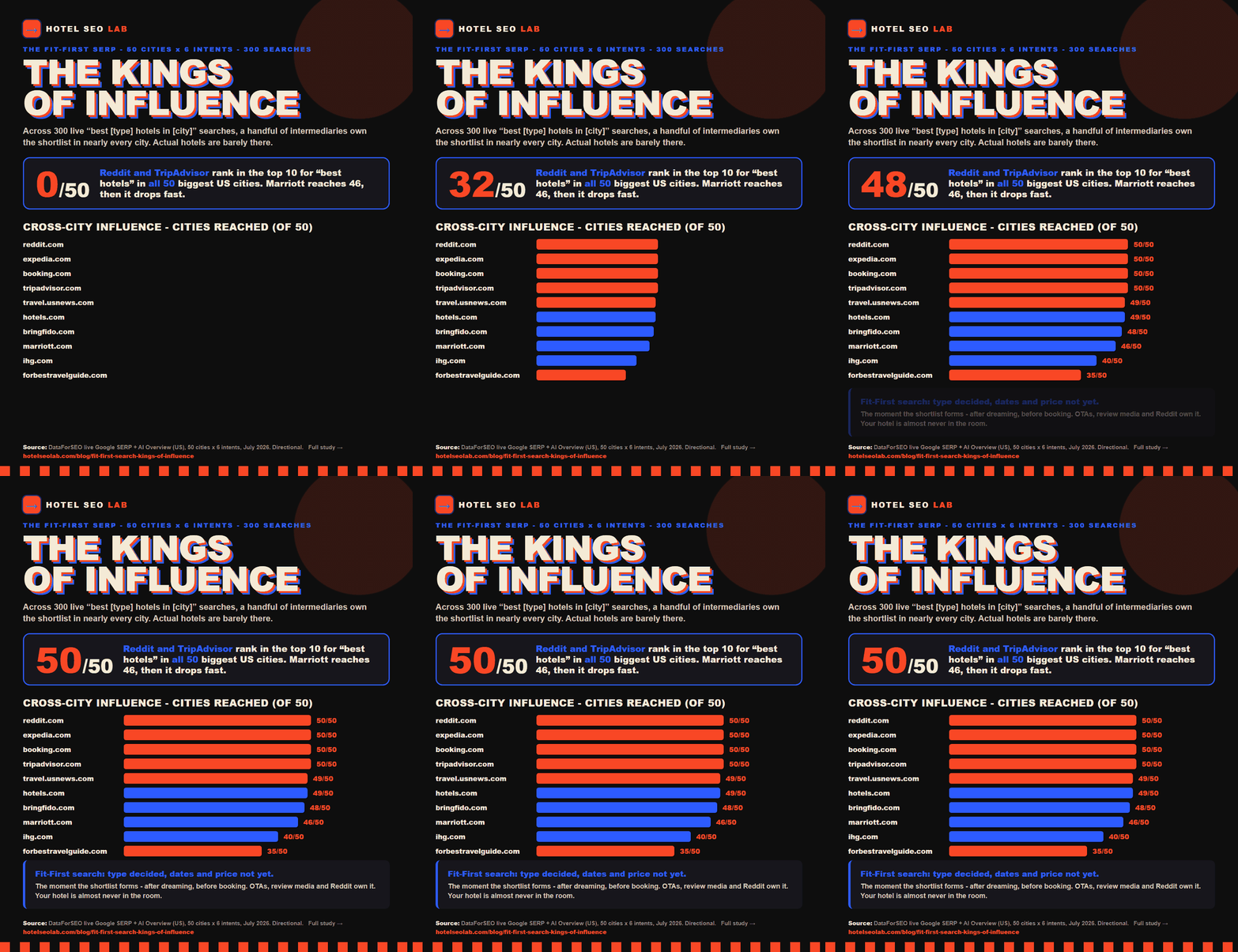
Read the top of that table slowly, because it is the thesis. Four domains reach all fifty cities: TripAdvisor, Expedia, Reddit, and Booking. Hotels.com and U.S. News reach forty-nine. Not one of those six is a hotel. Five are aggregators, OTAs, or editors whose entire product is other people’s inventory and other people’s opinions, and one, Reddit, is a message board.
The headline: Reddit ranks in all 50 cities
If you take one number away, take this one. Reddit appears in the Google top 10 for all fifty cities. A forum. Not a hotel, not an OTA, not a glossy travel magazine. A place where strangers argue about which neighborhood is walkable and which “boutique” hotel is actually a dressed-up motel now shapes the shortlist in every major market in the country, with 216 top-10 appearances across the 300 SERPs.
This is Google telling you something in the plainest possible language: for Fit-First queries, it trusts crowd consensus over marketing. The searcher typed “best,” and Google decided the most honest answer to “best” is a thread of humans with no incentive to lie, sitting one slot away from the OTA that very much does have an incentive. Reddit outranking the entire independent hotel sector in fifty out of fifty cities is not a quirk. It is the new shape of the page.
The crown: who actually rules the Fit-First SERP
Put labels on the leaders and the hierarchy is stark. TripAdvisor is the deepest presence on the board, all 50 cities and a staggering 267 top-10 slots, more than any other domain. Expedia is right behind at 50 cities and 247 slots, the OTA that shows up for nearly every intent everywhere. Booking and Hotels.com round out the OTA royalty. U.S. News is the editor that Google trusts most, 49 cities on the strength of its templated “Best Hotels in [City]” rankings. And Reddit is the wildcard king, proof that the crowd beats the brand.
These six are the ruling class of Fit-First search. They win because they are built exactly for the query: broad, comparison-shaped, city-by-city, and either crowd-sourced or editorially ranked. Google reads “best [type] hotels in [city]” as a request for a list or a discussion, and these are the domains that supply lists and discussions at industrial scale, in every city, on demand.
The hotel brands: only two have real reach
Here is where it gets personal for anyone who runs a property. Scan that master table for an actual hotel and you find a very short list.
Marriott is the standout, reaching 46 of 50 cities with 115 top-10 slots. That is genuine cross-city muscle, and it comes from Marriott having built templated city-level pages for its portfolio at a scale no independent can match. IHG is the only other brand with broad reach, 40 cities and 58 slots. Hilton, despite being one of the largest hotel companies on earth, trails badly at 29 cities and just 32 slots, less than a third the depth of Marriott. After those three, hotel brands essentially vanish from the cross-city picture. Four Seasons, Omni, and the Ritz make niche appearances in the luxury cut and nowhere else.
Sit with that. The three biggest hotel companies in America muster reach of 46, 40, and 29 cities, and every one of them is out-ranked, out-appeared, and out-influenced by a message board and four resellers. If the global chains with nine-figure marketing budgets cannot own “best hotels in [city],” what exactly did you think your 40-room independent was going to do by optimizing its homepage title tag? This is the rigged game I keep warning about, and I lay out the escape route in The Anti-Listicle: build the definitive local guide instead.
How the six intents differ
The master leaderboard flattens six very different battles. Here is the top domain and the best-performing hotel brand for each intent, which is where the practical nuance lives.
| Intent | Ruling domain (cities of 50) | Best hotel brand (cities) | Character of the SERP |
|---|---|---|---|
| Family | reddit.com (42) | marriott.com (28) | Crowd-led; brands present |
| Cheap | expedia.com (49) | none in top 12 | Pure OTA and metasearch |
| Luxury | tripadvisor.com (42) | fourseasons.com (13) | Editor-heavy; Forbes, U.S. News |
| Downtown | tripadvisor.com (50) | marriott.com (17) | Reviews and editors own it |
| Business | tripadvisor.com (48) | marriott.com (25) | Editorial and OTA |
| Pet-friendly | expedia.com (49) | marriott.com (36) | Niche specialist BringFido cracks it |
Two intents are where hotel brands are least invisible. In pet-friendly, Marriott reaches 36 cities, IHG 34, and Hilton 27, the only cut where all three chains show meaningful reach, because pet policies are a brand-level fact that chains can template cleanly. And notice the niche specialist BringFido at 48 cities, out-ranking every hotel brand in its lane. In family, Marriott reaches 28 cities and the oddball family-travel blog Six Suitcase Travel cracks the board at 26, beating most chains. The lesson repeats: a focused specialist that is genuinely about one fit beats a general-purpose brand page every time.
At the other extreme, the cheap cut is a brand desert. Expedia (49), Booking (47), TripAdvisor (45), Reddit (44), and Hotels.com (43) run the entire board, and not one hotel-brand domain reaches the top twelve. Budget travelers get handed straight to the resellers, full stop. I break the budget numbers down in The Budget Fit-First Report, and the pet-friendly upset in The Pet-Friendly Fit-First Report.
The AI Overview layer: same crowd, hotels still absent
Now the layer sitting on top. Google showed an AI Overview on 83 of the 300 queries, about 28 percent of these Fit-First searches. So this is not a fringe format you can ignore; more than a quarter of the time, the first thing your future guest reads is a machine-written summary above the blue links.
And here is the part that should end any hope that AI changes the pecking order in your favor. Look at who the AI Overview cites.
| Rank | Domain cited in AI Overview | AI Overviews citing it (of 83) | What it is |
|---|---|---|---|
| 1 | tripadvisor.com | 45 | Reviews / aggregator |
| 2 | expedia.com | 39 | OTA |
| 3 | booking.com | 27 | OTA |
| 4 | google.com | 25 | Google’s own surfaces |
| 4 | reddit.com | 25 | Community / forum |
| 6 | bringfido.com | 20 | Niche specialist |
| 7 | marriott.com | 18 | Hotel brand |
| 8 | hotels.com | 15 | OTA |
| 9 | travel.usnews.com | 12 | Editorial ranker |
| 9 | hilton.com | 12 | Hotel brand |
| 9 | youtube.com | 12 | Video / Google |
It is the same royal court. TripAdvisor, Expedia, Booking, and Reddit are the four most-cited sources in the AI answer, exactly as they are in the organic results. The AI is not discovering new authorities. It is reading the same crowd, the same OTAs, and the same review aggregators, and summarizing them. The only hotel brands that surface are Marriott (cited by 18 of 83 overviews) and Hilton (12), and they appear precisely because they already own the organic real estate the model is trained to trust.
For independent hotels the implication is brutal and clarifying at once. The AI Overview is not a new door that swings open for you. It is a mirror of the existing hierarchy. If you are not in the sources the crowd and the editors publish, you are not in the AI answer either. Winning AI visibility is downstream of winning the sources, which is the same fight, one layer up. If you want the mechanics of becoming quotable rather than merely present, start with Win Your Branded Search Back From the OTAs.
The honest caveats
I would rather you trust the pattern than over-read the decimals, so here is where this study stops.
It is one snapshot on one date. Google’s results shuffle daily. Run this next month and TripAdvisor might be at 264 slots instead of 267, Reddit might slip in two cities, a new editorial ranker might surge. The ordinal story, aggregators and the crowd on top, hotels mostly absent, is stable and has been for a while. The exact counts are not, and anyone who quotes them to three significant figures a year from now is fooling themselves.
It is United States, English, and desktop-shaped. Localized and personalized results mean your own screen will differ from my DataForSEO pull, especially if you are logged in or physically in one of the cities. Treat the reach numbers as directional national signal, not a guarantee about any single search.
The category labels are mine. Is Hotels.com an OTA distinct from Expedia, or the same house wearing two hats? Is Six Suitcase Travel a “niche specialist” or just a blog that got lucky in a few cities? I made defensible calls, but you could redraw some lines and shift a row or two. The buckets are a lens, not a law.
Reach is not revenue. Appearing in the top 10 for 50 cities means influence over the shortlist. It does not measure clicks, and it certainly does not measure booked room-nights, which no public dataset contains. I measured presence on the page, because presence is the necessary first condition for everything downstream. It is not the same as the sale.
What this means for your hotel
Stop fighting the kings on their own ground. You are not going to out-rank TripAdvisor, Reddit, and U.S. News for “best hotels in your city” with your homepage. Marriott, with all its scale, only reaches 46 of 50 cities and still loses the top slots. That door is closed, and beating your head on it is how independents burn budgets.
The move that actually works is to get placed inside the pages that already win. Be genuinely, cleanly reviewed on TripAdvisor, because it is the single deepest domain on the board and the most-cited source in the AI Overview. Be present, honest, and useful in the Reddit and community threads for your city, because the crowd ranks in all 50 markets and you want to be the property they name, not the one they warn about. Get your property into the editorial lists at U.S. News and the like, because editors are the authorities Google and its AI trust. And build the one thing you can genuinely own, the definitive local guide to your patch, so that when the aggregators need a source, you are it.
That is the whole strategy in a sentence: the visibility you want lives on other people’s pages first, so earn your place on them, then build the single page only you can write. The kings are not going anywhere. Your job is to get quoted in their court. The step-by-step for exactly that is in The Anti-Listicle playbook, and it is where I would send you next.