
Directional analysis, not gospel. This piece is built on a single snapshot of live Google results captured on one date in a specific market, and search moves constantly. The numbers below are counts from that snapshot, not audited index figures, and they will drift by the time you read this. Domain classification (which site is an OTA, a review index, a chain) is our own judgment. We are not affiliated with, endorsed by, or paid by any company named here. Nothing below is business, legal, or financial advice. Validate against your own market before you act.
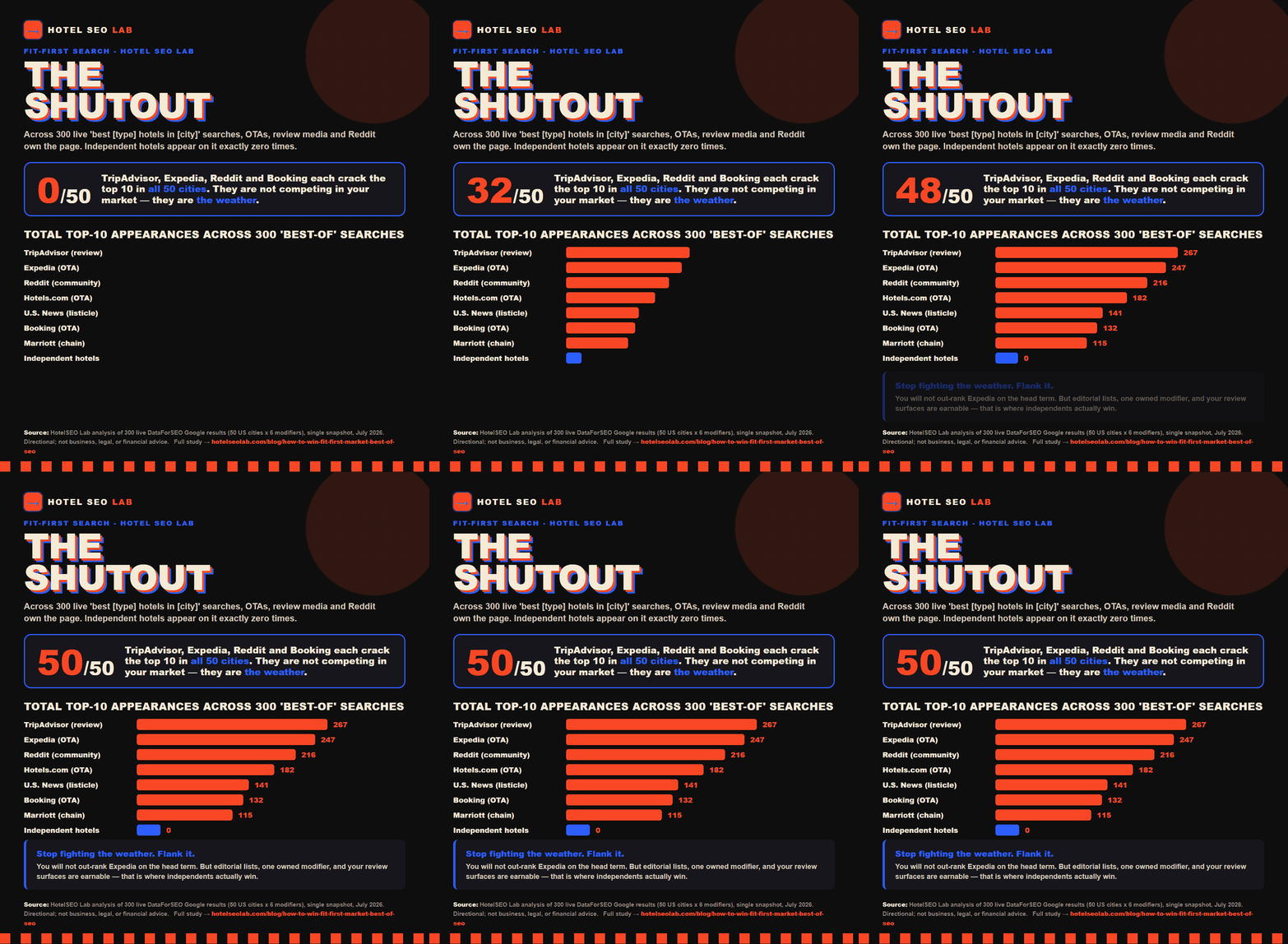
Download this study as a one-page PDF
How to Win Your Fit-First Market
There is a moment in every booking that marketers almost never talk about, because it sits in an awkward gap between two things they obsess over. It is not the dream-stage “where should we even go” moment, and it is not the final “book now” moment. It is the moment in between, when a traveler has already decided what KIND of hotel they want, but has not decided which one.
They have committed to the type. Family. Budget. Luxury. Downtown. Business. Pet-friendly. What they have not committed to is a property, a date, or a price. So they open Google and type the most predictable query in all of travel: “best [type] hotels in [city].” And they start building a shortlist.
I call that moment Fit-First search, and the page of results that answers it is the Fit-First SERP. It is where the shortlist forms: after dreaming, before booking. It is mid-to-low funnel, high-intent, and it is very close to the money. And if I am being honest with you, it is a page most independent hotels have quietly lost without ever realizing there was a fight.
I wanted to know exactly how lost. So I measured it. This is the practical, services-angled follow-up to the bigger study, Fit-First Search: The Kings of Influence. If you want the full teardown of who rules these results and why, read that one. This piece assumes the diagnosis and moves straight to the treatment: six concrete plays a hotel can actually run to win its Fit-First market.
How I got this data
I did not want to argue from vibes, so I pulled live results. Here is the method, plainly, so you can judge it.
I took the 50 biggest US cities and crossed them with six Fit-First modifiers, family, cheap, luxury, downtown, business, and pet-friendly, phrased as “best [type] hotels in [city].” That is 300 unique queries. I ran all 300 as live Google searches through DataForSEO on a single date and captured, for each one, the organic top 10 and any AI Overview citations.
Then I tallied two things. First, raw appearances: how many times a domain showed up across the 300 results. Second, and more interesting, cross-city reach: how many of the 50 cities a domain cracked the top 10 for at least once. Cross-city reach is the better influence signal, because appearing in all 50 cities means you are not a local fluke, you are structural.
Every number below comes from that one snapshot. It is a photograph, not a movie. Caveats live at the bottom, and they are real. But the picture is stark enough that the noise does not change the story.
The leaderboard: who actually owns the Fit-First SERP
Here is the cross-city leaderboard, ranked by how many of the 50 cities each domain reached, with total appearances across all 300 results as the tiebreaker.
| Rank | Domain | Cities (of 50) | Total appearances | What it is |
|---|---|---|---|---|
| 1 | tripadvisor.com | 50 | 267 | Review index |
| 2 | expedia.com | 50 | 247 | OTA |
| 3 | reddit.com | 50 | 216 | Community |
| 4 | booking.com | 50 | 132 | OTA |
| 5 | travel.usnews.com | 49 | 141 | Editorial listicle |
| 6 | hotels.com | 49 | 182 | OTA |
| 7 | bringfido.com | 48 | 48 | Niche vertical (pets) |
| 8 | marriott.com | 46 | 115 | Chain brand |
| 9 | ihg.com | 40 | 58 | Chain brand |
| 10 | forbestravelguide.com | 35 | 53 | Editorial listicle |
| 11 | momondo.com | 30 | 30 | Metasearch |
| 12 | skyscanner.com | 30 | 30 | Metasearch |
| 13 | hilton.com | 29 | 32 | Chain brand |
| 14 | cntraveler.com | 25 | 55 | Editorial listicle |
| 15 | kayak.com | 25 | 34 | Metasearch |
Read that top four again. TripAdvisor, Expedia, Reddit, and Booking each appear in the top 10 of all 50 cities. Not most. All of them. These four domains are not competing for your market; they are the weather in your market.
Now the observation that should stop you cold: scroll the entire leaderboard and try to find an independent hotel’s own website. You cannot. The only hotels that appear are chains, Marriott in 46 cities, IHG in 40, Hilton in 29, riding their programmatic brand pages. Independent hotels, the operators I write this blog for, are essentially absent from the page where their exact future guest is building a shortlist.
That is the whole problem in one sentence. The Fit-First SERP is owned by OTAs, review media, Reddit, and a handful of chains. Your independent hotel is not on it.
It changes by modifier, and that matters
The averaged leaderboard hides something useful: the mix shifts hard depending on which type the guest wants. Here is who leads each of the six modifiers by cross-city reach.
| Modifier | 1st | 2nd | 3rd | The tell |
|---|---|---|---|---|
| family | reddit (42) | tripadvisor (41) | expedia (36) | Parents trust the crowd; Reddit leads |
| cheap | expedia (49) | booking (47) | tripadvisor (45) | Pure OTA and metasearch territory |
| luxury | tripadvisor (42) | reddit (39) | forbestravelguide (35) | Editorial and prestige lists matter here |
| downtown | tripadvisor (50) | travel.usnews (44) | reddit (43) | Listicles own the location query |
| business | tripadvisor (48) | travel.usnews (46) | expedia (44) | U.S. News and editorial run deep |
| pet-friendly | expedia (49) | bringfido (48) | tripadvisor (40) | A niche vertical rivals the OTAs |
Two things jump out. On “cheap,” this is a knife fight between OTAs and metasearch, Expedia, Booking, momondo, skyscanner, hotwire, and honestly, an independent hotel has almost no organic path onto that page. But on “luxury,” “downtown,” and “business,” editorial listicles, U.S. News, Forbes Travel Guide, Conde Nast Traveler, run genuinely deep. Those lists are earnable. That distinction is the seed of the whole strategy.
And then there is pet-friendly, where a domain called BringFido reaches 48 of 50 cities. Hold that thought, it is Play 4, and it is the most hopeful number in the entire dataset for an independent operator.
The AI Overview layer
Of the 300 results, 83 showed an AI Overview, so this is not yet universal, but it is a meaningful chunk of the page and it is growing. When the AI answer did appear, here is who it cited most:
| Domain | AI Overview citations (of 83) |
|---|---|
| tripadvisor.com | 45 |
| expedia.com | 39 |
| booking.com | 27 |
| google.com | 25 |
| reddit.com | 25 |
| bringfido.com | 20 |
| marriott.com | 18 |
| hotels.com | 15 |
| travel.usnews.com | 12 |
Notice the AI Overview is not inventing new authorities. It leans on the exact same review-and-OTA corpus that already rules the organic results, plus Reddit and travel media. That is genuinely good news, because it means there is one job, not two. You do not become “citable by AI” through some separate trick. You become citable by being present and consistent across the surfaces the model already reads. AEO and SEO collapse into the same work.
The six plays
Everything above is the diagnosis. Here is what you actually do about it.
Play 1: Get placed on the lists that already rank
You are probably not going to out-rank U.S. News on “best downtown hotels in Denver.” But U.S. News, Forbes Travel Guide, and Conde Nast Traveler are on that page for you, if your property is on their list. In our data those three editorial domains reached 49, 35, and 25 cities respectively. Getting into their rankings puts you inside a result that already wins.
This is earned-media work, not keyword work. It means a real PR motion: press kits, pitches to the editors who maintain those regional lists, awards submissions, and the underlying merit that makes the placement defensible. Forbes Travel Guide runs an inspection program; U.S. News weights guest reviews and industry data. You cannot fake your way in, and you should not want to. Aim your energy at the two or three lists that rank in your city for your modifier, not all of them.
Play 2: Build your own authority content, the anti-listicle move
If you cannot beat the listicle on its own keyword, build the thing the listicle only pretends to be. Instead of a thin “best hotels in [city]” page that pits your single property against Expedia (a fight you are structurally built to lose, because you are an obvious conflict of interest and Google knows it), build the definitive local guide a concierge would actually hand a guest.
Neighborhood breakdowns. What is genuinely walkable. Which nights are quiet. The real answer to the questions your front desk fields every day. That content ranks for hundreds of long-tail queries the OTAs never bother with, and it earns the internal links that quietly turn a guide into a booking path. I lay out the full framework in The Anti-Listicle: build the definitive local guide. The Fit-First data is exactly why that move works: the head term is captured, so you win the body and the long tail instead.
Play 3: AEO, become a source the AI answer cites
The AI Overview showed up on 83 of 300 results and, as we saw, it cites review sites, OTAs, Reddit, and travel media. Being the source it quotes is not a prompt trick; it is presence engineering.
Concretely: ship clean, complete structured data on your own site so a machine can read your facts without guessing. Keep a steady flow of specific, recent reviews, because sentiment is the model’s raw material. Make sure your name, category, and location are accurate on every surface a crawler touches. And get genuinely discussed in the travel media and Reddit threads the models ingest, which loops right back to Plays 1 and 2. The reward is durable: even when the click stays inside Google, being woven into the answer keeps your name in front of the guest.
Play 4: Win the ONE modifier you truly fit, and own it completely
This is the most important play, and the data hands it to you on a plate. Look again at BringFido: 48 of 50 cities, but 48 total appearances, meaning it shows up in almost every city for exactly one modifier, pet-friendly, and nowhere else. It did not try to be everything. It became the definitive answer to one type of Fit-First search, and it now sits beside the OTAs on that page and gets cited by the AI Overview 20 times.
You can run the same play at property scale. You are not going to win family, luxury, downtown, business, cheap, and pet-friendly. Pick the ONE your property genuinely, defensibly is, the modifier a guest would agree with the second they walked in, and pour everything into owning it. Every review you nurture, every photo, every guide, every list placement, every schema field aimed at that single fit. Depth in one modifier beats shallow presence across six, every time. (See also sixsuitcasetravel reaching 26 cities purely on the family niche. Focused verticals punch far above their size.)
Play 5: Fix Google Business Profile and reviews first
Review surfaces do not just appear on the Fit-First SERP; they dominate it. TripAdvisor logged 267 appearances and led four of the six modifiers. Reddit reached all 50 cities. The AI Overview leaned hardest on review and community sources. The single clearest signal in the entire dataset is that your reputation, as expressed on surfaces you do not own, is doing the talking.
So make it say the right thing. A ruthlessly complete Google Business Profile, correct category, correct attributes (including the pet or family or business signals that map to your chosen modifier), fresh photos, and a relentless, human review-response habit. This is the highest-leverage, lowest-cost play on the list, and it is the one most independents half-do. Reviews are the raw material every other player on the page is built from. Own your slice of it.
A word on TripAdvisor before you pour effort into it. It sits at number one on this page today, 267 appearances and the lead in four of the six modifiers, so the reflex is to feed it. Don’t overinvest. Two reasons, and hoteliers already feel both. First, that dominance is a trailing indicator, not a forecast: the mid-funnel intent that used to land on TripAdvisor is quietly being rerouted to Google’s own surfaces, AI answers, and Reddit, and the review moat that once made it un-Googleable is visibly leaking. I walk through the full evidence in Is TripAdvisor Dying? An SEO Post-Mortem in Progress. Pouring budget into a channel that is repricing itself downward is how you win yesterday’s SERP. Second, and every operator reading this knows it in their gut: TripAdvisor has spent two decades as the platform hotels resent most, your reputation parked on a surface you do not control, reviews you dispute that are painful to get removed, and a paid “Business Advantage” upsell hovering over the whole thing. You do not own it, you cannot fully trust it, and it is fading. Keep your listing accurate, respond to what lands there, and then put the real work into the surfaces you actually own, your site, your schema, your Google Business Profile, your direct reviews (Plays 2 and 5). (Opinion, and our own read of the data, not a statement of fact about any company’s conduct.)
Play 6: Measure your Fit-First share of voice
You cannot manage what you refuse to count. Right now you almost certainly do not know whether you appear anywhere, organic, listicle, AI Overview, review panel, for “best [your type] hotels in [your city].” Fix that.
Define your set: your modifier, your city, plus the two or three nearby cities travelers substitute. Track, on a schedule, whether you show up at all and where, on the listicles that rank, in the AI Overview citations, in the review panels. That is your Fit-First share of voice, and it is the only scoreboard that tells you whether Plays 1 through 5 are working. Set the baseline before you start so the improvement is provable, not a story you tell yourself.
What this means for your hotel
Put the six plays in order and the strategy is almost embarrassingly clear. You are not going to beat the weather. TripAdvisor, Expedia, Booking, and Reddit are on all 50 of these pages and they are not leaving. Fighting them head-on for the head term is how independents burn budget for years and win nothing.
Instead: get placed on the lists that already rank (Play 1), build the adjacent authority you can actually win (Play 2), become a source the AI answer cites (Play 3), own the one modifier you truly fit the way BringFido owns pet-friendly (Play 4), fix the review surfaces that dominate the whole page (Play 5), and keep score honestly (Play 6). Every one of those is a flank, not a frontal assault, and every one of them is available to a property your size.
There is an adjacent fight worth naming while you are here: even when you do intercept a guest, the booking can still leak to an OTA at the last step. Winning Fit-First discovery only pays off if you also win your branded search back from the OTAs so the guest who went looking for you specifically actually lands on you.
The honest caveats
Before you act on any of this, hold the limits in view, because I would rather you trust the method than the marketing.
It is one snapshot, one date. Search results reshuffle daily; a rerun next month would move numbers, though I doubt it would move the shape. It is US-only and English-only, so if your market is neither, treat the pattern as a hypothesis to test, not a finding to import. The six modifiers are a deliberate simplification of a messier reality, real guests use dozens of phrasings and combinations. Domain classification is my judgment call, and reasonable people could bucket a few sites differently. AI Overviews appeared on only 83 of 300 results, so that layer is real but not yet universal, and it is a fast-moving target. None of these numbers are audited index counts; they are appearance tallies from live results. Validate against your own city and your own modifier before you spend a dollar.
What survives every one of those caveats is the core picture: on the page where your future guest builds a shortlist, OTAs, review media, Reddit, and chains are present and independents are not, and there are specific, earnable flanks that change that. The plays are the point. The exact decimals are not.
If you want help running these plays, whether that is the content and reputation work behind Plays 2 and 5, the SEO behind Play 2, the AEO and GEO work behind Play 3, or the Google Business Profile overhaul behind Play 5, that is the work we do at HotelSEO Lab. You can see how we break it down on our services page. No guarantees, no “number one in a week” nonsense, just an honest plan mapped to your specific Fit-First market.